
Asthma Action Plans: How to Build a Personalized Management Strategy That Works
If you or someone you care about has asthma, you’ve probably heard the term asthma action plan. But do you actually know what it is - or how to use it? Most people don’t. And that’s dangerous.
An asthma action plan isn’t just a piece of paper. It’s your personal roadmap for staying in control. It tells you exactly what to do when your breathing starts to change - before it turns into an emergency. The difference between having one and not having one can mean the difference between a normal day and a trip to the ER.
What Exactly Is an Asthma Action Plan?
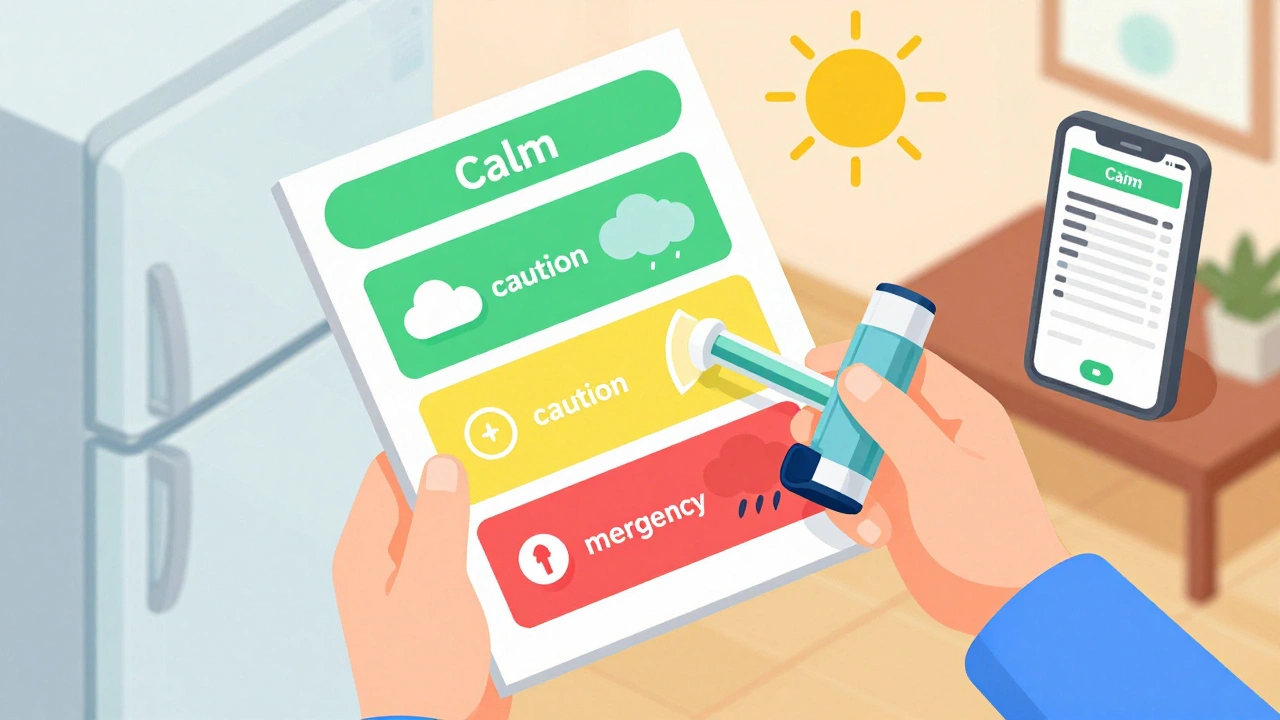
An asthma action plan is a written, step-by-step guide created with your doctor that shows you how to manage your asthma every day - and what to do when things get worse. It’s built around three simple color zones: green, yellow, and red. Each one matches how you’re feeling and what your breathing looks like.
It’s not a one-size-fits-all form. Your plan is made for you. It includes your name, your medications, your personal best peak flow number, and clear instructions for what to do when symptoms change. It’s meant to be kept where you can see it - on the fridge, in your wallet, on your phone. And it’s updated regularly, not tucked away in a drawer after your last doctor visit.
The National Heart, Lung, and Blood Institute says every person with asthma should have one. Yet only about 30% of people actually do. That’s not because they don’t care. It’s because most never got a proper one - or never learned how to use it.
The Three Zones: Green, Yellow, Red
Think of your asthma like a traffic light. Green means go. Yellow means slow down. Red means stop and get help.
Green Zone (Go): This is your normal. You’re breathing easy. No coughing, no wheezing, no waking up at night. You can run, play, work, sleep - all without trouble. Your peak flow readings are at 80-100% of your personal best. In this zone, you stick to your daily controller meds - usually an inhaled corticosteroid like fluticasone (Flovent) or budesonide (Pulmicort). You don’t change anything. You just keep doing what’s working.
Yellow Zone (Caution): This is your warning sign. You might notice a cough, tight chest, or wheezing. You could be waking up at night. Your peak flow drops to 50-79% of your personal best. You’re not in crisis yet - but you’re heading there if you ignore it.
Here’s what you do: Take your rescue inhaler - usually albuterol (ProAir, Ventolin) - right away. Two to four puffs. Wait 20 minutes. If you’re not better, take another two to four puffs. Keep using it every 4-6 hours as needed. But here’s the key: don’t stop your daily controller meds. Keep taking them. And track your symptoms every hour. If you’re not improving after 24 hours, or if you’re using your rescue inhaler more than every 4 hours, call your doctor. Don’t wait.
Red Zone (Danger): This is an emergency. You’re struggling to breathe. You can’t speak in full sentences. Your lips or fingernails turn blue. Your peak flow is below 50% of your personal best. Your rescue inhaler isn’t helping. You’re scared.
Don’t wait. Don’t call your doctor first. Don’t try to tough it out. Call 999 or go to the nearest emergency room right away. Have someone with you if you can. This is not the time to be alone. Your plan should have emergency contact numbers written clearly at the top - so even if you’re panicking, someone else can act.
How to Set Your Personal Best Peak Flow Number
Peak flow numbers are the backbone of your action plan. Without them, the yellow and red zones are just guesses.
Your personal best is the highest peak flow number you can reach when your asthma is under perfect control - for at least two weeks. No symptoms. No rescue inhaler use. You’re feeling normal.
To find it: Use your peak flow meter every morning and evening for two to four weeks. Write down each number. Then pick the highest one. That’s your personal best. Write it on your plan. If you don’t have a peak flow meter, ask your doctor for one. They’re cheap, easy to use, and often covered by insurance.
Calibrate it once a year. Old meters can drift. If your readings suddenly feel off, get a new one. And remember: your personal best changes over time. If your asthma gets better or worse, update your plan. Don’t keep using a 5-year-old number.

Medications in Your Plan: What to Take and When
Your plan should list every medication you take - and exactly when to take it.
Controller Medications: These are your long-term defense. Inhaled corticosteroids like fluticasone, mometasone, or budesonide. You take them every day, even when you feel fine. They reduce swelling in your airways. Skipping them is like ignoring a slow leak in your car’s tire - eventually, it goes flat.
Rescue Medications: These are your quick fix. Albuterol (ProAir, Ventolin) or levalbuterol (Xopenex). You use them only when you’re in yellow or red. They open your airways fast - in minutes. But they don’t fix the underlying inflammation. That’s why you still need your controller meds.
Some people also use combination inhalers like fluticasone/salmeterol (Advair) or budesonide/formoterol (Symbicort). These do double duty - controller and rescue - but only if your doctor says so. Never mix them up. Always know which one is which.
Why Most People’s Plans Don’t Work
Here’s the hard truth: most asthma action plans fail - not because they’re bad, but because they’re ignored.
People forget where they put it. They don’t update it. They don’t share it with teachers, coaches, or family. One Reddit user said, “My plan is useless without peak flow numbers - my doctor never established my personal best.” That’s not the plan’s fault. That’s a missed step.
Another common problem: people think they’re in the green zone when they’re really in yellow. “I’ve always wheezed a little,” they say. But that’s not normal. That’s chronic inflammation. Living in yellow for months is dangerous. It leads to lung damage over time.
And then there’s the color issue. About 8% of men and 0.5% of women have trouble seeing red and green. That’s why some newer plans use shapes - circles for green, triangles for yellow, stars for red - instead of colors. If you or someone you know has color vision issues, ask your doctor for a modified version.
How to Make Sure Your Plan Stays Useful
Here’s how to turn your plan from a paper relic into a living tool:
- Keep it visible. Tape it to your fridge. Save it as a photo on your phone. Put it in your wallet.
- Review it every 3 months. Even if you feel fine. Your triggers change. Your meds might need adjusting.
- Update it after every asthma flare-up. If you went to the ER, your plan needs to change.
- Share it with everyone who helps care for you - school nurses, coaches, babysitters, roommates.
- Use a tracking app. The Asthma and Allergy Foundation of America has a free app that logs symptoms and reminds you to take meds. It even shows trends over time.
- Bring it to every doctor visit. Don’t just hand it over - talk about it. Say, “This isn’t working. What should I change?”
One woman in Sheffield told me she started keeping her plan in her purse after her daughter had a bad attack at school. “I used to think it was just paperwork,” she said. “Now I know it’s my safety net.”
Digital Tools Are Changing the Game
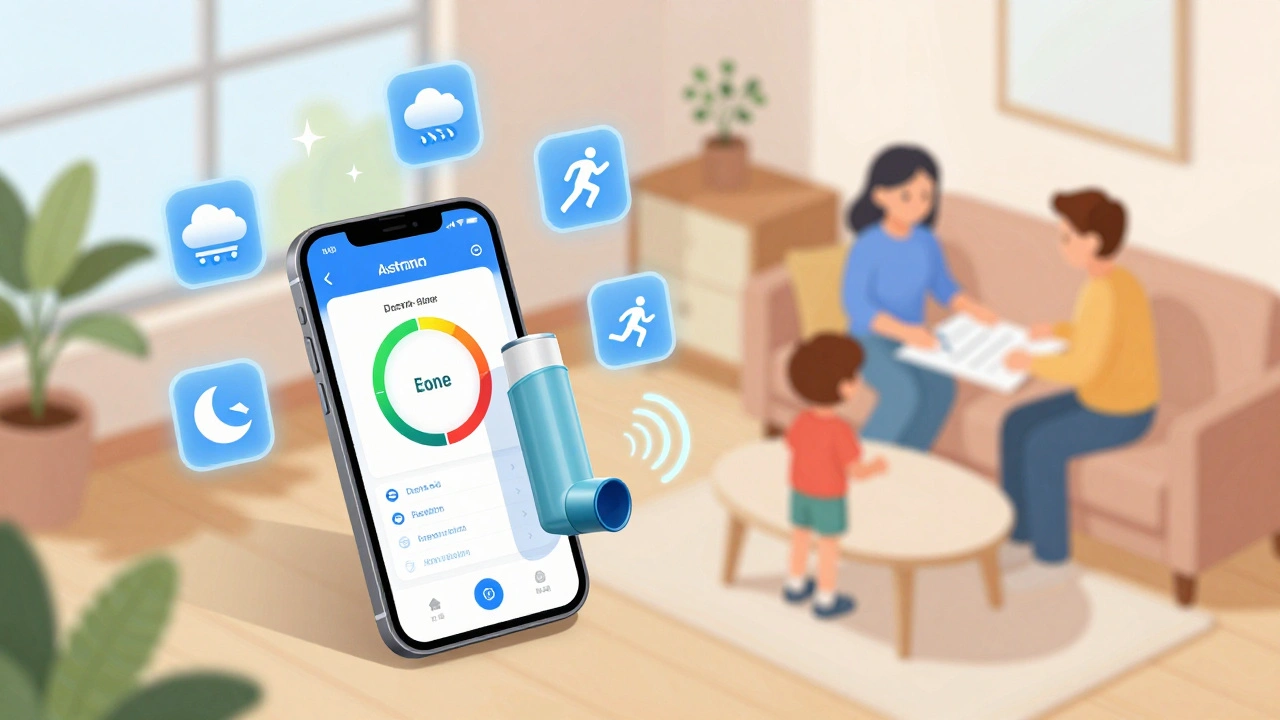
Smart inhalers are now syncing with asthma action plans. Devices like Propeller Health track when you use your inhaler - and where. If you’re using your rescue inhaler more than twice a week, the app sends you a warning: “You’re slipping into yellow. Talk to your doctor.”
Some clinics now use AI tools that analyze your symptom diary and local air quality to predict when you’re likely to flare up. One trial at UCSF predicted attacks with 82% accuracy. That’s not science fiction - it’s happening now.
But tech doesn’t replace the plan. It just makes it smarter. The three-zone system still works. It’s simple. It’s proven. It saves lives.
What If You Don’t Have a Plan Yet?
Start today. Don’t wait for your next appointment.
Download the free NHLBI asthma action plan template. It’s available in English and Spanish. Fill it out with your meds, your peak flow number, and your emergency contacts. Then, take it to your doctor. Say: “I want to make this work. Can we go through it together?”
If your doctor doesn’t have one ready, ask for the AAFA’s online plan generator. It walks you through each step. You print it, sign it, and use it.
And if you’re a parent: give your child’s plan to their school. By law, schools in the UK and US must keep a copy on file. It’s not optional. It’s protection.
Final Thought: This Isn’t Just About Breathing
An asthma action plan isn’t just medical advice. It’s freedom. It’s the difference between hiding from pollen, cold air, or exercise - and living without fear.
People with a good plan have 3.2 more symptom-free days every week. They go to the ER 70% less often. They sleep better. They work better. They live better.
You don’t need to be perfect. You just need to be prepared.
Do I need an asthma action plan if my asthma is mild?
Yes. Even mild asthma can turn dangerous fast. Many people who end up in the ER thought their asthma was "just a little annoying." A plan helps you catch changes early - before they become emergencies. It’s not about how bad your asthma is now. It’s about preventing it from getting worse.
Can I use my asthma action plan for my child?
Absolutely. In fact, children benefit even more from having a clear plan. Kids often can’t describe their symptoms well. A plan gives parents, teachers, and caregivers exact instructions: "If they’re coughing at night, give 2 puffs of albuterol and call me if it doesn’t improve in an hour." Share the plan with their school and any caregiver. It’s not just helpful - it’s essential.
What if I can’t afford a peak flow meter?
You don’t need one to start a plan, but you should get one. Many clinics give them out for free. If not, ask your doctor if you can use symptom tracking instead: "If I wake up coughing, have trouble walking up stairs, or need my rescue inhaler more than twice a week, that’s my yellow zone." It’s not as precise as numbers, but it still works. The goal is to recognize patterns - not to be perfect.
How often should I update my asthma action plan?
At least once a year - but more often if your asthma changes. If you’ve had a flare-up, started a new medication, moved to a new area with different pollen levels, or if your peak flow numbers have shifted, update your plan. Seasonal changes matter. If pollen triggers your asthma, review your plan in spring and fall. Your plan should grow with you.
What should I do if my doctor won’t give me a plan?
Ask again. If they still refuse, go to a different doctor or an asthma specialist. The NHLBI and global guidelines say every asthma patient needs one. It’s not optional. You can also download a template from the Asthma and Allergy Foundation of America or the NHLBI website. Fill it out yourself, bring it to your appointment, and say: "I’ve prepared this. Can we review it together?" Most doctors will be glad you came prepared.
Can I use an asthma action plan during pregnancy?
Yes - and you should. Uncontrolled asthma during pregnancy increases risks for both mother and baby, including preterm birth and low birth weight. Your plan may need adjustments - your controller meds might change - but stopping treatment is more dangerous than continuing it. Talk to your OB and asthma doctor together. Your plan should be part of your prenatal care.




Comments (15)
vinoth kumar
3 Dec 2025
Just got my first peak flow meter yesterday. Used to think I was fine 'cause I didn't wheeze all the time. Turns out I was living in yellow for years. This post? Lifesaver.
Charles Moore
5 Dec 2025
I work with teens with asthma in Dublin. We hand out laminated action plans with emoji zones - green 😊, yellow 😐, red 😱. They actually look at them. Colors don't work for everyone, but emojis? Always do.
bobby chandra
7 Dec 2025
Let me tell you - if you're skipping your controller meds because you 'feel fine,' you're playing Russian roulette with your lungs. That fluticasone isn't optional candy. It's your body's fire extinguisher. And no, your 'I'm fine' feeling is just your lungs screaming quietly while you ignore them.
Archie singh
7 Dec 2025
Everyone says 'get a plan' like it's magic. Newsflash: most docs give you a template and never explain how to use it. I had mine for 5 years. Never knew my personal best was wrong until I switched doctors. This isn't healthcare - it's a crapshoot.
Jim Schultz
7 Dec 2025
Wow. Just wow. I'm amazed someone actually wrote this without saying 'consult your doctor' 17 times. And it's not just accurate - it's actionable. I wish my pulmonologist had this level of clarity. Seriously, someone should make this a viral infographic.
Kidar Saleh
9 Dec 2025
I remember my first asthma attack in a London bus station - no plan, no inhaler, just panic. Now I carry mine in my wallet, next to my Oyster card. It’s not paper. It’s my insurance policy against silence - the kind that comes before you can’t breathe.
Chloe Madison
9 Dec 2025
My daughter’s school nurse called me last week because she used her inhaler twice in gym class. I showed her the plan - she didn’t know she was supposed to log it. We updated it together. Now she’s got a sticker chart. She’s 8. She’s proud. And she’s breathing better.
Vincent Soldja
10 Dec 2025
So what? Everyone knows this stuff.
Makenzie Keely
12 Dec 2025
For those asking about cost - my local pharmacy gave me a free peak flow meter with my prescription. No joke. Ask. They’re often subsidized. And if you’re on Medicaid/Medicare, it’s covered. Don’t let ‘I can’t afford it’ be your excuse - it’s a myth.
Albert Essel
13 Dec 2025
One thing people miss: the red zone isn’t just about symptoms. It’s about how you feel emotionally. That terror? That’s your body’s alarm. If you’ve ever felt like you’re drowning in air - that’s not anxiety. That’s asthma. Don’t rationalize it. Act.
Gavin Boyne
14 Dec 2025
Smart inhalers? AI predictions? Cute. Meanwhile, my cousin in rural Alabama still uses a 2008 inhaler he found in his dad’s drawer. Tech doesn’t fix access. It just makes rich people feel better about ignoring the system.
Rashi Taliyan
14 Dec 2025
I’m from a village where asthma is called 'breath sickness.' No one had plans. We used ginger tea and prayer. I brought this plan back home. Now my sister uses it. She’s not scared anymore. Thank you for writing this.
Gene Linetsky
16 Dec 2025
Who funded this? Pharma? The EPA? They want you dependent on inhalers so they can sell you more. Real asthma management is clean air, no allergens, and avoiding stress. This plan is a trap. You don’t need meds - you need to move to a forest.
Ignacio Pacheco
17 Dec 2025
So the red zone is when you can’t speak? Cool. But what if you’re mute? Or have cerebral palsy? Does the plan assume you can communicate? Just asking.
Kara Bysterbusch
17 Dec 2025
As someone who grew up in a household where asthma was treated with folk remedies and silence, this article feels like a revelation - not just medically, but culturally. To be given permission - nay, a structured, compassionate roadmap - to advocate for your own breath… that’s revolutionary. Thank you for writing this with such dignity and precision. I will share it with my grandmother, who still calls it 'the wheeze.' She deserves to know she can live without fear.