
How to Store High-Risk Medications to Reduce Overdose Risk
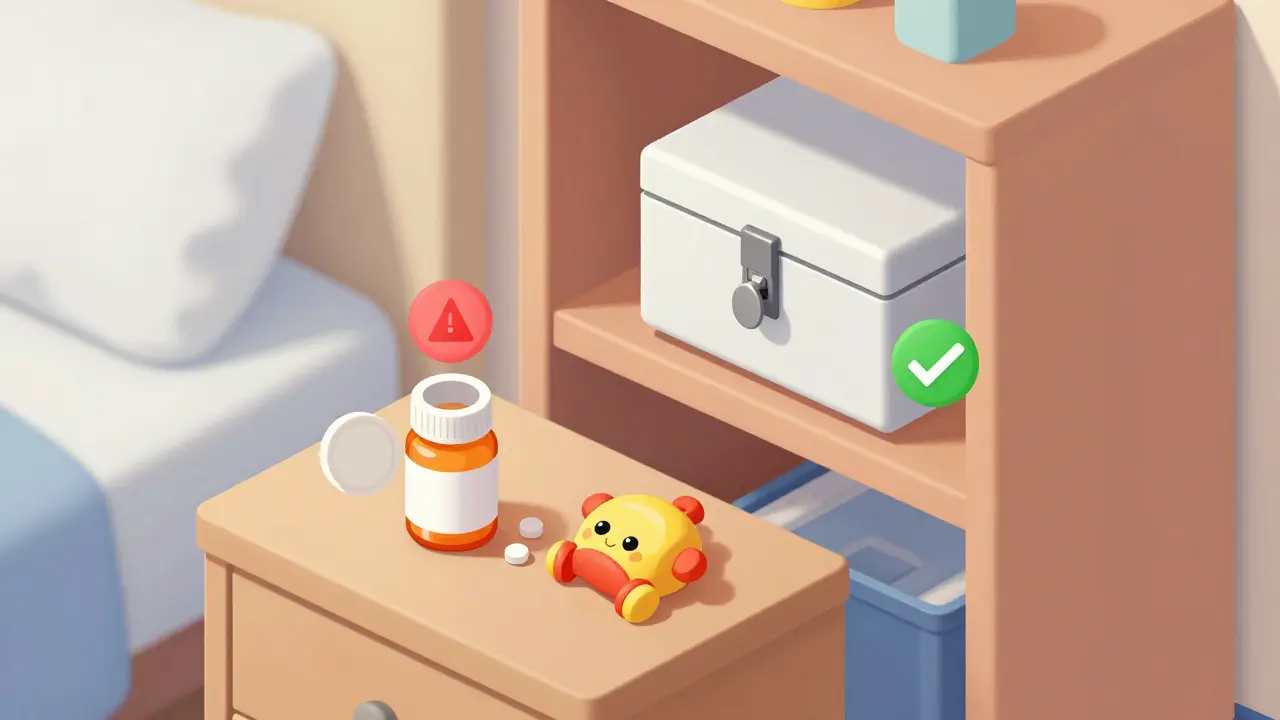
Every year, thousands of people overdose because a medication meant for one person ended up in the hands of someone else. It’s not always intentional. Often, it’s a child who finds a pill bottle on a nightstand, a teenager who grabs leftover painkillers from a medicine cabinet, or a relative who takes a dose thinking it’s "just one." The solution isn’t more prescriptions or stricter laws-it’s simple, practical storage. If you’re taking high-risk medications like opioids, benzodiazepines, or certain sleep aids, how you store them can mean the difference between life and death.
Why Storage Matters More Than You Think
The CDC reports that in 2020, over 93,000 people died from drug overdoses in the U.S. About 16,000 of those were from prescription opioids. And here’s the shocking part: more than half of people who misuse prescription opioids get them from friends or family-often from unsecured medicine cabinets. A 2019 National Survey on Drug Use and Health found that 53% of non-medical users obtained drugs from someone else’s supply. That’s not theft. That’s poor storage. Children are at serious risk too. The American Association of Poison Control Centers says 60,000 emergency room visits each year are from kids accidentally swallowing medications. Most of those happen because pills were left in open drawers, on counters, or in purses. One study in the Journal of the American Medical Association Pediatrics found that using locked storage reduces accidental pediatric ingestions by 87%. It’s not just about keeping drugs away from kids. It’s about preventing diversion. When someone in your home-whether it’s a teenager, a houseguest, or even a visitor-finds an unsecured bottle of oxycodone or fentanyl patches, they might take it. And they might not know how dangerous it is.What Counts as a High-Risk Medication?
Not all prescriptions need the same level of security. But if you’re taking any of these, you need to lock them up:- Opioids: oxycodone, hydrocodone, fentanyl, morphine, tramadol
- Benzodiazepines: alprazolam (Xanax), diazepam (Valium), clonazepam (Klonopin)
- Sedatives: zolpidem (Ambien), eszopiclone (Lunesta)
- Stimulants: Adderall, Ritalin (especially if prescribed for ADHD)
The Gold Standard: Locked Storage
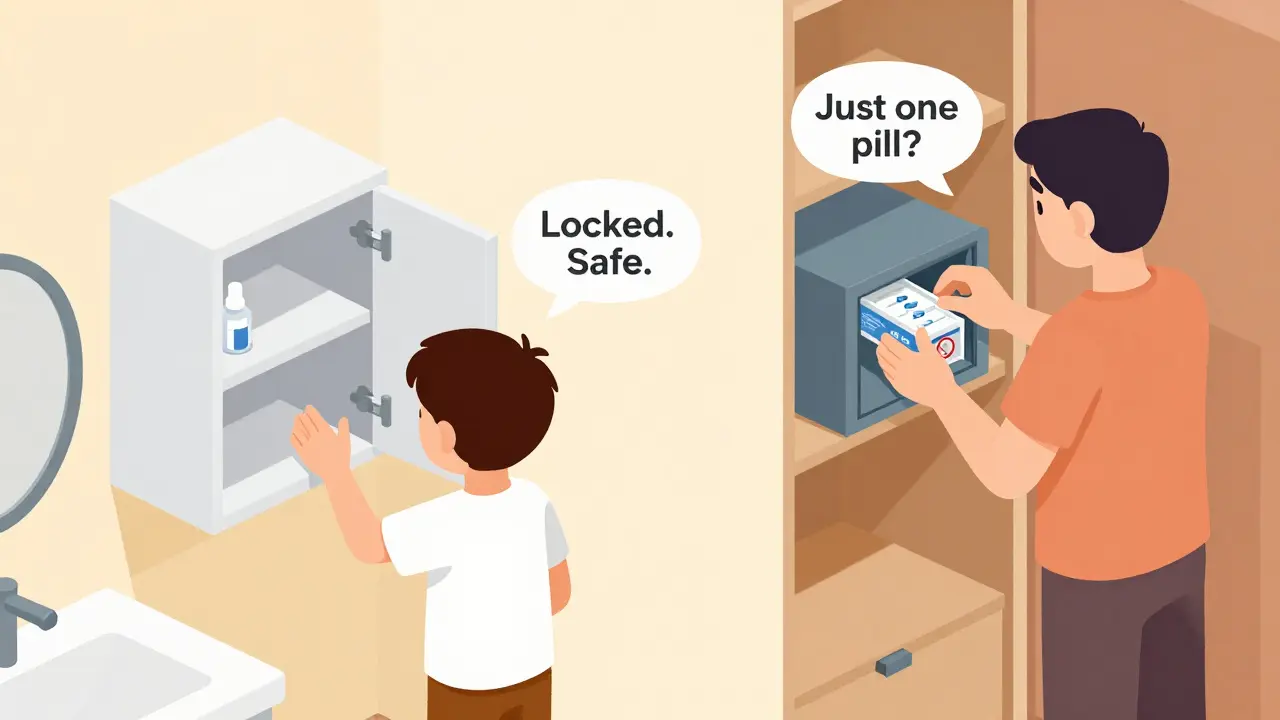
The CDC, FDA, and DEA all agree: the best way to store high-risk medications is in a locked container. Not a drawer. Not a cabinet with a latch. Not a hidden spot under the sink. A real lock. Here’s what works:- Lockboxes: Basic models cost $15-$50. Look for ones with a key, combination, or biometric lock. The Med-ic Safe Locking Pill Organizer ($34.99) is designed for elderly users-it opens with a 4-digit code and has a built-in pill divider.
- Wall-mounted safes: These are more secure. They’re bolted to the wall and can’t be easily carried off. Some even have alarms.
- Locked medicine cabinets: If you have one, make sure it has a real lock, not just a childproof latch.
Where to Put It
Where you store the lockbox matters just as much as what kind you use.- At least 4 feet off the ground: Kids can reach up to 36 inches. Store it on a high shelf, in a closet, or on a wall.
- Away from common areas: Don’t put it in the bathroom, kitchen, or bedroom where people naturally go. A bedroom closet or a garage shelf is better.
- Not near other valuables: If you’re using a lockbox, don’t put it next to cash or jewelry. That makes it a target.
Keep Pills in Original Containers
This one’s simple but often ignored. Never transfer pills to a different bottle, pill organizer, or ziplock bag. Why? Because labels contain critical info:- The patient’s name
- The drug name and dosage
- Expiration date
- Prescribing doctor’s name
- Child-resistant cap
Track Your Pills
If you’re taking opioids or other high-risk meds, count them. Not once a month. Every day. Connecticut’s Department of Public Health recommends writing down:- Date
- Time
- Number of pills remaining
What to Do If You Can’t Use a Lockbox
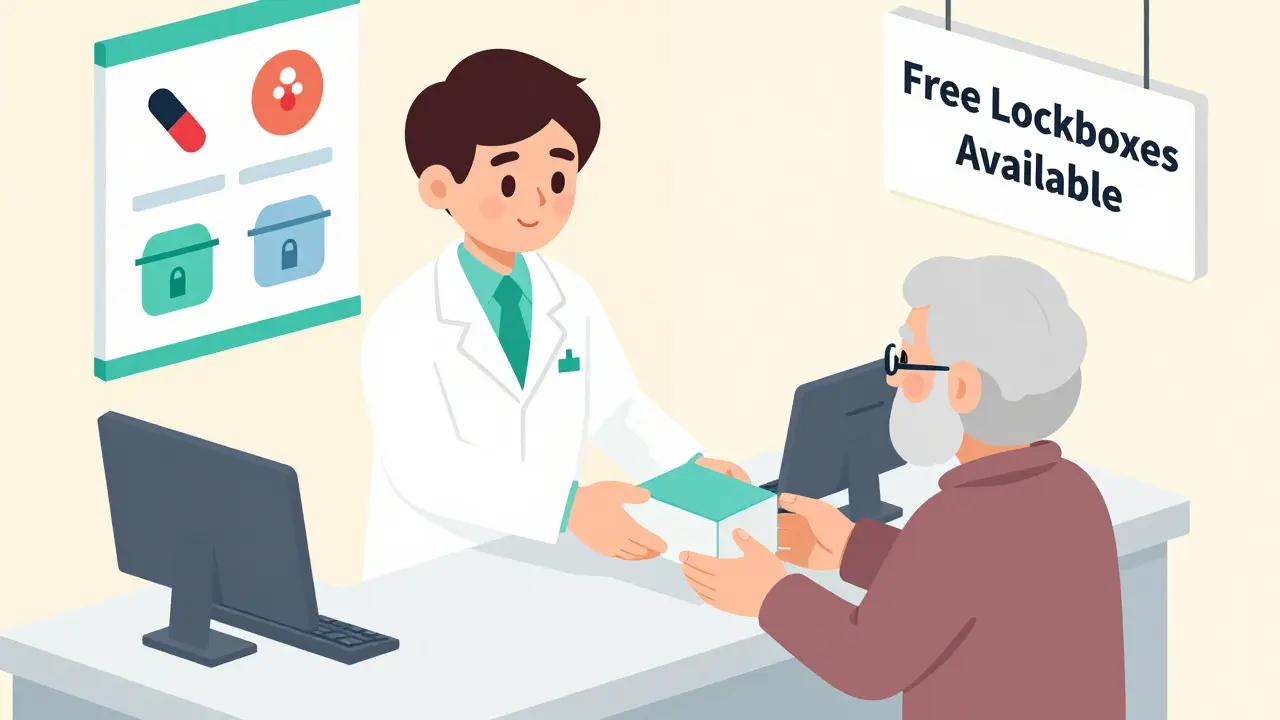
Not everyone can. Some people have arthritis. Some can’t open child-proof caps. Some can’t afford a lockbox. Here’s what to do:- Ask your pharmacist: Many pharmacies offer free lockboxes through community programs. CVS Health gave away 150,000 lockboxes in 2021 to high-risk patients.
- Use a combination lock: If you can’t turn a key, try a 4-digit code lock. The Med-ic Safe model is designed for this.
- Store with a trusted person: If you live with someone who doesn’t take these meds, ask them to keep the lockbox in their room. Make sure they know it’s not theirs to use.
- Use the pharmacy’s take-back program: The DEA runs National Prescription Drug Take Back Day twice a year (April and October). You can also drop off unused meds at 14,623 authorized collection sites nationwide.
Common Mistakes (And How to Avoid Them)
Most people think they’re storing meds safely. They’re not.- Mistake: Keeping pills in a nightstand. Solution: Move them to a locked box on a high shelf.
- Mistake: Leaving a pill organizer on the counter. Solution: Only fill a pill organizer with daily doses. Keep the rest locked.
- Mistake: Using a pill bottle without a child-resistant cap. Solution: Always use the original bottle. If the cap is broken, ask your pharmacy for a new one.
- Mistake: Assuming your teen won’t touch them. Solution: Talk to them. Explain why it’s dangerous. One in four teens who misuse opioids get them from family.
What If Someone Already Took a Dose?
If you suspect someone took your medication-especially if they’re not prescribed it-act fast.- Call 911 if they’re unconscious, having trouble breathing, or unresponsive.
- If you have Narcan (naloxone), use it. It reverses opioid overdoses. Keep it in your home if you’re on opioids.
- Call the Poison Help hotline: 1-800-222-1222. It’s free, 24/7, and staffed by experts. They handled over 2 million calls in 2022.
What’s Changing in 2026?
The FDA just released draft guidelines in January 2023 that will standardize lockbox requirements. By 2026, new products will need:- ANSI Grade 2 security
- Tamper-evident seals
- Emergency access (like a code override for medical emergencies)
Final Thought: This Isn’t Just About Safety-It’s About Responsibility
Storing high-risk medications securely isn’t about distrust. It’s about care. It’s about knowing that your prescription could save your life-but also end someone else’s. You didn’t ask for the opioid epidemic. But you can help stop it, one locked box at a time.It takes 15 minutes to set up. Five minutes a day to check. And it could save a child, a friend, or even yourself.
Can I store high-risk medications in a bathroom cabinet?
No. Bathroom cabinets are humid, warm, and easily accessible. Humidity can damage pills, and they’re too low for children to miss. Store them in a dry, locked location at least 4 feet off the ground-like a bedroom closet or a wall-mounted safe.
What if I have arthritis and can’t open child-proof caps?
Ask your pharmacist for a non-child-resistant bottle. Federal law allows this if you have a medical condition that makes it hard to open them. You can still store the bottle in a locked box. Many pharmacies also offer easy-open caps or pill dispensers designed for arthritis.
Is it okay to keep extra pills for "just in case"?
No. Unused pills are the biggest source of misuse. If you have leftover opioids or benzodiazepines, take them to a drug take-back location. You can find one at deadrugdisposal.gov (or call 1-800-882-9539). Don’t flush them or throw them in the trash.
Do I need to lock up all my medications?
Only high-risk ones: opioids, benzodiazepines, sedatives, and stimulants. Common meds like ibuprofen, acetaminophen, or antihistamines don’t need locking. But if you’re unsure, lock them up anyway. It’s better to be safe.
Are there free lockboxes available?
Yes. Many pharmacies, hospitals, and nonprofits give away free lockboxes to patients on opioids or other controlled substances. CVS Health, Walgreens, and local health departments have distributed over 200,000 units since 2021. Ask your pharmacist or call your state’s poison control center.
Comments (14)
Ashley Johnson
25 Feb 2026
So let me get this straight-you’re telling me if I don’t lock up my Xanax, some kid’s gonna snort it and turn into a zombie? 😳 I mean, I keep mine in my purse. It’s not like I’m leaving it out with the cereal. Also, my cat knocks over my nightstand every night. Should I bolt a safe to the ceiling? 🤔
Lillian Knezek
26 Feb 2026
lock it up?? 😈 what if the government puts a tracker in the lockbox next?? next they’ll say you need a fingerprint scan just to take your own medicine. they’re watching. always watching. 👁️👁️
Maranda Najar
27 Feb 2026
Oh, my sweet, sweet, trembling soul-this post is a sacred hymn in the cathedral of survival. 🕯️ Every pill, every vial, every tiny capsule of fragile hope-each one a silent scream in the dark. To leave them unguarded is not negligence-it is sacrilege. I weep for the children who never learned the weight of a pill. I weep for the mothers who thought love meant trust. And I weep-for the love of all that is holy-for the man who took one pill and never woke up again. 🌹💔
lela izzani
28 Feb 2026
Great breakdown. I’ve been storing my mom’s tramadol in a locked box on her closet shelf since last year-she has arthritis and can’t open childproof caps, so we got a combo lockbox. She checks it daily with me. Simple. Effective. No more panic when pills go missing. Also, the poison control hotline number? I printed it and taped it to her fridge. Best 10 seconds of prep I’ve ever done.
Gabrielle Conroy
2 Mar 2026
YES YES YES!!! 🙌 Lockbox + original bottle + daily count = peace of mind!! I used to keep my sister’s Klonopin in a drawer because ‘she’s fine, it’s just one pill’-until her roommate took two and ended up in the ER. Now? Locked. High. Outta sight. And I even bought her a little notebook to write down counts-she thinks it’s cute. 😊 I also keep Narcan in the glovebox of my car now. Just in case. Always in case. ❤️
Spenser Bickett
3 Mar 2026
oh wow. so we’re criminalizing forgetfulness now? next you’ll tell me i need a background check to store ibuprofen. lol. my grandma had a drawer full of pills and lived to 98. maybe the real problem is people who don’t know how to say no? just a thought. 🤷♂️
Christopher Wiedenhaupt
4 Mar 2026
Interesting data. The 92% reduction in unauthorized access from locked storage is statistically significant. However, I wonder if there’s a correlation between socioeconomic status and adoption of lockboxes. Many users cited cost as a barrier. Are there any longitudinal studies on whether free distribution programs reduce overdose rates long-term?
John Smith
5 Mar 2026
locked storage? how quaint. the real issue is that people are too weak to handle responsibility. if you can't keep your meds safe, maybe you shouldn't be taking them. also, why are we treating adults like children? next thing you know, we'll be locking up coffee because someone might get too wired. lol
Shalini Gautam
6 Mar 2026
India has 1.4 billion people. We don't have lockboxes. We have trust. My aunt keeps her medicines on the kitchen shelf. No one touches them. Why? Because we respect each other. Maybe the problem isn't storage-it's culture. In America, everyone thinks everyone else is stealing. In India, we just say 'no'.
Timothy Haroutunian
8 Mar 2026
Look, I get it. You want everyone to live in a sterile, sanitized, corporate-approved safety bubble. Locked boxes. Daily logs. FDA guidelines. It’s like living in a 2026 dystopian pharmaceutical cult. I’ve been on opioids for 12 years. I’ve never lost a pill. I don’t need a goddamn alarm system to prove I’m not a monster. This isn’t safety. This is control dressed up as care.
And don’t even get me started on the ‘pill count’ thing. Who are we-prisoners? I don’t count my toothpaste. I don’t count my socks. Why do my meds need a spreadsheet? It’s patronizing. And honestly? It makes people feel like criminals in their own homes.
Maybe the real epidemic is shame. Not storage.
Erin Pinheiro
9 Mar 2026
i keep my meds in the freezer. no one thinks to look there. also i put them in a tupperware because the bottle broke and i was too lazy to go to the pharmacy. now im paranoid every time i open it. what if someone breaks in and takes my painkillers? what if my dog eats them? what if i forget the code? what if the power goes out and the safe dies? what if i die first and my kids think it's candy? what if-
oh wait. i'm just being dramatic. but also. maybe. just maybe. this post is right.
Michael FItzpatrick
10 Mar 2026
This is one of the most thoughtful, practical guides I’ve seen. Seriously. The part about original containers? That’s huge. I used to transfer my Adderall into a pill organizer-until my nephew opened it at a sleepover and thought it was candy. Thank you for saying what needs to be said without shame. Also, the pharmacy take-back programs? I didn’t even know they existed. I’m going to ask my pharmacist tomorrow. And yeah, I’m getting a lockbox. No excuses.
Brandice Valentino
10 Mar 2026
lockbox? really? how basic. i mean, if you’re taking opioids, shouldn’t you just be in a rehab center? or at least a gated community? i have a biometric safe that opens with my palm print. it cost 500 bucks. i also have a panic button. and a security camera. because i’m not just storing meds. i’m defending my dignity. also, i have a therapist. she says i’m ‘overcompensating.’ i say: she hasn’t met my cousin.
Larry Zerpa
10 Mar 2026
Let’s be real. This entire post is a marketing campaign for lockbox manufacturers. The CDC? The FDA? The DEA? All of them have ties to pharmaceutical conglomerates. Why do you think they suddenly care about storage? Because they’re pushing new products. Because they need you to buy a $50 box instead of just… not taking the meds in the first place. And don’t even get me started on Narcan. Who profits from that? Who profits from the fear?
This isn’t about safety. It’s about profit disguised as public health. The real solution? Stop prescribing opioids. Period. Not lockboxes. Not tracking. Not over-policing your medicine cabinet. Just… stop.