
Blood Pressure Targets: 120/80 vs. Individualized Goals Explained
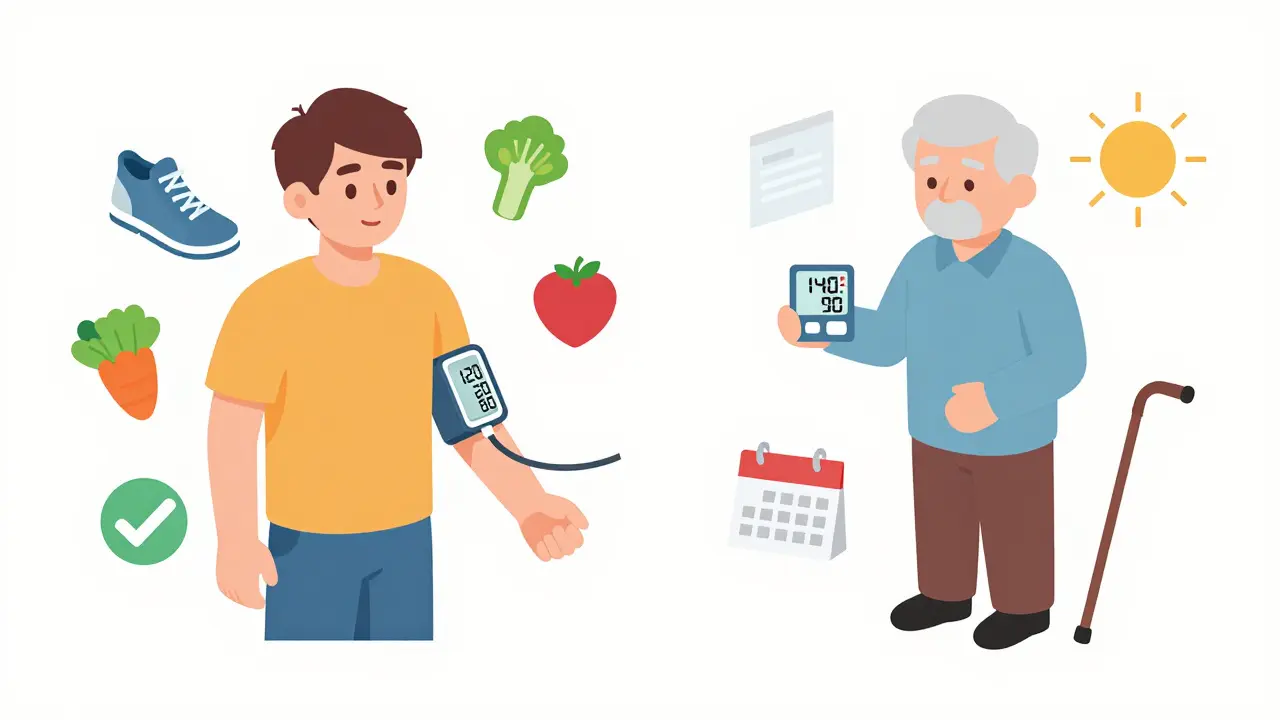
When you walk into your doctor’s office and they take your blood pressure, what are they really looking for? Is 120/80 the magic number everyone should hit-or is that just a guideline that doesn’t fit your life? The answer isn’t as simple as it used to be. In 2025, doctors in the U.S., Japan, and Europe are giving conflicting advice on what your blood pressure should be. Some say aim for 120/80. Others say 140/90 is fine. And a growing number are saying: it depends on you.
Why 120/80 Got So Popular
The 120/80 target didn’t come out of nowhere. It was pushed hard after the SPRINT trial in 2015, which followed nearly 9,400 people with high blood pressure. Those who were treated to get their systolic pressure below 120 mm Hg had 25% fewer heart attacks, strokes, and heart failures-and 27% fewer deaths-than those told to stay below 140. That’s a big deal. The American Heart Association and American College of Cardiology jumped on it. By 2017, they reclassified normal blood pressure as anything under 120/80. Anything above 130/80? That’s stage 1 hypertension. No more gray zone. But here’s what the trial didn’t tell you: most of those 9,400 people were carefully selected. They didn’t have diabetes. They weren’t over 75. They weren’t at high risk of falling. They were, in many ways, the healthiest people with high blood pressure you could find. Real-world patients? They’re different. Many are older. Many take five or six medications. Many feel dizzy when their pressure drops too fast.The Other Side: Why 140/90 Still Makes Sense
The American Academy of Family Physicians (AAFP) looked at the same data-and came to a different conclusion. In their 2022 update, they said: stick with 140/90 as the main target. Why? Because lowering pressure below that doesn’t save many more lives, but it does cause more problems. For every 33 people you treat to get their systolic pressure below 120, one will have a bad reaction: fainting, kidney trouble, or dangerously low blood pressure that sends them to the ER. Think about it this way: if you’re 78, have mild high blood pressure, and feel fine, do you really want to add another pill just to shave off 10 points? That extra pill might make you dizzy when you stand up. It might make your kidneys work harder. It might cost you $80 a month. And the benefit? You might avoid a heart attack in 10 years. But you could feel awful next week. The AAFP isn’t saying “don’t treat high blood pressure.” They’re saying: treat it well, but don’t overdo it. Get to 140/90 first. Then, if you’re young, healthy, and feel great, talk about going lower. But don’t push everyone into that 120/80 box.Japan’s Bold Move: One Target for Everyone
In January 2025, Japan changed everything. The Japanese Society of Hypertension dropped its old rules and said: everyone-no matter their age, health, or risk-should aim for under 130/80. No exceptions. They based this on a massive global analysis of over 400,000 people. Every time systolic pressure dropped by 5 points, the risk of heart attack or stroke dropped by 10%. It didn’t matter if you were 40 or 84. The math held up. But here’s the catch: Japan has a different healthcare system. People see their doctor every month. Blood tests are routine. Pharmacists check in with patients daily. If your pressure drops too low, you’re flagged fast. In the U.S., many patients go 6-12 months between visits. That’s a problem if you’re on a regimen that could make you faint in the shower. Japan’s approach works because it’s supported by constant monitoring. In places without that infrastructure, forcing everyone to 130/80 could do more harm than good.
What Europe Does: Age-Based Targets
Europe took the middle path. The European Society of Hypertension says: your target should change with your age.- Under 65? Aim for 120-129/70-79.
- 65 to 79? 130-139 systolic is fine.
- 80 and older? 140-150 is acceptable.
Who Should Aim for 120/80?
Not everyone needs to chase 120/80. But some people benefit hugely.- People under 65 with diabetes or kidney disease
- Those with a 10-year heart disease risk over 7.5% (calculated using tools like PREVENT)
- People with a history of heart attack, stroke, or heart failure
- Those who can tolerate multiple medications without side effects
Who Should Stick with 140/90?
If you’re over 75, especially if you’re frail, have balance issues, or take multiple pills for other conditions, 140/90 is safer. Same if you’re in your 60s but have no heart disease, no diabetes, and your blood pressure only creeps above 135/85. Forcing a lower target here doesn’t add years to your life-it adds pills, side effects, and anxiety. A 2024 Medscape survey showed 62% of cardiologists want lower targets. Only 41% of family doctors agree. Why? Family doctors see the real world: the 80-year-old who faints after taking her morning pill. The diabetic who gets kidney trouble from too many meds. The man who can’t afford his new prescriptions and skips doses because he’s scared of side effects.
What About the Cost?
Lower targets mean more drugs. More tests. More doctor visits. In the U.S., the antihypertensive market hit $28.7 billion in 2024 and is expected to grow to $33.2 billion by 2027. That’s billions spent on pills that might not be necessary for many people. The PREVENT risk calculator is now used in 78% of U.S. primary care offices. It helps doctors decide who needs meds. But it’s not perfect. It doesn’t know if you can afford your meds. It doesn’t know if you live alone and can’t get to the pharmacy. It doesn’t know if you’re scared of needles or have a fear of hospitals.What Should You Do?
Forget the one-size-fits-all number. Your goal isn’t to hit 120/80. Your goal is to live longer, feel better, and avoid hospital visits.- Get your blood pressure checked regularly-at home and at the doctor’s.
- Ask: “What’s my risk of heart attack or stroke in the next 10 years?”
- Ask: “What side effects have other people had with these drugs?”
- Ask: “What happens if I don’t take this extra pill?”
The Future: Personalized Blood Pressure
The next big shift won’t be about numbers. It’ll be about prediction. Researchers are now using AI to look at your genes, your kidney function, your sleep patterns, even your social stress levels-and predict how your body will respond to different blood pressure targets. In five years, your doctor might not say, “We need to get you to 120.” They might say, “Your data shows you respond best to a target of 128. We’ll aim for that.” For now, the best advice is simple: work with your doctor. Don’t let a guideline decide for you. Your body isn’t a statistic. It’s yours.Is 120/80 the ideal blood pressure for everyone?
No. While 120/80 is considered normal, it’s not the right goal for everyone. For healthy adults under 65 with high heart disease risk, it may be beneficial. But for older adults, those with multiple chronic conditions, or people prone to dizziness, aiming for 140/90 is often safer and just as effective at preventing serious events.
Why do different countries have different blood pressure targets?
Different countries weigh the benefits and risks differently. The U.S. heart groups focus on preventing long-term damage, even if it means more medication. The American Academy of Family Physicians prioritizes avoiding side effects in real-world patients. Japan, with its strong primary care system, can safely push for lower targets. Europe splits targets by age to match how bodies change over time.
Can I lower my blood pressure without medication?
Yes. For many people, lifestyle changes work well. Reduce salt, eat more vegetables and whole grains, walk 30 minutes a day, lose excess weight, limit alcohol, and manage stress. These changes can drop systolic pressure by 10-20 points. For stage 1 hypertension (130-139/80-89), doctors often recommend trying this for 3-6 months before prescribing pills.
What are the risks of lowering blood pressure too much?
Too-low blood pressure can cause dizziness, fainting, falls, kidney injury, and electrolyte imbalances like high potassium. In older adults, this increases the risk of hip fractures and hospitalization. Studies show that for every 33 people treated to reach below 120 systolic, one will have a serious side effect like syncope or acute kidney injury within 3-4 years.
Should I buy a home blood pressure monitor?
Yes, especially if you’re being treated for high blood pressure. Home readings are often more accurate than clinic readings, which can be affected by stress or “white coat hypertension.” Look for an upper-arm monitor that’s validated by the British Hypertension Society. Record your readings and bring them to your appointments.



Comments (15)
RAJAT KD
9 Jan 2026
120/80 isn't a target-it's a marketing slogan sold by pharma with a side of echo chambers. Real medicine isn't about hitting numbers. It's about keeping people functional, not medicated into oblivion.
Angela Stanton
10 Jan 2026
LOL at the US pushing 120/80 while 40% of people can’t afford their meds. 😅 We’re treating stats, not humans. Also, ‘white coat hypertension’ is just the system screaming for a reboot.
Patty Walters
10 Jan 2026
My grandma’s BP was 142/88 and she walked 2 miles daily, cooked for 10, and never went to the hospital. The guidelines don’t know your life. Get a home monitor, track trends, talk to your doc-but don’t let a number dictate your peace.
Chris Kauwe
11 Jan 2026
It’s fascinating how the American medical establishment has become a cult of arbitrary metrics. The SPRINT trial was a statistical fantasy built on a cherry-picked cohort-healthy, young, compliant, and insulated from the real world. Meanwhile, the AAFP understands that medicine isn’t about optimizing for a lab report. It’s about preserving dignity. When you force an 80-year-old into a 120/80 straitjacket, you’re not saving lives-you’re institutionalizing fear under the guise of science.
Japan’s one-size-fits-all mandate? That’s not innovation-it’s authoritarian medicine enabled by infrastructure we don’t have. Their system has pharmacists monitoring patients daily. We have patients Googling side effects at 2 a.m. while their insurance denies the refill. The European age-tiered model is the only sane approach: medicine must evolve with the body, not force the body to evolve for the guideline.
And let’s not pretend the PREVENT calculator is neutral. It doesn’t factor in whether you’re working two jobs, can’t afford healthy food, or live in a food desert. It doesn’t know if your stress comes from rent or racism. It just spits out a percentage and a script. That’s not medicine. That’s algorithmic paternalism.
AI-driven personalized targets? Maybe in 2030. But until then, the most radical thing you can do is ask your doctor: ‘What happens if I do nothing?’ Not ‘How do I get to 120?’ But ‘What’s the cost of chasing this number?’ Because the real cost isn’t in pills-it’s in sleepless nights, dizziness in the shower, and the quiet shame of feeling like your body is broken just because it doesn’t fit a spreadsheet.
We’ve turned cardiovascular health into a moral performance. You’re not ‘bad’ if your BP is 138. You’re human. And humanity doesn’t come with a target range.
Pooja Kumari
12 Jan 2026
Ugh I just had to take my mom to the ER last week because they pushed her BP too low and she passed out in the kitchen and cracked her skull. 😭 She’s 79, takes 6 meds, and they just kept adding more because ‘you need to get under 120’. I cried for 3 days. Why do doctors act like we’re robots? I don’t want my mom to live to 90 if she’s dizzy all day and can’t hug her grandkids without falling. I’d rather have her alive, even if her BP is 142. It’s not about the number-it’s about her being able to laugh at bad TV with me. 🫂
Jacob Paterson
13 Jan 2026
Oh wow, so now we’re admitting the medical-industrial complex is running on greed and fear? Shocking. 🙄 The real scandal isn’t the BP targets-it’s that we let corporations dictate health policy while real doctors are too busy filling out 17 forms just to prescribe a diuretic. You want change? Stop paying for pills you don’t need. Stop letting your doctor be a sales rep for Big Pharma. And for god’s sake, stop trusting a guideline written by a committee that’s never met a patient who works two shifts.
Maggie Noe
14 Jan 2026
120/80 is the new ‘you should be thin’ for middle-aged men. 🤦♀️ We’ve turned a physiological range into a virtue signal. If your BP is 135 and you’re not diabetic, not obese, not sedentary, you’re not ‘hypertensive’-you’re just alive. And maybe you’re doing fine. The data says ‘individualized’-but the system says ‘comply’. We’re not treating patients. We’re managing compliance metrics.
Also, I love how every study says ‘it depends’… then the guidelines come out and it’s ‘everyone must do this’. 🤡
Catherine Scutt
14 Jan 2026
My doc told me to aim for 120. I said ‘I’m 72, take 4 meds, and I get dizzy when I stand’. She said ‘we’ll adjust’. I haven’t seen her in 8 months. I’m still dizzy. And now I’m paying $120 a month for pills I don’t want. The system doesn’t care if you feel like crap. It only cares if your number is green.
Ian Long
15 Jan 2026
There’s truth on both sides. The SPRINT data is solid-but it’s not universal. And the AAFP isn’t being lazy; they’re being responsible. Medicine isn’t about doing everything possible. It’s about doing what’s right for the person in front of you. I’ve seen patients get worse from aggressive treatment. I’ve seen others thrive with lifestyle changes alone. The answer isn’t 120 or 140. It’s ‘what works for YOU, without breaking you’.
Kiruthiga Udayakumar
15 Jan 2026
As an Indian woman, I’ve seen both worlds. In India, many can’t even afford BP meds. So we focus on walking, salt reduction, and stress. In the US, people get 5 pills and panic if it’s 131. We need balance-not extremes. And yes, home monitors help. But don’t obsess. Your body talks. Listen.
Phil Kemling
15 Jan 2026
What if the real problem isn’t blood pressure… but the belief that every biological variable must be controlled? We’ve turned health into a project. A task. A KPI. But the body isn’t a machine to be calibrated. It’s a living system that adapts, resists, and sometimes just… needs rest. Maybe 120/80 isn’t the goal. Maybe the goal is to stop treating life like a spreadsheet.
Jenci Spradlin
16 Jan 2026
Just got my home monitor. Took 5 readings. Avg was 136/86. I’m 58, active, no meds. My doc said ‘we’ll watch it’. That’s it. No panic. No new pills. Just… presence. Sometimes the best treatment is not treating.
Jerian Lewis
18 Jan 2026
They say ‘it depends on you’-but if you’re poor, old, or tired, ‘you’ don’t get a say. The system picks your target for you. And then you’re the problem when you can’t hit it.
Elisha Muwanga
19 Jan 2026
Japan’s model is superior. Why? Because they care about outcomes, not lawsuits. In America, we treat numbers to avoid liability, not to save lives. The AAFP is just afraid of getting sued if someone faints. So they choose the path of least legal resistance. Not the path of best health.
Drew Pearlman
20 Jan 2026
Hey everyone-just wanted to say I’ve been working on lowering my BP for 8 months now. Cut salt, started walking 30 mins a day, lost 18 lbs, and my BP dropped from 148/92 to 128/80 without a single pill. It’s not easy, but it’s possible. And honestly? I feel better than I have in 10 years. I’m not saying everyone needs to do this-but if you’re willing to try, your body might surprise you. You’ve got this. 💪❤️