
MedWatch vs VAERS: How the FDA and CDC Track Drug and Vaccine Side Effects
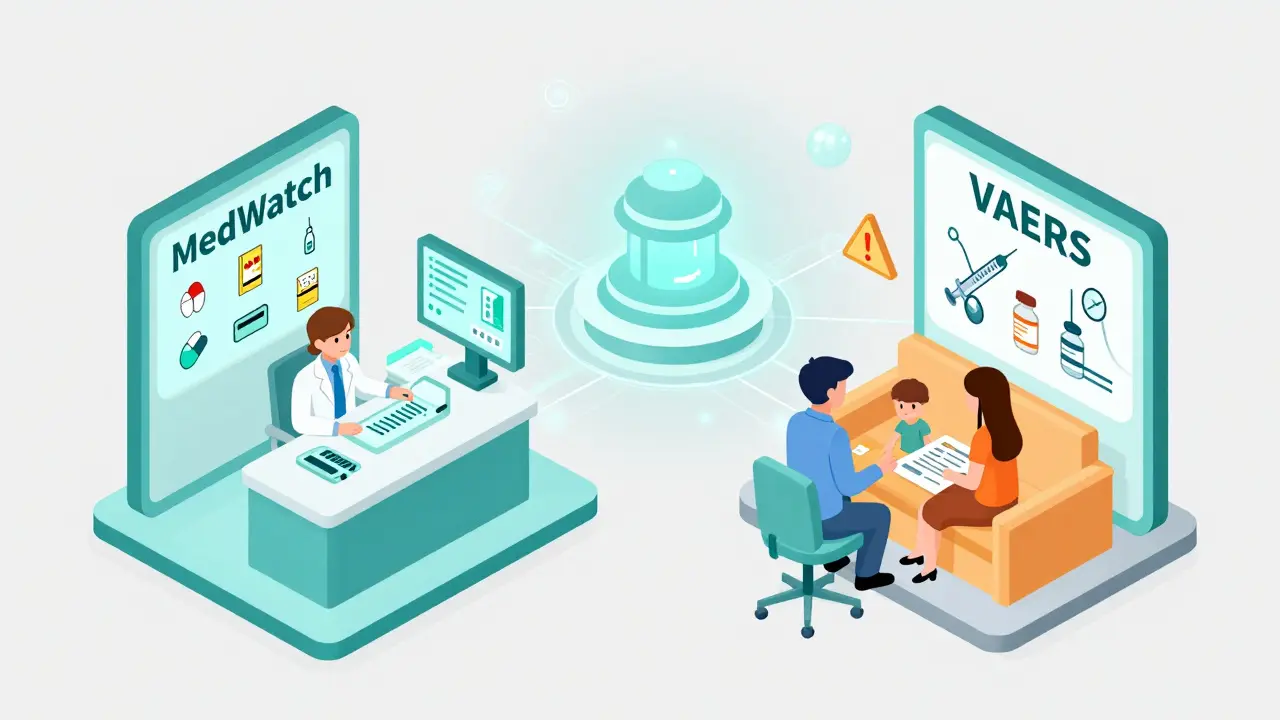
MedWatch vs VAERS Comparison Tool
How to Use This Tool
This tool helps you understand the key differences between MedWatch and VAERS - two critical reporting systems for drug and vaccine safety. Select any feature to see how each system handles it, or view the complete comparison below.
MedWatch
What it monitors
Everything except vaccines - prescription drugs, OTC medicines, medical devices, supplements, tobacco products
Who runs it
U.S. Food and Drug Administration (FDA)
Who reports
Healthcare providers, patients, manufacturers (mandatory for companies)
Mandatory reporting
Yes, for manufacturers and certain facilities
Key data collected
Drug name, dose, duration, patient history, outcome
Can it prove causation?
No
Used to detect
Unexpected reactions to drugs, devices, supplements
VAERS
What it monitors
Vaccines only - flu, COVID-19, measles, HPV, shingles, tetanus
Who runs it
Centers for Disease Control and Prevention (CDC) + FDA
Who reports
Anyone - patients, parents, doctors, vaccine makers
Mandatory reporting
No, but healthcare providers must report specific serious events
Key data collected
Vaccine brand, lot number, date given, time to symptom, prior health
Can it prove causation?
No
Used to detect
Unusual patterns after vaccination
Key Differences Explained
Why separation matters
Combining these systems would create confusion. A report about a headache after a flu shot would go to VAERS, while a headache after a blood pressure pill would go to MedWatch. Mixing them would make it impossible to determine which product caused which reaction.
Misconception alert
VAERS doesn't prove vaccines cause side effects - it's a starting point to identify patterns. Less than 1% of actual vaccine reactions get reported. Just counting VAERS reports without context is dangerous. You need to compare rates to general population data to determine if a vaccine is actually causing problems.
Take the Quick Quiz
Test your knowledge about MedWatch and VAERS
When you hear about a new side effect from a vaccine or a prescription drug, it’s easy to assume someone just noticed it and told the government. But how does that information actually get to the FDA? And why are vaccine reports handled completely separately from drug reports? The answer lies in two systems that look similar but serve very different purposes: MedWatch and VAERS.
One tracks drugs, devices, and medical products. The other tracks only vaccines. Mixing them up can lead to serious misunderstandings - especially when people cite VAERS data to claim a drug caused harm, or use MedWatch to question vaccine safety. These aren’t interchangeable. They’re designed differently, governed by different rules, and used for different kinds of safety checks.
What Is MedWatch?
MedWatch is the FDA’s system for collecting reports about harmful side effects from everything except vaccines. That includes prescription drugs, over-the-counter medicines, medical devices like pacemakers or insulin pumps, dietary supplements, and even tobacco products. If it’s approved by the FDA and it’s not a vaccine, it goes through MedWatch.
Reports come from doctors, pharmacists, patients, and manufacturers. But here’s the key difference: manufacturers are legally required to report serious side effects. If a drug company finds out that one of its medications caused a heart attack in 10 people last month, they must submit those reports to the FDA within 15 days. Failure to do so can lead to fines or legal action.
When a report comes in, the FDA routes it to the right center - the Center for Drug Evaluation and Research for pills, the Center for Devices for implants, or the Center for Food Safety for supplements. They don’t act on single reports. Instead, they look for patterns. If 50 people report the same rare reaction to a blood pressure drug over six months, that’s a red flag. Then they dig deeper with studies, lab data, or real-world health records.
MedWatch doesn’t prove cause and effect. It’s a warning system. A report says, “This happened after taking the drug.” It doesn’t say, “The drug caused it.” That’s why the FDA doesn’t pull drugs off the market based on MedWatch alone. They use it to decide which products need more study.
What Is VAERS?
VAERS - the Vaccine Adverse Event Reporting System - is run jointly by the CDC and FDA. But unlike MedWatch, it only handles vaccines. That means every shot you get: flu, COVID-19, measles, HPV, shingles, tetanus. If it’s given to prevent disease and it’s a vaccine, it’s tracked in VAERS.
Anyone can report to VAERS. You don’t need to be a doctor. You don’t even need to be sure the vaccine caused the problem. If your child had a fever two days after getting the MMR shot, you can file a report. If a grandparent went to the hospital after the shingles vaccine, that goes in too. The system is built to catch things you might not expect - like a rare neurological reaction or an unusual pattern of fainting among teenagers.
VAERS forms ask for details you won’t find in drug reports: vaccine brand, lot number, date of vaccination, time between shot and symptom, and whether the person had other illnesses or took other meds. That’s because timing matters. If someone gets a flu shot on Monday and has a stroke on Tuesday, it’s worth noting. If they got the shot last year and had a stroke now? Probably unrelated.
But here’s the hard truth: VAERS doesn’t prove vaccines cause side effects. Less than 1% of actual vaccine reactions get reported. Many people don’t know about it. Others don’t report because they assume it’s not serious. Some reports are incomplete. A few are even made up.
That’s why the CDC and FDA never say, “VAERS proves the vaccine caused X.” They say, “VAERS flagged a possible pattern. Now we’re checking with other systems.”
Key Differences Between MedWatch and VAERS
At first glance, both systems look like online forms where you report bad reactions. But their structure, rules, and purpose are worlds apart.
| Feature | MedWatch | VAERS |
|---|---|---|
| What it monitors | All FDA-approved medical products except vaccines | Vaccines only |
| Who runs it | U.S. Food and Drug Administration (FDA) | Centers for Disease Control and Prevention (CDC) + FDA |
| Who reports | Healthcare providers, patients, manufacturers (mandatory for companies) | Anyone - patients, parents, doctors, vaccine makers |
| Mandatory reporting | Yes, for manufacturers and certain facilities | No, but healthcare providers must report specific serious events |
| Key data collected | Drug name, dose, duration, patient history, outcome | Vaccine brand, lot number, date given, time to symptom, prior health |
| Can it prove causation? | No | No |
| Used to detect | Unexpected reactions to drugs, devices, supplements | Unusual patterns after vaccination |
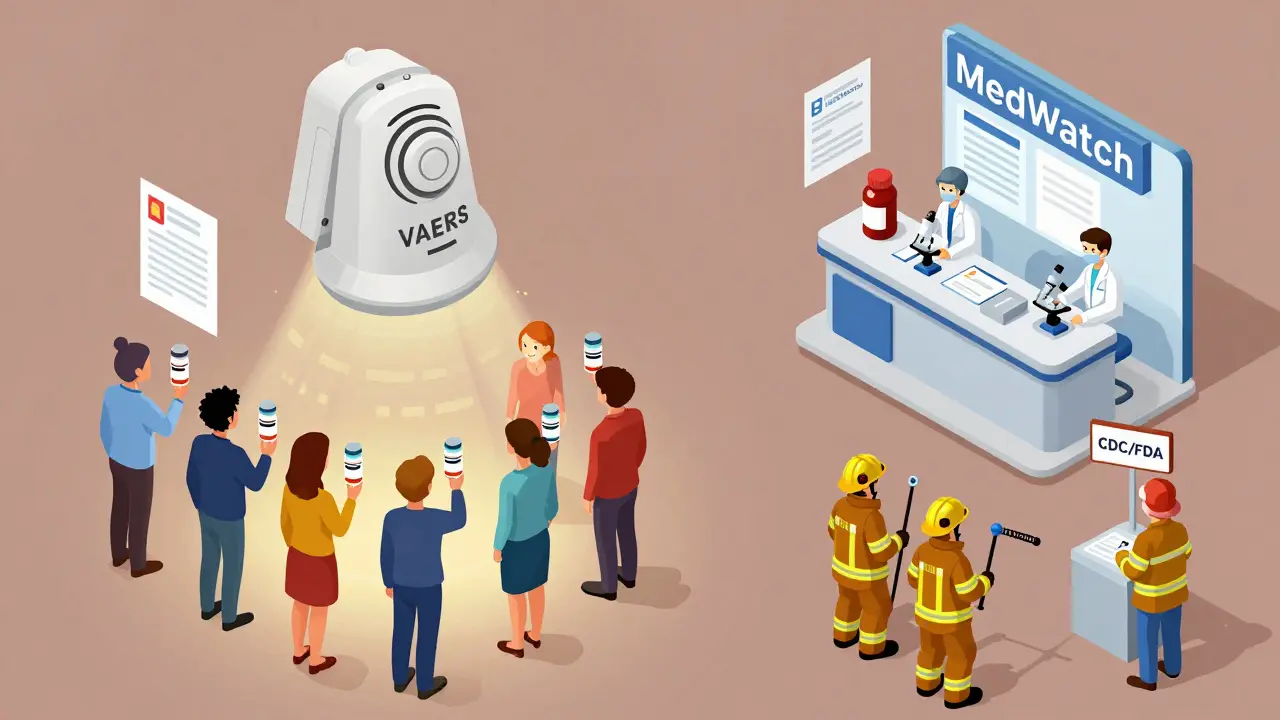
The biggest mistake people make is treating VAERS like a database of confirmed vaccine injuries. It’s not. It’s a starting point. Think of it like a smoke alarm. It doesn’t tell you if there’s a fire - it just tells you something unusual is happening. Then firefighters (the CDC and FDA) show up with better tools to find out if there’s a real problem.
MedWatch works the same way, but for drugs. If a new diabetes drug starts showing up in 200 reports of liver damage, the FDA doesn’t ban it right away. They compare it to older drugs. They check if those patients had other risk factors. They might ask hospitals for electronic health records. Only after multiple lines of evidence do they act.
Why the Separation Matters
Why don’t they just combine them? Because vaccines are different. They’re given to healthy people - often kids - to prevent disease, not treat it. The bar for safety is higher. A drug for cancer might have serious side effects because the illness is deadly. A vaccine for the flu? It needs to be extremely safe.
VAERS was created because vaccine safety requires extra scrutiny. The system was designed to catch rare events that only show up after millions of doses are given. Before VAERS, those signals got lost. Now, they’re flagged fast.
Also, vaccine manufacturers report to VAERS. Drug manufacturers report to MedWatch. If you mix them, you get confusion. Someone might report a headache after a flu shot - and it goes into VAERS. Then someone else reports a headache after a new blood pressure pill - and it goes into MedWatch. If both were in the same system, you’d have no way to tell which product caused which reaction.
And here’s something people rarely mention: VAERS data is publicly available. You can download it. But the CDC warns that using it without context is dangerous. You can’t just count how many people died after a vaccine and say, “That proves it’s unsafe.” You have to know how many people got the vaccine in the first place. You have to compare it to death rates in the general population. You have to account for age, existing conditions, and timing.
MedWatch data is harder to access publicly, but that’s not because it’s secret. It’s because the FDA wants to make sure it’s interpreted correctly. They release summaries, not raw data, to prevent misuse.
What Happens After a Report?
Neither system acts alone. Both feed into larger safety networks.
For vaccines, if VAERS flags something - say, a spike in Guillain-Barré syndrome after a new flu shot - the CDC pulls in its Vaccine Safety Datalink (VSD). VSD uses health records from millions of people across the U.S. to compare vaccinated and unvaccinated groups. If the rate of Guillain-Barré is actually higher in the vaccinated group, they investigate further. If not, they close the signal.
For drugs, if MedWatch shows a pattern of kidney damage from a new antidepressant, the FDA checks the BEST system (Biologics Effectiveness and Safety), which uses insurance claims and hospital data to see if the pattern holds up in real life. They might also partner with universities to run controlled studies.
In both cases, the initial report is just step one. Real science comes later.
Common Misconceptions
Let’s clear up the biggest myths:
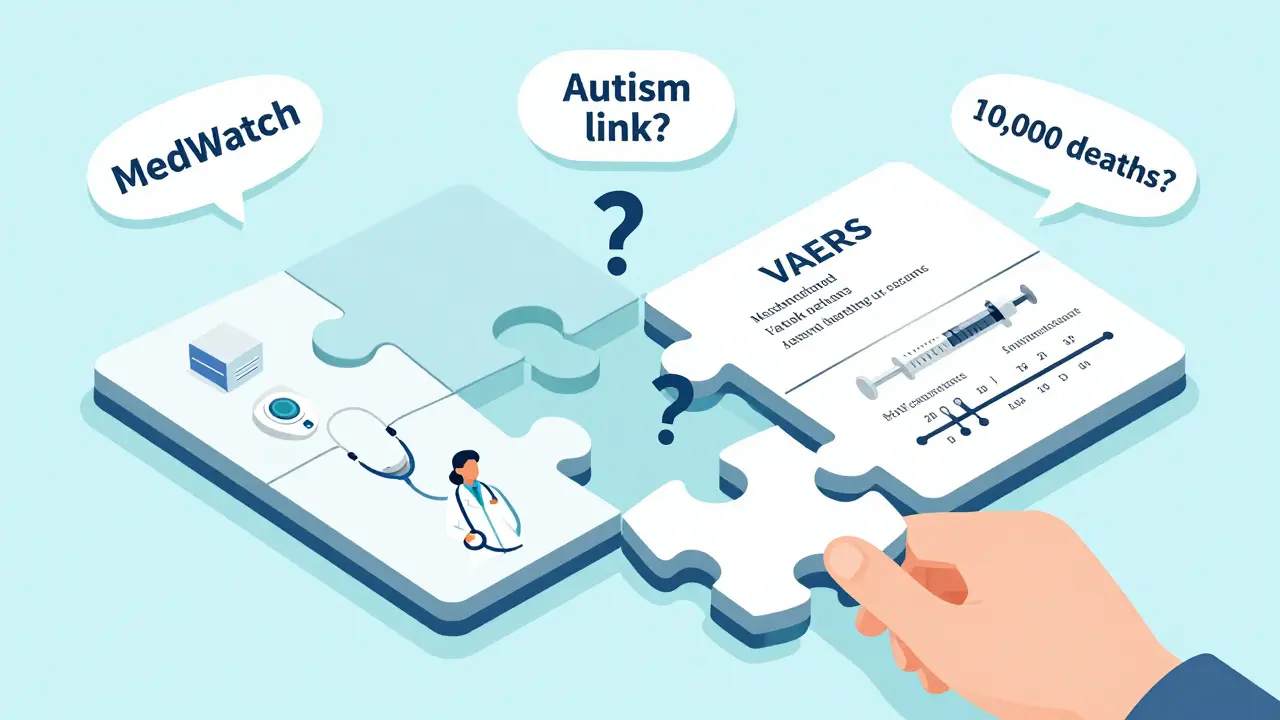
- Myth: “VAERS has 10,000 reports of death after the COVID vaccine - that means it’s dangerous.” Truth: VAERS doesn’t confirm cause of death. Many reports are from people who died of heart disease, cancer, or accidents days or weeks after vaccination. That doesn’t mean the shot caused it.
- Myth: “If MedWatch doesn’t have many reports about this drug, it must be safe.” Truth: Underreporting happens. Many side effects aren’t noticed, or patients don’t report them. A lack of reports doesn’t equal safety.
- Myth: “I can report my child’s autism to VAERS.” Truth: Autism is not caused by vaccines. VAERS collects reports, but decades of scientific studies have found no link. Reporting it doesn’t change that.
- Myth: “The FDA hides bad side effects.” Truth: The FDA publishes safety updates regularly. If a drug has a new warning, it’s posted online within weeks. If a vaccine has a new precaution, it’s added to the CDC’s website.
What Should You Do?
If you or a loved one has a bad reaction:
- For vaccines: Report it to VAERS. Go to vaers.hhs.gov. You don’t need a doctor’s note. Just fill out the form. Even if you’re unsure, report it.
- For drugs or devices: Report it to MedWatch. Go to fda.gov/medwatch. You can file online or call 1-800-FDA-1088.
And if you’re reading about side effects online? Always ask: Is this from VAERS? Or MedWatch? And is the source explaining how the data was used - or just showing numbers?
Neither system is perfect. But together, they help keep millions of people safe. The goal isn’t to eliminate all risk. It’s to find the real dangers - and fix them fast.
Can I report a side effect even if I’m not sure the vaccine or drug caused it?
Yes. Both VAERS and MedWatch encourage reports even when you’re unsure. The systems are designed to catch unexpected patterns, and uncertainty doesn’t mean you shouldn’t report. If something unusual happened after taking a drug or getting a shot, it’s worth reporting - even if you think it might be a coincidence.
Why can’t VAERS data prove vaccines cause side effects?
VAERS collects reports from anyone, and reports can be incomplete, inaccurate, or coincidental. For example, if 10,000 people get a flu shot and 10 of them have heart attacks the next day, VAERS will record all 10. But heart attacks happen every day in people who didn’t get the shot. Without comparing those numbers to the general population, you can’t say the vaccine caused them. That’s why scientists use other systems like VSD to check for real patterns.
Do I need a doctor to report to VAERS or MedWatch?
No. Both systems allow anyone - patients, parents, caregivers - to submit reports. You don’t need medical training or a doctor’s approval. The goal is to gather as many observations as possible so safety experts can spot trends.
Are vaccine side effects reported more than drug side effects?
Not necessarily. More people report to VAERS because vaccines are given to healthy people - including children - and many parents are more likely to report minor symptoms like fever or sore arms. Drug side effects often go unreported because patients assume the reaction is normal or they don’t know where to report. But that doesn’t mean vaccines are less safe - just that reporting habits differ.
What happens if I report a side effect and nothing happens?
Most reports don’t lead to immediate action - and that’s normal. One report rarely changes anything. But when hundreds or thousands of similar reports come in over time, it triggers deeper investigation. Your report might be part of a pattern that leads to a warning label, a dosage change, or even a product recall. Even if you don’t see results, your report helps.
Understanding MedWatch and VAERS isn’t about being skeptical. It’s about being informed. These systems aren’t perfect - but they’re the best tools we have to catch dangers before they become widespread. The next time you hear a claim about vaccine or drug safety, ask: Where did that data come from? And what else are they not telling you?



Comments (13)
Tom Bolt
11 Mar 2026
Let me be crystal clear: VAERS is not a registry of verified injuries. It’s a surveillance tool. Period. When you see headlines screaming ‘10,000 deaths after COVID shot!’-that’s not evidence, it’s noise. The FDA and CDC don’t treat raw VAERS data as causation. They treat it as a starting point for epidemiological detective work. If you’re going to cite it, at least understand what you’re citing.
Shourya Tanay
13 Mar 2026
From a pharmacovigilance standpoint, the structural divergence between MedWatch and VAERS reflects fundamental epistemological differences in risk-benefit calculus. Vaccines are administered to asymptomatic populations, necessitating a lower threshold for signal detection-hence the permissive reporting architecture of VAERS. Conversely, MedWatch’s mandatory manufacturer reporting aligns with the risk mitigation protocols inherent in therapeutic interventions. The systems aren’t flawed-they’re optimized for distinct public health paradigms.
Kenneth Zieden-Weber
14 Mar 2026
Oh wow, so you’re telling me the government doesn’t just take every single report at face value? Shocking. Next you’ll tell me that not every headache after a vaccine is proof of a conspiracy. I mean, I guess if you’re into facts and stuff. But hey, I’m just here for the drama. Anyone else notice how the FDA’s website looks like it was designed in 2003? I’m not saying it’s suspicious… but I’m not *not* saying it either.
David L. Thomas
16 Mar 2026
VAERS is like a radar system-it doesn’t tell you where the plane is, just that something’s up in the sky. The real magic happens when the CDC cross-references it with VSD, which pulls real-world data from millions of electronic records. That’s how they spot true signals. I’ve seen people misinterpret VAERS like it’s a death toll, but the truth? Most reports are mundane-fever, fatigue, sore arm. The scary stuff? That’s what gets followed up. Patience, people. Science isn’t instant.
Miranda Varn-Harper
18 Mar 2026
It is a matter of considerable concern that the public is being misled into believing that these reporting systems constitute empirical validation of causality. The very premise that anecdotal submissions can serve as evidentiary foundation for public health policy is, in my professional estimation, a dereliction of scientific rigor. One must question the institutional integrity of systems that permit unverified claims to be publicly accessible without adequate contextual disclaimers.
Alexander Erb
19 Mar 2026
Yessss! This is exactly why I love how transparent this stuff is. 🙌 You don’t need to be a doctor to report something weird after a shot or a pill. That’s the whole point. I reported my cousin’s weird rash after her shingles vaccine-just to be safe. And guess what? Nothing blew up. But now it’s in the system. If 50 other people report the same thing? Boom. They’ll look. That’s how safety works. No drama. Just science. ❤️
Donnie DeMarco
20 Mar 2026
bro like VAERS is just a giant google form that says "did you feel weird after the jab?" and then some dude in a cubicle goes "huh, weird" and moves on. meanwhile medwatch is like a corporate audit where pharma companies get fined if they don’t report every sneeze. so yeah, they’re totally different. but also kinda the same? both are just the first step. the real magic is in the data crunching after. also i reported my dog’s side effect once. no one cared. but i felt better.
LiV Beau
21 Mar 2026
Thank you for explaining this so clearly!! 🌟 I used to scroll through VAERS stats and panic, but now I get it-it’s like a fire alarm. Doesn’t mean there’s a fire. Means someone noticed smoke. And honestly? Reporting something even if you’re unsure? That’s how we protect each other. My niece got a fever after her 2-month shots. I reported it. No big deal. But if 1000 other moms do the same? They’ll find the pattern. That’s community science. And it’s beautiful.
Adam Kleinberg
22 Mar 2026
So let me get this straight-your so-called "safety system" lets anyone report anything and then pretends it’s not a data mine for anti-vaxxers? And you wonder why people don’t trust you? The FDA doesn’t even make VAERS data easy to use. It’s buried in CSV files like they’re hiding something. And don’t get me started on how they let doctors report but not patients? It’s a joke. You can’t control the narrative if you don’t control the data. And you don’t. So why should I believe you?
Denise Jordan
22 Mar 2026
Ugh. I read the whole thing. So… what? We report stuff. Then what? They do… something? With… data? Look, I just want to know if my kid’s vaccine is safe. Not a lecture on epidemiology. Can we just have a simple yes/no? Or is that too much to ask?
Gene Forte
23 Mar 2026
The pursuit of truth in public health requires humility. We do not know everything. We cannot predict every outcome. But we can build systems that listen-quietly, patiently, systematically. MedWatch and VAERS are not perfect. But they are honest. They do not pretend to have answers. They ask questions. And in that humility, there is wisdom. Let us not mistake the signal for the noise. Let us not confuse the alarm for the fire. Let us simply be present-and report.
Chris Bird
25 Mar 2026
VAERS is a trap. They want you to think it’s open. But it’s not. They filter. They delete. They only look at what helps them. I’ve seen reports vanish. I’ve seen people get banned for asking questions. This ain’t transparency. This is control. And if you believe otherwise, you’re not paying attention.
Bridgette Pulliam
25 Mar 2026
This is actually one of the clearest explanations I’ve seen. I used to think VAERS was just a list of bad outcomes. Now I see it’s a starting line-not a finish line. The fact that anyone can report, even if they’re unsure? That’s genius. It’s like crowdsourcing safety. And the separation between vaccines and drugs? Makes total sense. Vaccines are given to healthy people. That’s a whole different ballgame. Thank you for writing this. I’m sharing it.