
Mirtazapine and Weight Gain: What You Need to Know About This Common Side Effect
Mirtazapine Weight Gain Estimator
Estimate potential weight gain while taking mirtazapine based on clinical study data. This calculator uses average values from research, but individual results vary significantly.
Many people start taking mirtazapine to help with depression, insomnia, or anxiety - and many end up gaining weight. It’s not rare. It’s not unusual. In fact, it’s one of the most predictable side effects of this medication. If you’ve noticed the scale creeping up after starting mirtazapine, you’re not alone. And you’re not imagining it. This isn’t just about eating more cookies. There’s real science behind why this happens - and what you can do about it.
Why Does Mirtazapine Make You Gain Weight?
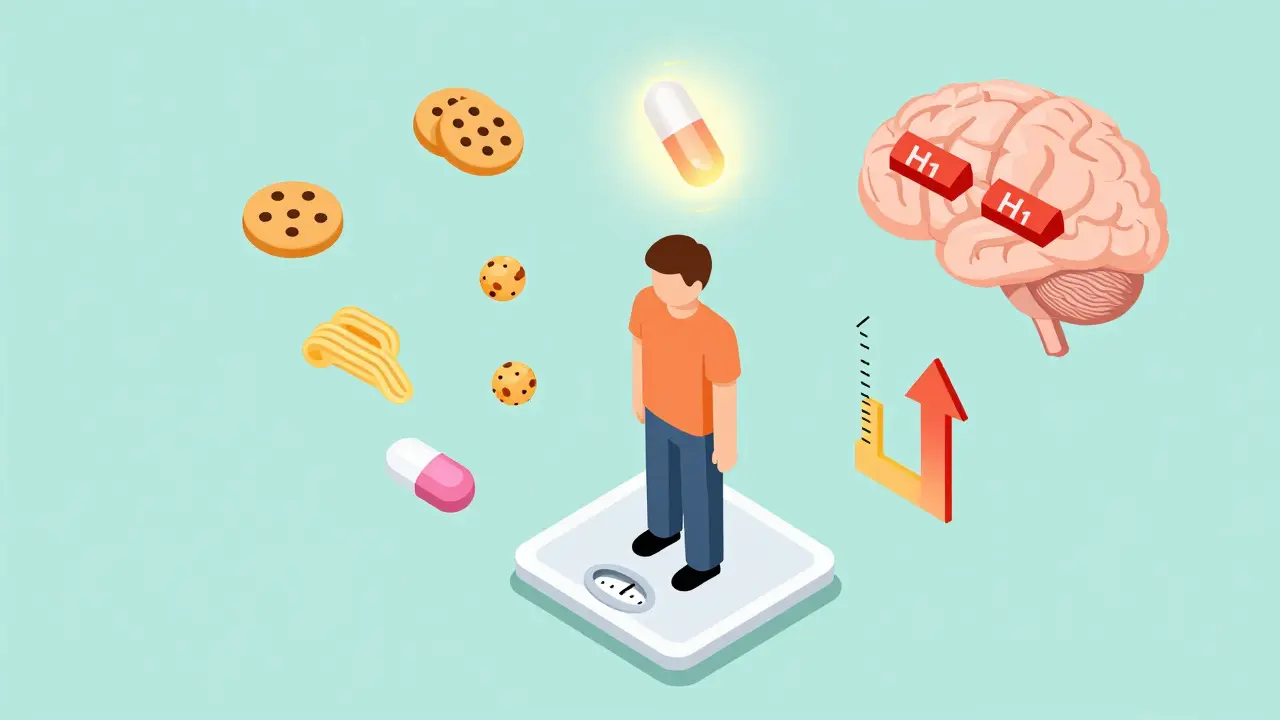
Mirtazapine, sold under the brand name Remeron, works by blocking certain receptors in your brain. One of those is the histamine H1 receptor. When this receptor is blocked, it triggers a powerful increase in hunger - especially for sugary, carb-heavy foods. A 2019 study found that even when people ate the same number of calories and stayed active, mirtazapine still made them crave sweets more than before. That’s not willpower. That’s biology.
But it’s not just hunger. Mirtazapine also changes how your body uses energy. It lowers your resting metabolic rate slightly - meaning you burn fewer calories just sitting still. At the same time, your body shifts toward storing more fat and using carbs as its main fuel source. One study showed a measurable increase in respiratory quotient (RQ), which means your body is preferring glucose over fat for energy. That’s a recipe for weight gain, even if your eating habits don’t change much.
Insulin levels rise too. A 2019 trial found mirtazapine increased insulin release by nearly 20% during glucose testing. Higher insulin means your body is more likely to store calories as fat instead of burning them. Triglycerides went up, HDL went down, and HbA1c - a marker for long-term blood sugar control - rose slightly. These changes happen fast, often within the first week, even before you gain noticeable weight.
How Much Weight Do People Actually Gain?
Numbers vary, but the data is clear: weight gain is common. About 25% of people taking mirtazapine gain 7% or more of their body weight - that’s 11 pounds or more for someone who weighs 150 pounds. In clinical trials, the average weight gain over six weeks was about 8 pounds. But here’s the twist: not everyone gains weight. Some gain 40 pounds. Others gain 4. Some even lose weight.
Why the big difference? Genetics, baseline metabolism, diet, activity level, and even the dose you’re on all play a role. A 2020 analysis of 21 antidepressants ranked mirtazapine second for weight gain - only behind paroxetine. It causes significantly more weight gain than sertraline, escitalopram, or bupropion (which can actually help you lose weight).
But don’t believe everything you read online. Some Reddit threads talk about 100-pound gains. Those are outliers. A survey of over 1,800 people in a dedicated mirtazapine support group found only 12% gained more than 20 pounds. Most people gain between 5 and 15 pounds in the first few months. After 12 weeks, the rate of gain slows down for most. It’s not a free-for-all. It’s a trend.
Mirtazapine Isn’t Just a Weight-Gain Drug - It’s a Lifesaver for Some
For people with cancer, eating disorders, or severe depression with appetite loss, mirtazapine can be a game-changer. A 2024 JAMA Oncology trial showed that cancer patients on mirtazapine ate nearly 20 grams more protein and 15 grams more fat per day than those on placebo. That’s huge when you’re trying to stay strong during chemo. One patient with pancreatic cancer said she gained 12 pounds in eight weeks - and that helped her finish treatment.
That’s why doctors still prescribe it. It’s not just about mood. It’s about survival. In palliative care, 28% of mirtazapine prescriptions are for appetite stimulation. In older adults, it’s one of the most common antidepressants because it helps with sleep and hunger - two things that often crash with depression in seniors.
So while weight gain is a problem for some, it’s a benefit for others. The key is knowing which side you’re on - and managing it accordingly.

Dose Doesn’t Always Mean More Weight Gain
You’ve probably heard that lower doses of mirtazapine are better for sleep and appetite, while higher doses are for depression. That’s partly true - but not because the drug works differently at different doses. The truth is, mirtazapine’s receptor binding doesn’t change much between 7.5 mg and 45 mg. Higher doses just cause more norepinephrine release, which can reduce the sedative effect. That’s why some people feel less drowsy on 30 mg than on 15 mg - not because the appetite effect is weaker.
But here’s the practical takeaway: lower doses often mean less weight gain. A 2017 study found that people on 7.5 mg gained 42% less weight over 12 weeks than those on 30 mg. If you’re worried about weight, starting low - even at 7.5 mg - might be the smartest move. You can always increase it later if your mood doesn’t improve.
What Can You Do About the Weight Gain?
You don’t have to just accept it. There are real, evidence-backed ways to reduce the impact.
- Time your dose. Take mirtazapine at night. The sedation helps you sleep, and it may reduce daytime cravings. A 2019 study found people who took it in the evening had fewer carb cravings than those who took it in the morning.
- Focus on protein. A 2022 pilot study showed that people who ate 1.2 to 1.6 grams of protein per kilogram of body weight each day gained 63% less weight than those who didn’t. Protein keeps you full longer and helps preserve muscle mass while you’re gaining fat.
- Track your weight monthly. The American Psychiatric Association recommends checking your weight, waist size, and blood pressure every month for the first three months. Catching a trend early lets you adjust before it becomes a problem.
- Move your body. Even light activity - walking 30 minutes a day - can help offset the drop in resting metabolism. You don’t need to run marathons. Just keep moving.
There’s also new research on combining mirtazapine with low-dose naltrexone. Early results from a National Institute of Mental Health trial show this combo cuts weight gain in half - without hurting the antidepressant effect. It’s still experimental, but it’s a sign that solutions are coming.

When Should You Worry?
Weight gain isn’t the only metabolic concern. Mirtazapine can raise triglycerides and lower HDL cholesterol - even without weight gain. That’s a red flag for heart disease risk. If your fasting triglycerides jump by more than 20% after a few months, talk to your doctor. The European Medicines Agency now requires quarterly blood tests for anyone on mirtazapine longer than 12 weeks.
If you’re gaining weight fast - more than 10 pounds in two months - or if your blood sugar, cholesterol, or blood pressure changes, don’t wait. Ask about alternatives. There are other antidepressants that won’t make you gain weight. Bupropion is one. Vortioxetine is another. Sertraline and escitalopram are much gentler on the scale.
But don’t quit mirtazapine cold turkey. Depression can come back harder. Work with your doctor to adjust, switch, or add support.
The Bottom Line
Mirtazapine works. For many, it’s the only antidepressant that helps with sleep, appetite, and mood all at once. But it comes with a cost: weight gain. It’s not a flaw in your discipline. It’s a biological effect of the drug. The good news? You can manage it. You don’t have to let it take over your health.
Start low. Eat more protein. move daily. Monitor your numbers. Talk to your doctor before making any changes. And remember - this isn’t a life sentence. If the weight gain becomes too much, there are other options. Mirtazapine is a tool, not a trap. Use it wisely, and it can still be part of your recovery - not your setback.

Comments (14)
vishnu priyanka
13 Jan 2026
Man, I took this for insomnia and gained 18 lbs in 3 months. Thought I was just lazy, turns out my brain was screaming for donuts. Biology is a cruel joke sometimes. 🤷♂️
Scottie Baker
15 Jan 2026
Stop blaming the drug. You just got weak. I’ve been on mirtazapine for 5 years. I lift. I track macros. I don’t gain weight. It’s not the med, it’s you.
Anny Kaettano
16 Jan 2026
As a psych NP, I see this daily. The H1 antagonism is the primary driver, but don’t overlook the orexin modulation and ghrelin upregulation. Protein intake >30g/meal and circadian-aligned dosing (always nocturnal) can mitigate 60-70% of the metabolic shift. Also-avoid liquid carbs. They bypass satiety signaling hard.
Rosalee Vanness
18 Jan 2026
I was skeptical at first, but after 11 months on 15mg, I’ve only gained 7 lbs-and I’m a 5’2” grandma who eats pasta like it’s oxygen. The key? I started drinking 2L of water before dinner. It cuts the midnight snacking. Also, I switched to black coffee in the morning instead of sugary tea. Small things. But they stack. I didn’t ‘fight’ it-I adapted. And honestly? My sleep’s never been better. Worth it.
mike swinchoski
18 Jan 2026
People are so weak. If you can’t control your eating, don’t take the pill. Just go eat a whole cake and call it therapy. You’re not sick, you’re lazy. Get a life.
Milla Masliy
20 Jan 2026
My mom took this after my dad passed. She gained 20 lbs, but she started eating again. That’s more than I can say for the other 3 antidepressants she tried. Sometimes the weight gain is the price of being alive.
sam abas
21 Jan 2026
lol so mirtazapine causes weight gain? shocker. next you’ll tell me water is wet. also the study they cited? 2019? bro that’s ancient. i read a 2023 meta-analysis that showed the effect is mostly in the first 8 weeks and plateaus. also-did they control for baseline BMI? no. so it’s all noise. also-naltrexone combo? sounds like pharma’s next cash grab. i’ll stick to my 20mg sertraline and my 6 pack.
Nelly Oruko
22 Jan 2026
Weight gain ≠ failure. Biological adaptation ≠ moral lapse. This isn’t about discipline. It’s about neurochemistry. We need less shaming, more science.
Angel Tiestos lopez
23 Jan 2026
bro i took 7.5mg for 2 weeks and gained 5 lbs. i thought i was just bloated. then i realized-my brain was ordering pizza at 2am like it had a subscription. 🍕😭 i switched to bupropion. lost it all. 10/10 would recommend. also i now cry less. win-win.
Acacia Hendrix
24 Jan 2026
The RQ shift is statistically significant (p<0.01), but the clinical relevance is questionable. Most studies lack adequate control for dietary compliance. The insulin elevation is transient in normoglycemic individuals. The real issue is confounding by sedentary behavior and polysubstance use. Also, 7.5mg is not ‘low dose’-it’s the minimum effective dose for H1 blockade. Higher doses engage 5-HT2C antagonism, which may attenuate weight gain. The literature is deeply flawed.
Adam Rivera
25 Jan 2026
Just wanna say-this post saved me. I was about to quit mirtazapine because I felt like a failure. Turns out my body’s just doing what it’s told. I’m trying the protein thing and walking after dinner. No judgment here. We’re all just trying to survive.
Trevor Whipple
26 Jan 2026
you guys are overthinking this. just eat less. done. problem solved. stop making excuses. i’ve been on this med for 3 years. i lost 15lbs. you just suck at willpower.
Lethabo Phalafala
27 Jan 2026
My sister took this after her miscarriage. She gained 30 pounds. She didn’t care. She said, ‘At least I’m alive. At least I can eat.’ I cried reading that. This isn’t just a drug. It’s a lifeline for people who’ve lost everything. Don’t reduce it to a number on a scale.
Alan Lin
28 Jan 2026
Thank you for this comprehensive, evidence-based overview. As a clinician, I am consistently dismayed by the reductionist narratives surrounding psychopharmacology. The metabolic impact of mirtazapine must be contextualized within its unique therapeutic profile-particularly in populations with cachexia, anorexia nervosa, or geriatric depression. A one-size-fits-all approach to antidepressant selection is not only clinically unsound-it is ethically indefensible. I commend the author for presenting nuance in an era of algorithmic simplification.