
PSA Screening Controversies: Why Shared Decision-Making Matters for Prostate Cancer
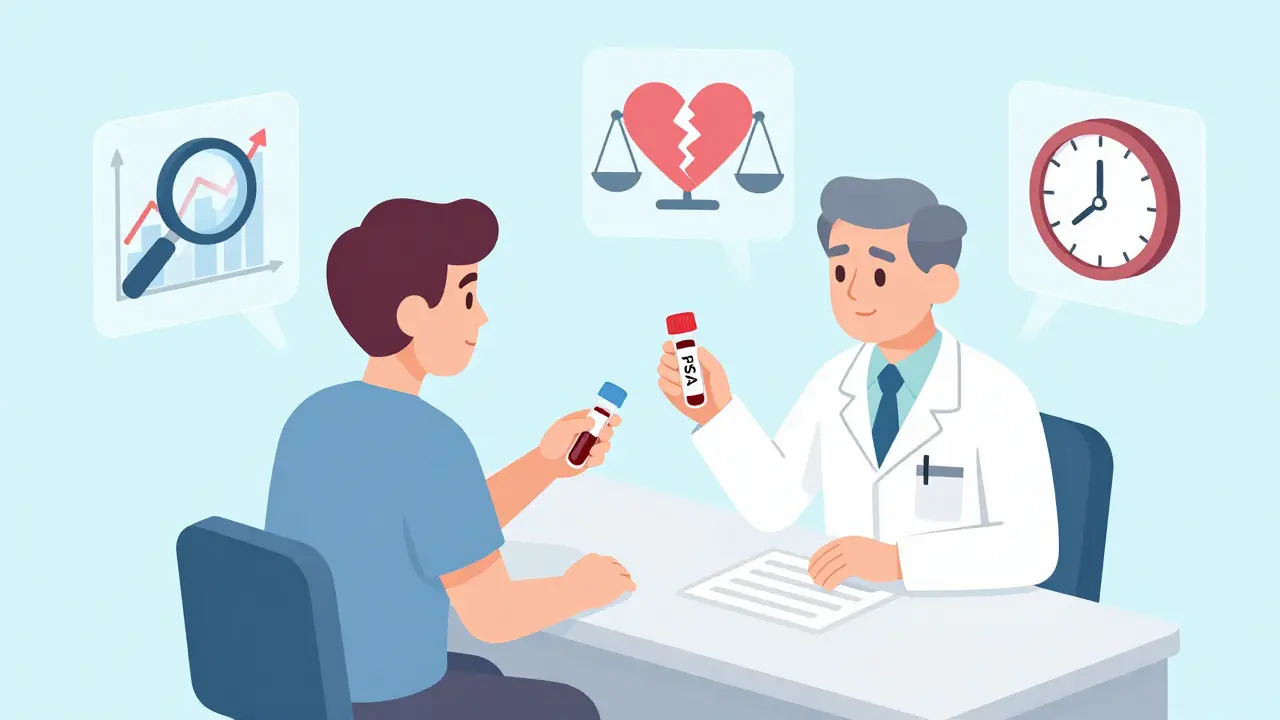
PSA screening isn’t as simple as it seems
Most men over 50 have heard about the PSA test. It’s a simple blood draw, quick and painless. But behind that routine checkup lies a medical debate that’s divided doctors, confused patients, and changed how we think about early cancer detection. The truth? Getting a PSA test doesn’t mean you’re doing the right thing-it means you’ve started a conversation that needs real attention.
What PSA screening actually tells you
The PSA test measures prostate-specific antigen, a protein made by the prostate gland. When levels rise, it can mean cancer-but it can also mean a swollen prostate, an infection, or even a long bike ride. About 75% of men with PSA levels between 4.0 and 10.0 ng/mL don’t have cancer. That’s not a false alarm-it’s the norm.
And here’s the twist: 15% of men with aggressive prostate cancer have PSA levels below 4.0. So a low number doesn’t guarantee safety. The test isn’t broken-it’s just not precise enough to be used alone. That’s why doctors now look at trends: how fast PSA rises over time, how it compares to prostate size, and whether other markers like free PSA or 4Kscore are elevated.
The numbers no one talks about
For every 1,000 men aged 55 to 69 who get screened yearly for 10 years:
- 1 to 2 prostate cancer deaths are prevented
- 100 to 120 men get false-positive results and go through unnecessary biopsies
- 80 to 100 men are diagnosed with cancers that would never have caused harm
That last part is the heart of the controversy. Many of these cancers grow so slowly they’d never be found without screening. But once detected, they often lead to surgery, radiation, or hormone therapy-all of which carry risks of incontinence, impotence, and bowel problems. The Prostate Cancer Research Institute estimates that between 17% and 50% of diagnosed cases are overdiagnosed. That means thousands of men every year undergo brutal treatments for cancers that were never going to hurt them.
What the big studies really showed
Two massive studies, one in Europe and one in the U.S., gave conflicting answers. The European Randomized Study of Screening for Prostate Cancer (ERSPC) found a 21% drop in prostate cancer deaths among screened men. But the U.S.-based PLCO trial found no benefit at all. Why the difference? In PLCO, many men in the control group got PSA tests anyway-so the comparison wasn’t clean. Still, both studies agree on one thing: the benefit is small, and the harms are real.
The U.S. Preventive Services Task Force (USPSTF) flipped its stance twice because of this. In 2012, they said don’t screen. In 2018, they said: only if you’ve talked it through. Now they recommend screening only for men 55 to 69 after a full discussion. For men over 70? The risks outweigh the benefits. That’s not a blanket rule-it’s a recognition that age, health, and personal values matter.
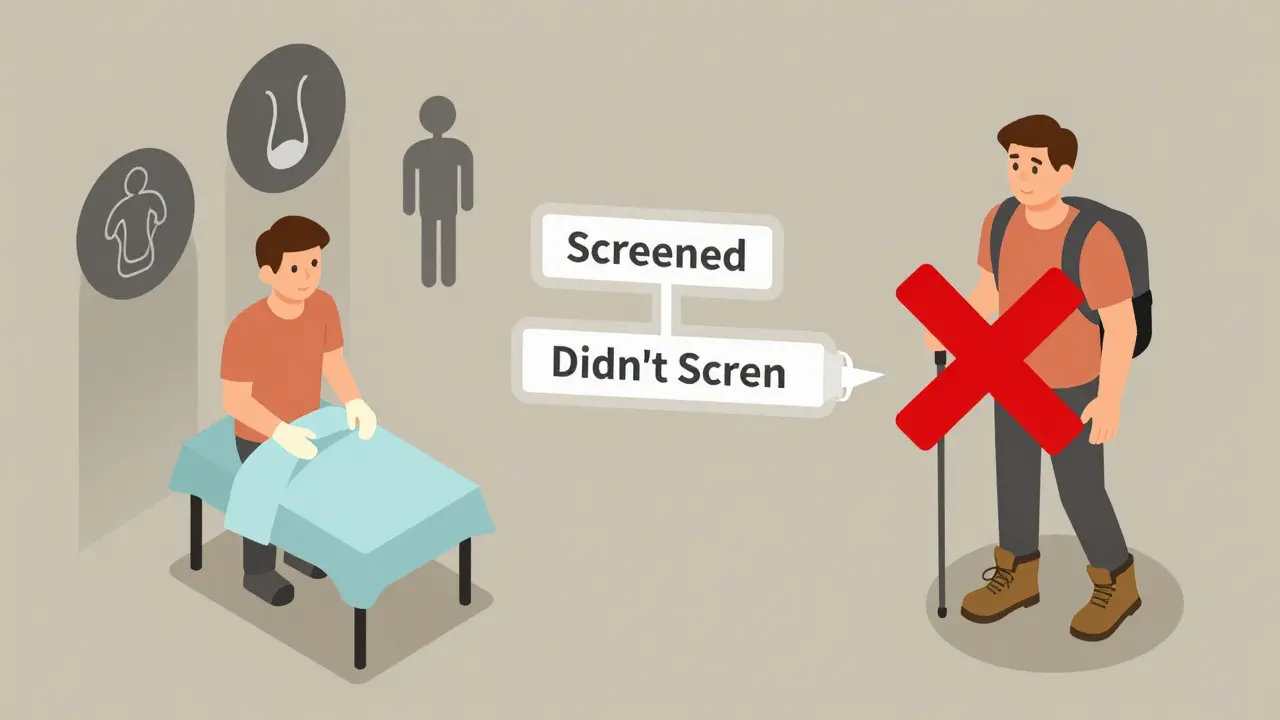
Shared decision-making isn’t a buzzword-it’s a requirement
Doctors used to say, “Get your PSA test.” Now, guidelines from the American Cancer Society, American Urological Association, and American College of Physicians all say the same thing: shared decision-making must come first.
That means a conversation-not a sales pitch. It means explaining that PSA screening can save a life… but it can also ruin one. It means asking: What are you afraid of? What are you willing to live with? Some men want to catch cancer early at any cost. Others would rather avoid the fear and side effects of treatment unless they absolutely must.
Real shared decision-making includes tools like the Ottawa Personal Decision Guide or the Mayo Clinic’s visual risk calculator. These show men, in plain terms, what the odds really are. One study found that using these tools reduced decisional conflict by 35%. Men who used them were less likely to regret their choice-even if they chose not to screen.
What’s replacing PSA? Not much… yet
There are better tests out there. The 4Kscore test combines four blood markers and clinical data to predict high-risk cancer with 95% accuracy. Multiparametric MRI can scan the prostate before biopsy, reducing unnecessary procedures by 27%. Genomic tests like Oncotype DX and Prolaris can tell you if a diagnosed cancer is likely to spread-or stay harmless.
But they’re expensive. A PSA test costs $20 to $50. A 4Kscore? $400 to $600. Genomic tests? Up to $4,000. Most insurance plans won’t cover them unless PSA is already high. So for now, PSA is still the gateway. The goal isn’t to ditch it-it’s to use it smarter. Baseline PSA at age 45 can help predict future risk. Men with levels under 1.0 ng/mL may never need another test. Those with higher levels? They need more frequent checks and better follow-up tools.
Why some men are being left behind
African American men are 70% more likely to get prostate cancer and more than twice as likely to die from it. Yet they’re 23% less likely to have a proper shared decision-making conversation before screening. Why? Time. Bias. Lack of access. A 2022 study found primary care doctors spend just 3.7 minutes on PSA discussions on average-far less than the 15 to 20 minutes experts recommend.
And it’s not just about race. Men in rural areas, those without regular doctors, or those with low health literacy are less likely to get the full picture. This isn’t a medical failure-it’s a system failure. Screening only works if everyone understands what they’re signing up for.
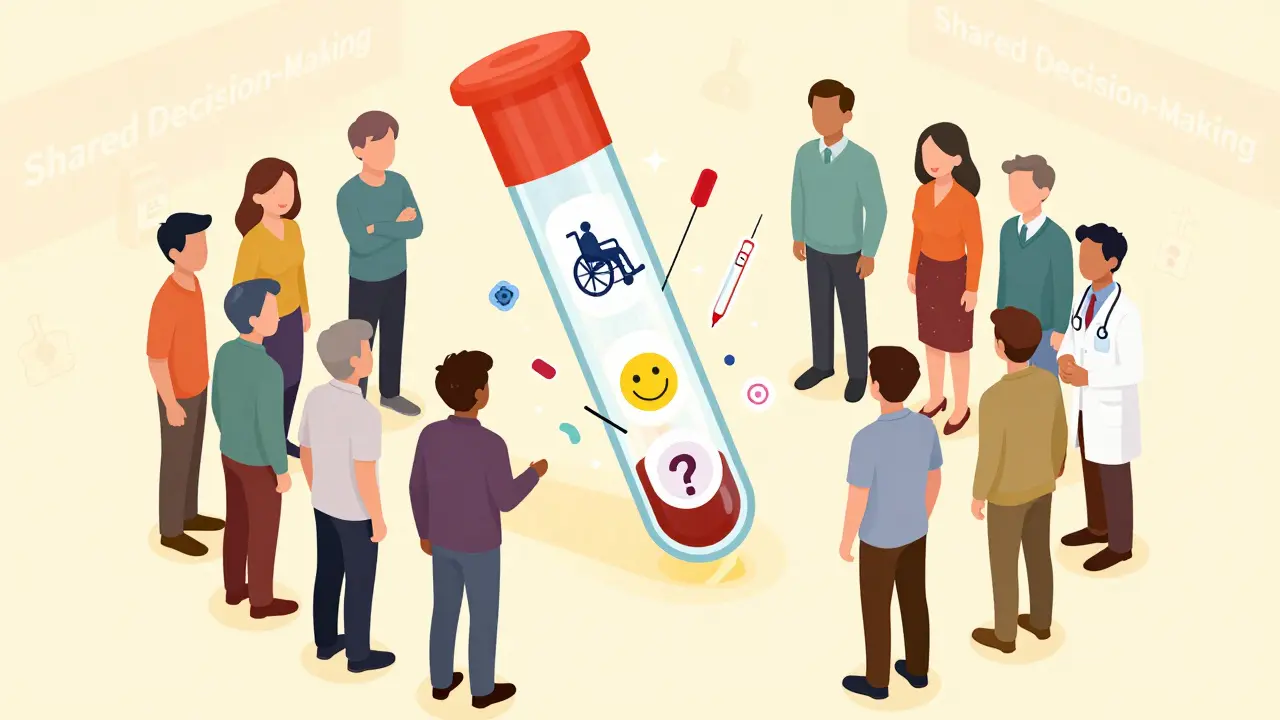
What happens when you skip the talk?
One man, 62, got a PSA of 4.7. His doctor said, “Let’s biopsy.” He had surgery. Three months later, he was incontinent and impotent. The cancer? Low-grade. It would’ve never spread. He told his story on Reddit: “I thought I was being proactive. I didn’t know I was being misled.”
Another man, 59, refused screening for years. Then he got sudden back pain. He was diagnosed with stage IV prostate cancer that had spread to his spine. He’s on hormone therapy now. “If I’d known PSA could catch it early,” he said, “I’d have pushed for it.”
Both stories are real. Both men made decisions based on incomplete information. That’s what happens when shared decision-making is skipped.
What should you do?
If you’re a man between 55 and 69:
- Ask your doctor: “What are the chances this test will save my life?”
- Ask: “What are the chances it will lead to treatment I don’t need?”
- Ask: “What are the side effects of treatment?”
- Ask: “Can we check my baseline PSA now, so we know where to start?”
- Ask: “Do you use a decision aid to help explain this?”
If you’re under 55 or over 70, ask: “Is there any reason, based on my family history or race, that I should be screened?”
If you’ve already had a PSA test and don’t know the results, get them. If you don’t remember the conversation you had, ask for it again. You have the right to understand what you’re agreeing to.
The future is smarter screening-not more screening
Researchers are working on AI tools that predict prostate cancer risk from routine blood tests. New PSA variants like IsoPSA claim 92% accuracy for detecting aggressive cancer. The BARCODE1 study is testing whether genetic markers can identify men who benefit most from screening.
But none of these tools replace the need for a conversation. Even the best test can’t tell you what you’re willing to live with. That’s still yours to decide.
Final thought
PSA screening isn’t good or bad. It’s a tool-with limits. And like any tool, it’s only as good as the person using it. The real breakthrough isn’t a new test. It’s a new way of talking. When men understand the trade-offs, they make better choices. And when doctors stop pushing and start listening, screening stops being a gamble and starts being a partnership.
Is PSA screening still recommended?
Yes-but only for men aged 55 to 69 after a full discussion with their doctor. For men under 55 or over 70, routine screening isn’t recommended unless there’s a strong family history or other risk factors. The U.S. Preventive Services Task Force gives it a Grade C recommendation: the benefit is small, but may be worth it for some men.
What’s the best PSA level to worry about?
There’s no single number. Traditional cutoffs were 4.0 ng/mL, but modern guidelines use age-specific ranges: 2.5 for men 40-49, 3.5 for 50-59, 4.5 for 60-69, and 6.5 for 70+. More important than the number is how fast it rises over time. A rise of more than 0.75 ng/mL per year is a red flag. Baseline PSA at age 45 can also help predict future risk.
Can a PSA test miss prostate cancer?
Yes. About 15% of men with aggressive prostate cancer have PSA levels below 4.0 ng/mL. That’s why some doctors now use additional tools like multiparametric MRI or biomarker tests (like 4Kscore) to improve detection. A normal PSA doesn’t guarantee you’re cancer-free.
Why do some doctors still push PSA screening?
Some doctors are used to the old way of doing things. Others worry about missing a case or facing legal liability. But guidelines have changed. The American Cancer Society and other major groups now say it’s unethical to screen without discussing risks and benefits. If your doctor doesn’t bring up shared decision-making, ask for it.
What if I don’t want to get screened?
You have every right to refuse. Many men choose not to screen because they don’t want to risk unnecessary treatment. That’s a valid decision. The key is making it based on facts, not fear. Ask your doctor to explain what you’re choosing to avoid-and what you’re choosing to accept.
Are there alternatives to PSA testing?
Yes. Multiparametric MRI can detect suspicious areas in the prostate without a biopsy. Tests like 4Kscore, PCA3, and IsoPSA offer better accuracy than traditional PSA. Genomic tests like Oncotype DX help determine if a diagnosed cancer is aggressive. But these are usually used after PSA raises a flag-not as replacements yet. They’re more expensive and not always covered by insurance.


Comments (9)
Kelly Mulder
19 Dec 2025
The notion that PSA screening is a benign, low-stakes intervention is not merely misleading-it is a catastrophic epistemological failure of modern medicine. We have normalized statistical noise as clinical signal, and in doing so, we have weaponized anxiety against the very populations we claim to protect. The 75% false-positive rate isn’t a flaw-it’s a feature of a system designed to extract revenue, not wisdom. And yet, we call this ‘preventive care’? Please.
Shared decision-making is the velvet glove on the iron fist of corporate healthcare. It sounds noble until you realize it’s a legal shield for physicians who still push the test because they’re terrified of malpractice. The Ottawa Decision Guide? A PowerPoint slide dressed as ethics. The real question isn’t whether men understand the trade-offs-it’s whether the system wants them to.
And let’s not pretend the racial disparities are accidental. Black men are 70% more likely to die from prostate cancer? Of course they are. They’re also 23% less likely to be given the time of day by a doctor who sees them as statistically expendable. This isn’t a screening problem. It’s a dehumanization problem.
Let me be clear: the only ethical choice is to abolish population-based PSA screening entirely. Until we replace it with truly predictive, equitable, and accessible biomarkers-none of which currently exist at scale-we are not saving lives. We are performing medical theater on the backs of the vulnerable.
And don’t get me started on the 4Kscore test. $600 to tell you what a $20 test already hinted at? That’s not innovation. That’s rent-seeking dressed in white coats.
Dominic Suyo
20 Dec 2025
Oh, sweet merciful hell. Another ‘nuanced take’ on PSA screening that reads like a medical school essay written by someone who’s never met a man who actually had to live with the consequences.
Let me break it down for you in plain English: PSA is a lottery ticket where you pay $20 and get a 1 in 5 chance of getting your dick permanently ruined by a cancer you didn’t even know you had. And the ‘benefit’? Two lives saved per 1,000 men. Two. That’s less than the number of people who die from getting a flu shot.
Meanwhile, 100+ men get biopsied like they’re being hunted in a goddamn video game. And for what? So some urologist can hit his quarterly quota? So a hospital can bill for a $12,000 procedure that’s 80% unnecessary?
The real scandal isn’t that the test is flawed-it’s that the entire prostate cancer industrial complex is built on fear, inertia, and the pathetic human need to ‘do something’ even when ‘nothing’ is the only rational choice.
And don’t give me that ‘shared decision-making’ crap. I’ve sat in those rooms. The doctor says ‘it’s your choice’ while subtly implying you’re a coward if you say no. That’s not autonomy. That’s emotional blackmail with a stethoscope.
Janelle Moore
20 Dec 2025
Did you know the FDA approved PSA tests without any real clinical trials? I looked it up. They just said ‘it’s a protein’ and called it a day. And now we’re all being guinea pigs. I heard a guy on YouTube say the government is using PSA to track men’s health for the New World Order. He said they want to control who lives and who dies. I don’t know if that’s true but I’m not taking the test anymore. My cousin’s uncle got prostate cancer after a PSA and now he’s on chemo and can’t pee. That’s not science. That’s a trap.
Also, why do doctors always say ‘it’s just a blood test’? If it’s just a blood test, why do they get so nervous when you say no? They’re hiding something. I’m not the only one who thinks this. My neighbor’s dog barks every time the clinic van pulls up. That’s not coincidence. That’s a sign.
Henry Marcus
22 Dec 2025
Okay, let’s get real for a second: the entire PSA debate is a distraction. The real issue? The pharmaceutical industry owns the narrative. They fund the studies. They pay the ‘experts.’ They lobby the USPSTF. And they profit from every biopsy, every surgery, every hormone shot. The 4Kscore? A $600 cash grab. The MRI? A $2,500 cash grab. The ‘decision aids’? Glorified brochures printed by Pfizer’s marketing team.
Meanwhile, the only thing that’s been proven to reduce prostate cancer mortality? Diet. Exercise. Vitamin D. Sunlight. Not PSA. Not biopsies. Not algorithms. Just living like a human being.
And yet, no one talks about that. Why? Because you can’t patent broccoli. You can’t patent walking. But you can patent a blood test and sell it for a billion dollars.
PSA isn’t broken. The system is. And the system doesn’t want you to know that.
Also, I’ve seen the data. The ‘low-grade’ cancers? They’re not harmless. They’re just waiting. Like a bomb with a slow timer. And if you don’t catch it early, you’re dead. So don’t tell me ‘overdiagnosis’ is the real problem. It’s the lack of better tools that’s the problem.
And if you think doctors are ‘pushing’ PSA because of fear of lawsuits-then why don’t they push mammograms the same way? Hmmm? Why is prostate cancer the only one where we’re told to ‘think about it’? Because men are disposable. That’s why.
Carolyn Benson
24 Dec 2025
There’s a deeper philosophical question here that no one dares to ask: What does it mean to be alive if your life is defined by the fear of a number? The PSA test doesn’t detect cancer-it detects anxiety. It turns the body into a data point, and the man into a statistic. We’ve outsourced our mortality to a lab report.
And yet, we treat the result as if it holds divine truth. A rise of 0.75 ng/mL per year? A red flag? That’s not medicine. That’s numerology. We’ve replaced intuition with algorithms, and now we’re shocked when the algorithm fails.
But here’s the real tragedy: men are not being given the freedom to be uncertain. We’ve created a culture where not acting is seen as negligence. Where silence is interpreted as ignorance. Where refusing a test is equated with suicide.
What if the most courageous act isn’t getting screened-but saying, ‘I refuse to let my life be governed by a number I don’t understand?’
Maybe the real breakthrough isn’t a better test. Maybe it’s a better relationship with uncertainty. With mortality. With the fact that we don’t get to control everything-even when we think we do.
Chris porto
24 Dec 2025
I’ve been a primary care doc for 22 years. I’ve seen both sides.
One guy, 61, got a PSA of 8.5. Biopsy showed low-grade cancer. He chose active surveillance. Five years later, still fine. No surgery. No side effects. Just regular checkups.
Another guy, 68, refused the test. Came in with back pain. Stage IV. Spine metastases. Now he’s on hormone therapy and can’t walk without help.
Neither was ‘right.’ Neither was ‘wrong.’ They just had different values.
My job isn’t to push the test. My job is to make sure they know what they’re getting into. I use the Mayo calculator. I show them the numbers. I say: ‘If you’re the kind of guy who wants to catch it early, even if it means risking impotence-I’ll help you. If you’d rather live without the fear, even if it means a higher risk down the road-I’ll respect that.’
Most men just need someone to sit with them while they think. Not a brochure. Not a guideline. Just a conversation.
And yeah, I know it takes time. But it’s worth it. Because when a man walks out of here knowing what he chose, he’s not just healthier-he’s freer.
holly Sinclair
26 Dec 2025
It’s fascinating how we treat cancer like a villain to be hunted down at all costs, when in reality, it’s often just a biological glitch-like gray hair or wrinkles-that happens as we age. We don’t screen for every cell mutation in the body. Why prostate cancer? Because it’s visible. Because it’s ‘manly.’ Because we’re afraid of dying with dignity.
But here’s the uncomfortable truth: we’re not trying to prevent death. We’re trying to prevent the *idea* of death. PSA screening is less about medicine and more about denial. We want to believe that if we just test enough, we can cheat time.
And yet, the science says: no. You can’t cheat time. You can only delay it, at great cost.
So why do we keep doing it? Because we’ve been taught that health means control. That wisdom means intervention. That courage means action.
But what if true courage is accepting that some things are beyond our grasp? What if wisdom is knowing when to let go?
Maybe the most profound medical decision isn’t whether to screen-but whether to stop treating aging like a disease.
I don’t have a PSA test. I don’t need one. I’m not afraid of dying. I’m afraid of living a life defined by fear of dying.
And if that makes me reckless? Good. At least I’m alive.
Monte Pareek
26 Dec 2025
Let me cut through the noise. PSA screening isn’t about cancer. It’s about agency.
Men are told to ‘be proactive.’ But no one tells them what that actually means. So they get the test because it’s expected. Because their dad had it. Because their buddy got it. Because the doctor said ‘it’s just a blood test.’
That’s not proactive. That’s passive. That’s surrendering your choice to habit.
Real agency? It’s asking the five questions in the post. It’s saying, ‘I want to know the odds.’ It’s walking into that room with your eyes open.
And if your doctor doesn’t have the time? Find one who does. Or print out the Ottawa Decision Guide. Bring it in. Say, ‘I want to make an informed choice. Can we go through this together?’
Most docs will be surprised. But they’ll respect you.
And if you’re Black? If you’re rural? If you’re low-income? You deserve this conversation just as much as anyone else. Demand it. Write to your clinic. Call your rep. This isn’t just about prostate cancer. It’s about whether your life matters enough to be explained to you.
Don’t wait for permission. You already have the right to know.
And if you’re over 70? Then maybe your time is better spent hiking with your grandkids than sitting in a urologist’s office. But only if you chose that. Not because someone told you to.
That’s the real win.
Not a lower PSA.
A clearer conscience.
Tim Goodfellow
26 Dec 2025
PSA is a trap. Don't get it.