
Selegiline Transdermal and Serotonergic Drugs: How to Avoid Dangerous Interactions
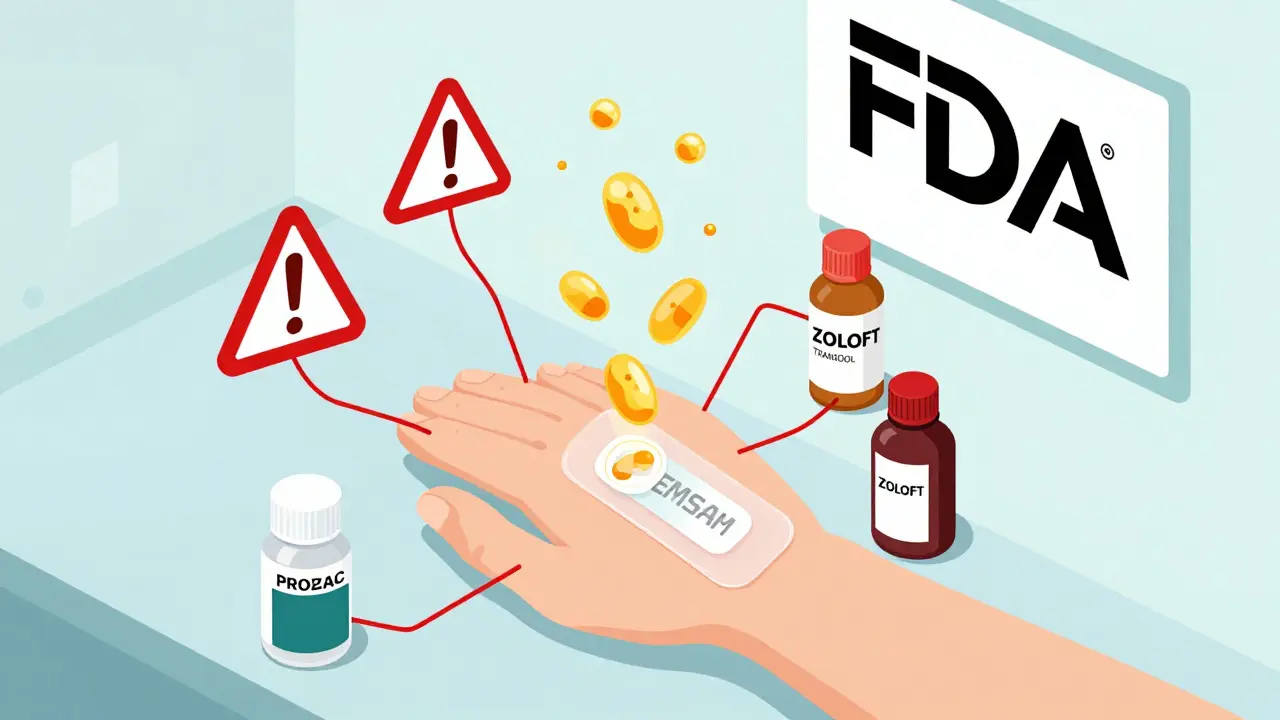
Selegiline transdermal, sold under the brand name EMSAM, is one of the few antidepressants that works differently from the rest. Instead of being swallowed as a pill, it’s delivered through a patch worn on the skin. This method was designed to make it safer - especially when it comes to food restrictions. But here’s the catch: selegiline transdermal still carries a serious, potentially deadly risk when mixed with common serotonergic drugs. And too many people don’t realize it.
Why Selegiline Transdermal Is Different - But Not Safe
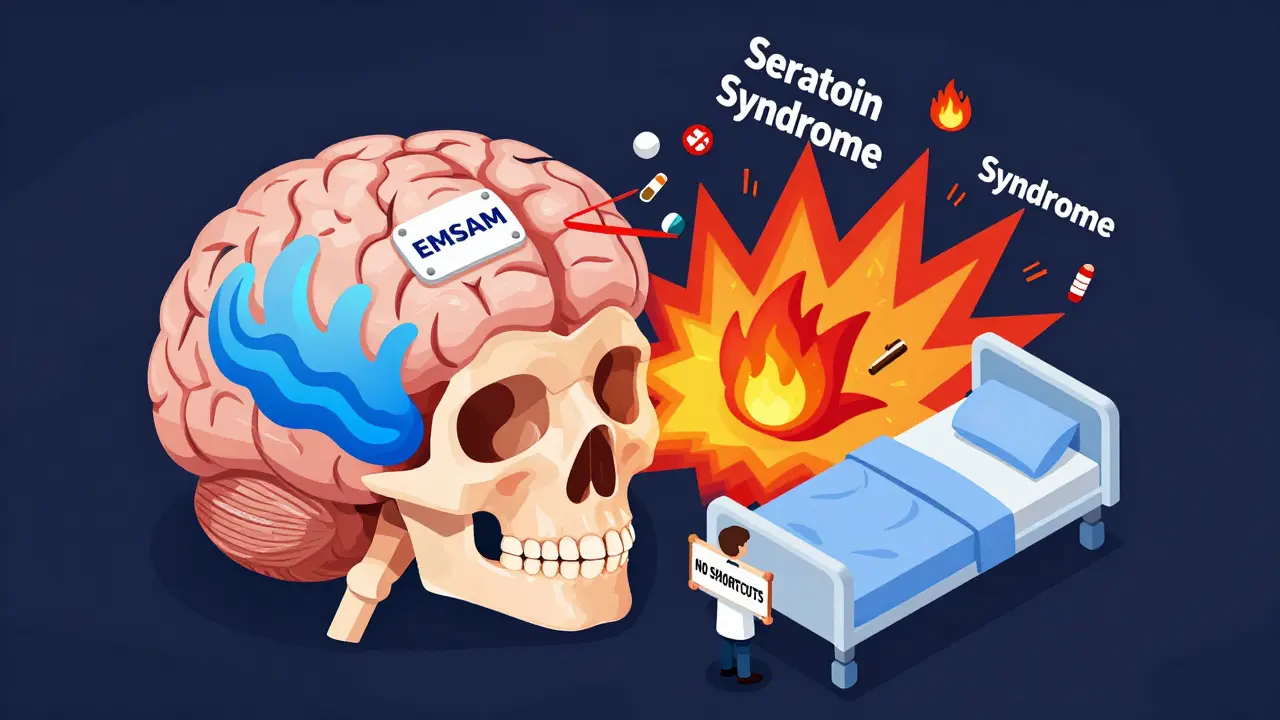
Unlike older oral MAOIs, the transdermal patch avoids most of the digestive system. At the lowest dose (6 mg/24 hours), it barely touches the MAO-A enzyme in your gut. That’s why you don’t need to avoid aged cheese, red wine, or cured meats anymore. No more scary ‘cheese effect’ blood pressure spikes. But that doesn’t mean you’re safe from other dangers. The patch still delivers selegiline into your bloodstream, where it crosses into your brain. There, it blocks MAO-A - the enzyme that breaks down serotonin. When serotonin builds up too much, you risk serotonin syndrome. This isn’t just a side effect. It’s a medical emergency. Symptoms include high fever, rapid heartbeat, muscle stiffness, confusion, seizures, and in severe cases, coma or death. The FDA added a black box warning to EMSAM for this reason. Even though it’s a patch, it’s not a gentle drug. And mixing it with other serotonin-boosting medications? That’s playing with fire.Which Drugs Can Trigger Serotonin Syndrome With EMSAM?
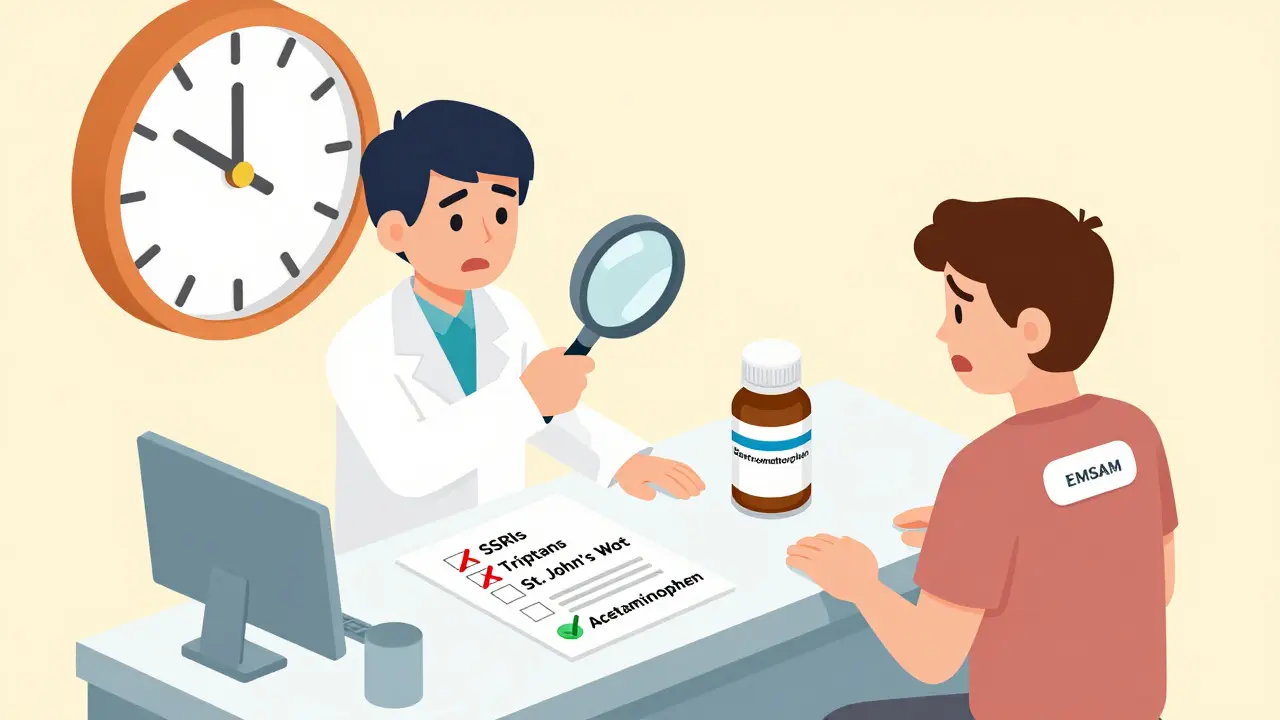
You might think only antidepressants are dangerous. They’re not. Many everyday medications can set off a reaction. Here’s the full list of drugs you must avoid while using EMSAM:- SSRIs: fluoxetine (Prozac), sertraline (Zoloft), escitalopram (Lexapro)
- SNRIs: venlafaxine (Effexor), duloxetine (Cymbalta)
- Tricyclic antidepressants: amitriptyline, nortriptyline
- Triptans: sumatriptan (Imitrex), rizatriptan (Maxalt) - used for migraines
- Tramadol - a painkiller many people take for back pain or arthritis
- Dextromethorphan - the active ingredient in many cough syrups and cold meds
- Buspirone - an anti-anxiety drug
- St. John’s Wort - a popular herbal supplement for mild depression
- Tryptophan - sold as a sleep aid or mood booster
- Linezolid - an antibiotic sometimes used for stubborn infections
- Intravenous methylene blue - used in some surgeries and for rare blood conditions
Washout Periods: The Only Way to Switch Safely
If you’re switching from another antidepressant to EMSAM - or vice versa - you can’t just stop one and start the other the next day. You need a washout period. This is not a suggestion. It’s a requirement. Here’s what the FDA and updated guidelines say:- After stopping EMSAM before starting an SSRI/SNRI: Wait at least 14 days. For fluoxetine (Prozac), wait 5 weeks.
- After stopping an SSRI/SNRI before starting EMSAM: Wait 2 weeks. For fluoxetine, wait 5 weeks.
- After stopping tramadol, triptans, or dextromethorphan before EMSAM: Wait 2 weeks.
- After stopping St. John’s Wort or tryptophan before EMSAM: Wait 2 weeks.
What Happens If You Mix Them Anyway?
Serotonin syndrome doesn’t always come on slowly. In clinical case studies, symptoms appeared within 24 to 72 hours after adding a serotonergic drug to EMSAM. In one series of 12 documented cases over five years, three involved EMSAM. All three patients were on the 12 mg dose. One had mild symptoms. Two needed ICU care. Symptoms to watch for:- High fever (over 101°F)
- Fast heartbeat or irregular pulse
- Shaking, twitching, or rigid muscles
- Confusion, agitation, hallucinations
- Nausea, vomiting, diarrhea
- Sweating, dilated pupils
- Loss of coordination
Why Doctors Still Get This Wrong
A 2023 survey of patients on EMSAM found that 68% were never properly warned about drug interactions. Many were told, “You don’t need to avoid cheese, so you’re fine.” That’s dangerously misleading. Even electronic health record systems often miss these interactions. A 2020 study found that nearly 60% of hospital EHRs didn’t flag critical combinations like EMSAM + tramadol or EMSAM + dextromethorphan. That means a doctor might click “approve” on a prescription without ever seeing the warning. The FDA had to issue a Drug Safety Communication in May 2022 specifically reminding doctors: “The absence of dietary restrictions at the 6 mg dose does not equate to absence of drug-drug interaction risks.”How to Protect Yourself
If you’re prescribed EMSAM, here’s what you need to do:- Make a full list of every medication you take. Include pills, patches, supplements, and over-the-counter drugs. Don’t leave out cough syrup or sleep aids.
- Bring this list to every doctor visit. Even if you’re seeing a dermatologist or dentist. Tell them you’re on EMSAM.
- Ask before taking anything new. Even a single dose of a cold medicine can be risky.
- Know the symptoms of serotonin syndrome. If you feel off after starting a new drug, don’t ignore it.
- Keep emergency contact info handy. Write down your psychiatrist’s number and your local ER’s phone number. Put it on your phone and in your wallet.
The Bigger Picture: Why This Drug Still Matters
EMSAM isn’t for everyone. It’s expensive. It’s not first-line. But for people who’ve tried four or five antidepressants and still aren’t better, it can be life-changing. In 2022, it made $132 million in U.S. sales - small compared to the whole antidepressant market, but vital for those who need it. Its niche is treatment-resistant depression. And that’s exactly why the risks must be managed so carefully. You’re not taking it because it’s easy. You’re taking it because nothing else worked. That means you need to be extra smart about how you use it. A new diagnostic test is in development - one that could tell if your genes make you more sensitive to MAO inhibition. That might help personalize safety in the future. But for now, the rules are simple: no mixing. No shortcuts. No assumptions.What If You Accidentally Mix Them?
If you took a cough medicine with dextromethorphan while wearing your EMSAM patch - stop it immediately. Call your doctor. If you’re feeling any of the symptoms listed above, go to the ER. Don’t wait until tomorrow. Don’t wait until morning. There’s no antidote for serotonin syndrome. Treatment is supportive: cooling you down, controlling your heart rate, giving sedatives, and sometimes paralyzing you so your body can reset. The sooner you get help, the better your chance of survival.Final Reminder
Selegiline transdermal is not a safer MAOI. It’s a different delivery system. It reduces one risk - dietary tyramine - but leaves the other one fully intact: drug interactions. The patch doesn’t make you invincible. It doesn’t erase the danger. It just changes how it shows up. If you’re on EMSAM, treat every new medication like a potential landmine. Ask. Double-check. Confirm. Your life depends on it.Can I use EMSAM with over-the-counter cold medicine?
No. Many cold and cough medicines contain dextromethorphan, which can trigger serotonin syndrome when combined with EMSAM. Always check the active ingredients. If it says "dextromethorphan," "DXM," or "cough suppressant," avoid it. Use saline nasal spray or honey-based cough drops instead. Always ask your pharmacist before taking any OTC product.
Is the 6 mg EMSAM patch safe to use with SSRIs?
No. Even at the lowest dose, EMSAM still inhibits MAO-A in the brain. Combining it with SSRIs like sertraline or escitalopram can cause serotonin syndrome. The FDA and updated clinical guidelines strictly prohibit this combination. There is no safe dose of EMSAM to use with any SSRI or SNRI.
How long does it take for EMSAM to leave my system?
Selegiline itself clears from your blood within hours. But the enzyme inhibition is irreversible. Your body needs to make new MAO enzymes, which takes about 2 weeks. For full safety, wait 14 days after stopping EMSAM before starting another antidepressant. For fluoxetine, wait 5 weeks. New research suggests up to 28 days may be needed for complete enzyme recovery.
Can I use EMSAM if I’ve had serotonin syndrome before?
No. If you’ve had serotonin syndrome from any cause, EMSAM is contraindicated. The risk of recurrence is extremely high. Your doctor should explore other treatment options, such as ketamine therapy, TMS, or non-serotonergic antidepressants like bupropion.
Does EMSAM interact with alcohol?
Alcohol isn’t directly linked to serotonin syndrome with EMSAM, but it can worsen side effects like dizziness, drowsiness, and low blood pressure. It can also interfere with sleep and mood stability - which defeats the purpose of taking an antidepressant. Most psychiatrists recommend avoiding alcohol entirely while on EMSAM.
What should I do if my doctor prescribes an SSRI while I’m on EMSAM?
Do not take the SSRI. Politely but firmly tell your doctor you are on EMSAM and that combining the two is dangerous. Ask them to consult a psychiatrist or pharmacist about alternatives. If they insist, get a second opinion. Your safety matters more than convenience.
Can I use EMSAM with painkillers like ibuprofen or acetaminophen?
Yes. Ibuprofen (Advil), naproxen (Aleve), and acetaminophen (Tylenol) do not interact with EMSAM. They are safe for pain or fever. Avoid tramadol, codeine, or any opioid that affects serotonin. Stick to plain NSAIDs or acetaminophen unless your doctor confirms otherwise.
Is it safe to use EMSAM during pregnancy?
There is limited data. EMSAM is classified as Pregnancy Category C - meaning animal studies showed risk, but human data is lacking. If you’re pregnant or planning to be, talk to your psychiatrist. The risks of untreated depression must be weighed against the unknown risks of EMSAM. Never stop or start this medication without medical supervision during pregnancy.
What happens if I forget to remove my patch before surgery?
Tell your anesthesiologist you’re wearing an EMSAM patch. Many anesthetics and pain medications used during surgery (like meperidine, tramadol, or even some anti-nausea drugs) can trigger serotonin syndrome. You may be asked to remove the patch 14 days before surgery. Do not remove it yourself unless instructed. Your surgical team needs to plan around it.
Can I switch from oral MAOIs to EMSAM?
No. You cannot switch directly from any oral MAOI (like phenelzine or tranylcypromine) to EMSAM. The risk of serotonin syndrome is extremely high. You must wait at least 14 days after stopping the oral MAOI before starting EMSAM. Always follow your psychiatrist’s exact transition plan - never guess.


Comments (12)
Gerald Tardif
28 Dec 2025
Been on EMSAM for 18 months. Took me two years to find something that didn’t make me feel like a zombie. But I still double-check every OTC med like it’s a landmine. Learned the hard way after accidentally grabbing a cough syrup with DXM. Ended up in the ER with a heart rate of 130. Don’t be me. Read the labels. Even the tiny ones.
Also, tell your dentist. Seriously. They don’t always think about it.
Monika Naumann
29 Dec 2025
It is deeply unfortunate that modern medicine has become so reckless. One must exercise utmost caution, for the body is not a machine to be tinkered with by careless hands. The pharmaceutical industry profits from confusion, and the public pays with their lives. This is not merely a medical issue-it is a moral failure of the system.
Elizabeth Ganak
29 Dec 2025
Ugh, I wish more doctors actually read the damn guidelines. My psychiatrist told me ‘you’re fine on the patch’ and didn’t mention dextromethorphan until I asked about my cold meds. I felt so dumb for not knowing. But now I keep a printed list in my wallet. Everyone should. This stuff is silent but deadly.
Also, St. John’s Wort is a sneaky one. I used to take it ‘naturally’-now I know better.
Nicola George
31 Dec 2025
Wow. So the patch is just a fancy placebo with a side of ‘oops, you’re dead now’? Cute. I love how pharma markets these as ‘safer’ just to sell more. Same old poison, new packaging. And don’t even get me started on how EHRs still can’t flag obvious combos. We’re running on 2008 software with 2024 drugs. Good luck.
Also, if your doctor says ‘it’s fine’-go elsewhere. They’re either lazy or didn’t go to med school.
Raushan Richardson
31 Dec 2025
YES. This is the info nobody tells you. I’ve been on EMSAM for a year and I still get nervous every time I need a new prescription. I have a little card in my phone that says: ‘I’m on EMSAM. Do NOT give me: SSRIs, tramadol, dextromethorphan, or St. John’s Wort.’ I show it to every provider-even the dentist.
And if you’re on this patch? You’re not ‘fine.’ You’re one bad decision away from ICU. Treat it like a bomb. Because it kind of is.
Robyn Hays
2 Jan 2026
What’s wild is how much of this is buried in footnotes. I read the FDA label twice and still missed the part about intravenous methylene blue. How is a patient supposed to know? Even my pharmacist didn’t flag it when I asked about Zofran.
I think we need a standardized ‘EMSAM Safety Card’-like a wallet-sized card you get with your prescription. Something you can hand to ER staff. Maybe even a QR code that pulls up the full interaction list. This shouldn’t be on us to memorize.
Liz Tanner
3 Jan 2026
Just wanted to add: if you're switching from fluoxetine, 5 weeks isn't a suggestion-it's biology. Fluoxetine's half-life is 4 to 6 days, but its active metabolite, norfluoxetine, lingers for weeks. The 14-day rule? That's for drugs that clear fast. Fluoxetine? No. You're not being ‘overcautious.’ You're being scientifically literate.
Also, if your doctor says ‘I’ve never seen a case,’ that doesn't mean it doesn't happen. It just means they haven't seen it yet.
Babe Addict
4 Jan 2026
Look, this whole ‘serotonin syndrome’ thing is overblown. You know what else causes ‘serotonin syndrome’? Being sad. That’s serotonin. It’s a natural neurotransmitter. The real danger is doctors overdiagnosing it to cover their own incompetence. I’ve seen people get labeled with it after taking a single Advil. Pathetic.
Also, MAOIs are ancient. Why are we still using them? We have ketamine. We have psychedelics. This patch is a relic. The real issue is the medical system’s refusal to innovate.
Satyakki Bhattacharjee
4 Jan 2026
People are too careless. In India, we know that medicine is not a toy. You do not mix things. You do not take random pills. Your body is not a chemistry set. This is why the West is sick. Too much freedom. Too little discipline. The patch is not safe. The drugs are not safe. Only obedience saves you.
Kishor Raibole
6 Jan 2026
One cannot help but reflect upon the tragic irony of our age: that in a civilization capable of mapping the human genome, we remain incapable of ensuring that a simple patch does not kill its wearer through the negligence of a distracted pharmacist or a hurried physician. The tragedy is not in the pharmacology-it is in the human failure to exercise due diligence. The patch is not the villain. The indifference is.
John Barron
7 Jan 2026
⚠️ FYI: I’ve been on EMSAM for 2 years. I’ve had 3 near-misses. Once, my mom gave me NyQuil ‘for the cold’-it had DXM. I got dizzy, my heart raced, and I had to call 911. I’m alive. But I cried for 3 hours after. 🥲
Now I have a little sticker on my pill organizer that says: ‘NO COLD MEDS. NO TRAMADOL. NO ST. JOHN’S WORT.’
And yes, I’ve told my dog. He knows. 🐶
Liz MENDOZA
7 Jan 2026
Thank you for writing this. I’ve been on EMSAM since 2021. I used to feel like I was the only one terrified of every new prescription. But this? This is the guide I wish I’d had. I’ve started sharing it with my support group. Everyone needs to see this.
And if you’re reading this and you’re on EMSAM-don’t feel guilty for being cautious. You’re not paranoid. You’re prepared. And that’s a superpower.