
Tracking Boxed Warning Changes: A Guide to FDA Label Updates
FDA Boxed Warning Impact Estimator
Based on 2008-2015 data, this tool simulates the probability of a labeling change falling into specific categories (New, Major, or Minor) and demonstrates the visual urgency required by 21CFR 201.57(e).
Simulation Parameters
Imagine prescribing a medication you've used for years, only to find out a new, life-threatening risk was added to the label six months ago. For healthcare providers, this isn't a hypothetical scenario-it's a daily reality. A boxed warning is the most serious safety alert the U.S. Food and Drug Administration (FDA) can mandate on a prescription drug label. Often called a "black box warning," it's designed to scream for your attention, ensuring that the most dangerous risks aren't buried in the fine print. But as drugs evolve and new data emerges, these warnings change. Tracking these updates is the difference between a safe patient outcome and a preventable tragedy.
The Essentials of Boxed Warning Design
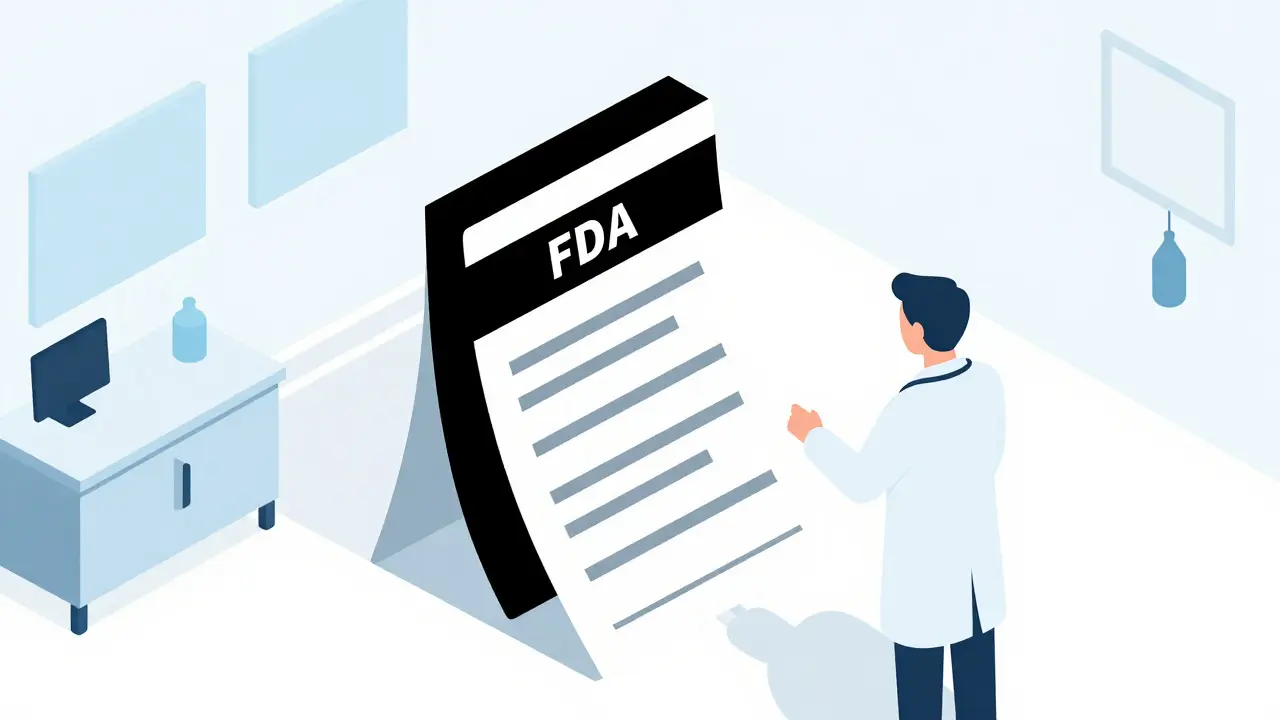
The FDA didn't choose the boxed format by accident. Since 1979, this specific layout has been used to create a visual "stop sign" for clinicians. According to 21CFR 201.57(e), these warnings must follow strict rules: they require a prominent black border, bulleted information for quick scanning, and a header written in bold uppercase letters. This ensures the warning is the first thing a doctor sees when opening the Prescribing Information.
Unlike standard warnings or precautions, a boxed warning usually indicates a risk of death or permanent disability. For example, Antipsychotics are heavily impacted, with about 87% of drugs in this class carrying these alerts. The urgency is reflected in the law; once the FDA notifies a manufacturer of a necessary change, the update must generally be implemented within 180 days. This tight window acknowledges that when a drug can kill a patient, every day of delay is a day too many.
How Boxed Warnings Evolve Over Time
Warnings aren't static. They move through a lifecycle of discovery, implementation, and sometimes, removal. Data from 2008 to 2015 shows that not every update is a brand-new alert. In a study of 111 warnings, only 29% were entirely new. The rest were either major updates (32%) or minor tweaks (40%). This tells us that the FDA is constantly refining the language to be more precise as more patients use the drug in the real world.
The most common triggers for these changes are cardiovascular risks and death. Interestingly, drug addiction has become a recurring theme in recent updates. There is also a troubling lag in the system. While we might hope risks are caught in clinical trials, most boxed warnings come from post-marketing surveillance. The median time from a drug's approval to a safety action has climbed to 11 years. This means a medication could be on the market for a decade before the "black box" finally appears.
| Update Type | Percentage of Changes | Common Focus |
|---|---|---|
| New Warnings | 29% | Life-threatening risks, New indications |
| Major Updates | 32% | Death, Cardiovascular events |
| Minor Updates | 40% | Clarifications, Dosage adjustments |
Navigating the FDA's Tracking Systems
If you're trying to track boxed warning changes, you can't rely on a single source. The information is fragmented across different databases. Since January 2016, the primary tool has been the SrLC database, or the Drug Safety-related Labeling Changes database. This is where the FDA logs all modern updates. However, if you need to look at a drug's history before 2016, you have to dive into the MedWatch archives or check Drugs@FDA for the original approval history.
Using the SrLC database isn't exactly intuitive. Pharmacists have reported a learning curve of three to five hours just to become proficient with its search parameters. To stay current, many academic medical centers have shifted to a proactive model. For instance, the University of Michigan Health System spends about 12 pharmacist-hours every month just reviewing new safety changes. For those in hospital settings, automated alert systems are common, though they often trigger "alert fatigue" due to a high volume of false positives.
The Real-World Impact on Prescribing
Do these warnings actually change how medicine is practiced? The data suggests yes, but with a catch. When the FDA added a warning about tendon rupture for fluoroquinolones in 2008, nearly 68% of surveyed physicians changed their prescribing habits. Similarly, when Chantix received a psychiatric risk warning in 2009, some clinics saw a 40% drop in prescriptions. But when that warning was removed in 2016, those numbers bounced back. This shows that the "box" has an immense power to sway clinical decision-making.
However, not all clinicians agree with the approach. Some argue that the FDA is too cautious. A Medscape poll found that 52% of physicians feel some warnings lead to the unnecessary avoidance of beneficial drugs. The case of Avandia is a prime example; many endocrinologists felt the cardiovascular warning restricted access to a helpful treatment without enough evidence to justify the scare. There is a delicate balance between protecting patients from harm and preventing them from accessing life-saving medication.
Closing the Gap: Future of Risk Communication
The future of drug safety is moving toward faster detection and clearer communication. The Sentinel Initiative, launched in 2008, uses big data to spot safety signals about 2.3 years faster than old-school reporting methods. The goal now is to shrink that 11-year gap between approval and warning to under five years. The FDA is currently collaborating with the OHDSI consortium to make this a reality.
We are also seeing a shift in how these warnings are delivered. The FDA's 2023 Strategic Plan aims to modernize the boxed warning format by 2026 to make it more readable for the digital age. This is crucial because while 87% of providers check for warnings on new drugs, 63% admit they often miss updates to drugs they already know. The move toward a more "tiered" system-distinguishing between a theoretical risk and a proven danger-is a conversation currently led by experts at institutions like Harvard Medical School to reduce clinician burnout and improve patient clarity.
What is the difference between a boxed warning and a precaution?
A boxed warning is the most severe level of alert, reserved for risks that could lead to death or permanent harm. Precautions are less severe and typically suggest how to use the drug safely or who should avoid it, but they do not carry the same visual urgency or regulatory weight as a black box warning.
Where can I find the most recent boxed warning updates?
The most reliable source for updates since January 2016 is the FDA's SrLC (Drug Safety-related Labeling Changes) database. For older updates, you will need to search the MedWatch archives or the Drugs@FDA database.
How long does it take for a warning to appear after a risk is found?
Historically, the median time from drug approval to a boxed warning has been around 11 years. However, the FDA is working with the OHDSI consortium to reduce this timeframe to under 5 years using better post-marketing surveillance.
Do boxed warnings always stay on the label?
No. If new data proves the risk was overestimated or if the risk is mitigated by new clinical evidence, the FDA can remove the warning. For example, the psychiatric risk warning for Chantix was removed in 2016.
Does the European Medicines Agency use the same system?
The EMA uses a different system called "black triangle" monitoring for new drugs to signal that they require extra surveillance, but they do not use the exact same boxed-border format mandated by the FDA in the United States.
Next Steps for Healthcare Providers
To avoid missing critical updates, don't rely on memory or the occasional email from a manufacturer. If you are a clinician, consider setting up a monthly calendar alert to scan the SrLC database for the top 10 most prescribed drugs in your practice. For pharmacists, integrating automated alert systems into your pharmacy management software can help, but be sure to calibrate them to avoid excessive false positives. If you're a patient, always ask your pharmacist if a "Medication Guide" is available; studies show these guides can increase your understanding of boxed risks from 42% to 78%.



Comments (11)
Ajinkya Joshi
24 Apr 2026
Oh great, so we just trust a system where the median time to find out a drug might kill you is eleven years. Absolutely stellar efficiency from the FDA. I'm sure the patients are thrilled to be part of this long-term experiment.
Rick Brewster
25 Apr 2026
it is truly a fascinating study in the ontological tension between safety and utility where the FDA attempts to quantify risk yet fails to grasp the essence of human fragility as they dance around these labels with a bureaucratic clumsiness that is almost poetic in its ineptitude and honestly who even cares about a box when the entire pharma complex is just a facade for capital accumulation anyway
Dave Edwards
26 Apr 2026
Imagine the sheer arrogance of these manufacturers waiting 180 days to update a label while people are literally dying 🙄 It's morally bankrupt! Why is the standard so low?? 😱
Mel Glick
26 Apr 2026
Cut the crap about "too cautious." If a drug causes tendon rupture, you put it in a box! Period. We need to stop pretending that clinical convenience outweighs patient safety. Get with the program or get out of the clinic!
Divyanshu Giri
28 Apr 2026
Keep pushing for that 5 year goal guys!! We can make it happen if we stay hyped and keep checking those lists!! Let's goooo!
Ally Warren
28 Apr 2026
The dichotomy between a theoretical risk and a proven danger is where the real intellectual battle lies. We are essentially trying to map uncertainty onto a binary visual cue.
RAJESH MARAVI
30 Apr 2026
This whole thing is a joke lol... why do we need a box when the doc just ignores it anyway? a total waste of ink and paper if u ask me, just pure propaganda for the big pharma guys to avoid law suits!!
Olayinka Ibukunoluwa Mercy
1 May 2026
It is so wonderful to see efforts to make this information more accessible for everyone!!! 🌟 Let's all support each other in learning these new systems... it can be overwhelming but we are in this together!! ❤️🙏
Dan Wizard
2 May 2026
I find it quite interesting that the European Medicines Agency takes such a different approach with their black triangles, and it makes me wonder if a more fluid monitoring system might actually reduce the anxiety that comes with a hard-line boxed warning while still keeping the clinicians informed through a more consistent stream of data rather than a sudden shock to the system.
Odicha ude Somtochukwu
2 May 2026
The integration of the Sentinel Initiative represents a commendable leap forward in our collective ability to protect public health... It is imperative that we continue to refine these methodologies for the betterment of all patients!!!
Saptatshi Biswas
4 May 2026
It is absolutely pathetic that the US thinks its fragmented databases are a gold standard. My country has far more efficient ways of handling public health data without this bureaucratic nightmare. You Americans love to overcomplicate the simplest things just to justify the existence of a thousand different consultants. It is a disgrace to the scientific community that you actually spend twelve hours a month just to find out if a drug is still safe. In India, we value actual results over these decorative black boxes that only serve to protect the lawyer's fees of the pharmaceutical giants. Your system is a bloated mess of inefficiency and a testament to why your healthcare costs are an international laughing stock. Honestly, the fact that you need a "learning curve" of five hours to use a search database is the most American thing I have ever heard in my entire life. You are not tracking safety; you are tracking the failure of your own administrative capabilities. Absolute shambles.