
CPAP vs. BiPAP: Key Differences and When to Use Each
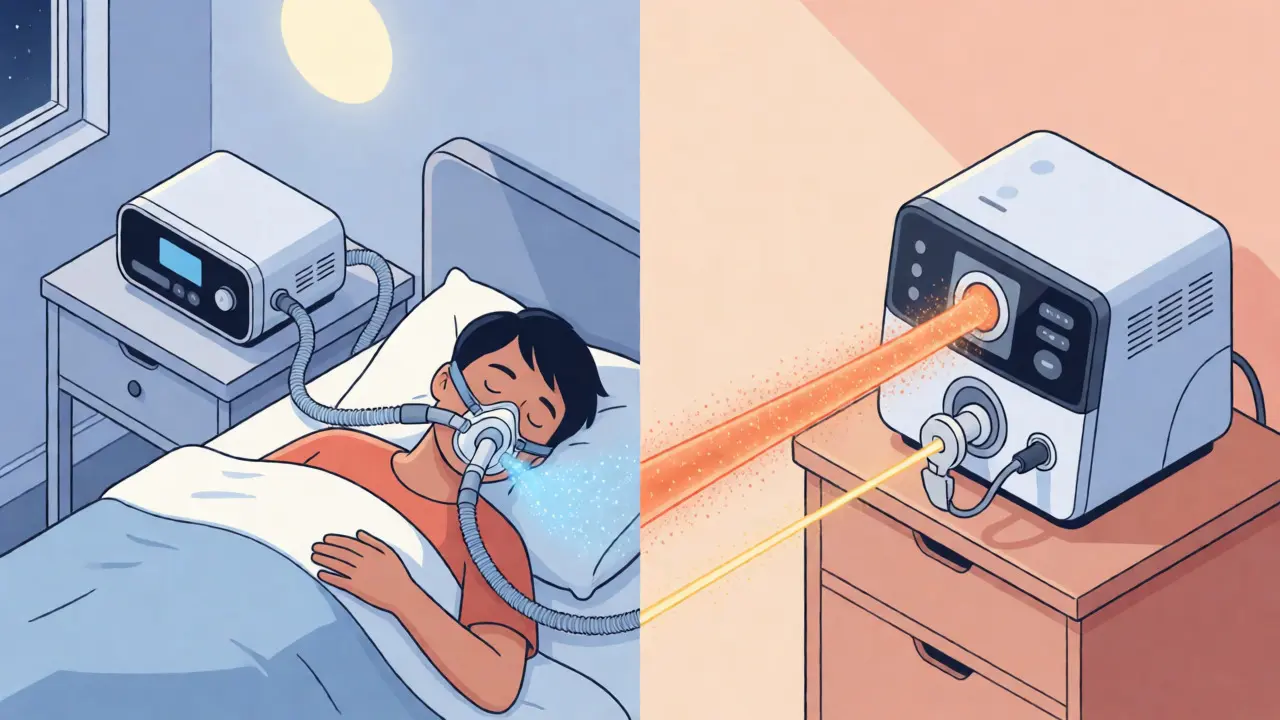
You’re exhausted. You’ve tried the pills, the mouthguards, maybe even a new mattress. Now your doctor says you need CPAP or a machine that pushes air into your lungs while you sleep. But then they mention BiPAP, and suddenly you’re confused. Are these the same thing? Is one better than the other? And why does your insurance company care which one you pick?
Here’s the short answer: CPAP is the standard first-line treatment for most people with obstructive sleep apnea (OSA). BiPAP is a specialized tool for specific cases where CPAP doesn’t cut it. Choosing wrong can mean months of discomfort, poor sleep, and wasted money. Let’s break down exactly how they differ, who needs what, and how to make sure you get the right device.
How They Actually Work: The Pressure Difference
The biggest difference between CPAP and BiPAP isn’t just the name-it’s how they deliver air. Think of breathing like blowing up a balloon. With CPAP, the machine pushes air at one constant speed. Whether you’re inhaling or exhaling, the pressure stays the same. It’s steady, reliable, and simple. Most modern CPAP machines, like the ResMed AirSense 11, operate within a range of 4 to 20 cm H₂O. If your titration study says you need 10 cm H₂O, the machine gives you 10 cm H₂O all night long.
BiPAP changes the game. It provides two different pressures: a higher one when you breathe in (IPAP) and a lower one when you breathe out (EPAP). For example, a typical setting might be 12 cm H₂O for inhalation and 6 cm H₂O for exhalation. This drop in pressure during exhalation makes it significantly easier to push air out of your lungs. Studies show this reduces the work of breathing by 30-40% compared to CPAP at similar average pressures. That sounds great, right? So why isn’t everyone on BiPAP?
Why CPAP Is Still the Gold Standard
If BiPAP feels easier, why do doctors prescribe CPAP first? Because for about 85-90% of sleep apnea patients, CPAP works perfectly well. It’s cheaper, simpler, and backed by decades of clinical data proving it effectively keeps airways open. The American Academy of Sleep Medicine recommends CPAP as the initial therapy for uncomplicated OSA because it’s effective and cost-efficient.
There’s also the issue of complexity. CPAP has one setting to worry about. BiPAP has multiple modes-Spontaneous (S), Timed (T), and Spontaneous/Timed (S/T)-plus backup rates and rise times. If those settings aren’t tuned correctly, the machine can fight against your natural breathing rhythm. A common complaint from BiPAP users is "machine cycling," where the device switches from inhale to exhale mode too early or too late, causing discomfort. For a healthy person with simple OSA, that added complexity offers little benefit but plenty of potential frustration.
When You Actually Need BiPAP
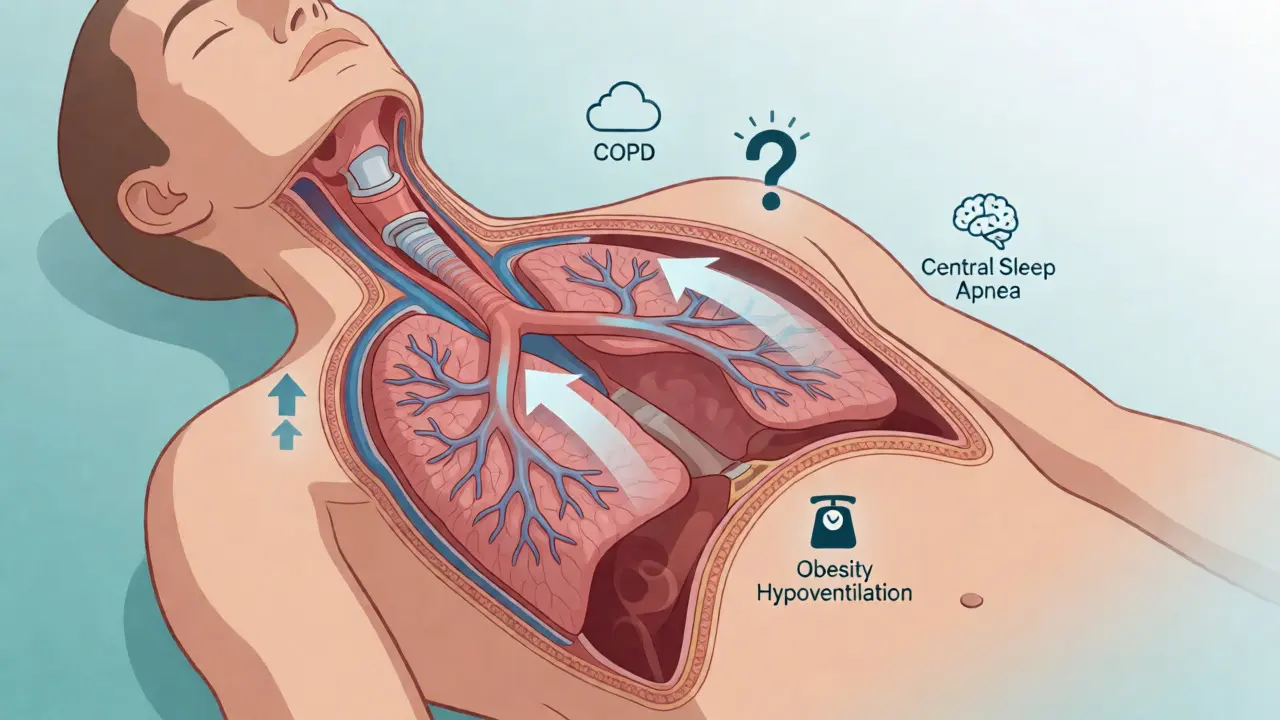
BiPAP isn’t an upgrade; it’s a solution for specific problems. Here are the clear indicators where BiPAP is medically necessary or strongly preferred:
- High Pressure Requirements: If your titration study shows you need more than 15 cm H₂O to keep your airway open, exhaling against that much constant pressure becomes physically exhausting. Many patients find they simply cannot tolerate CPAP above 12-14 cm H₂O. BiPAP allows high inspiratory pressure to stop apneas while keeping expiratory pressure low enough to breathe comfortably.
- COPD Overlap Syndrome: If you have both Chronic Obstructive Pulmonary Disease (COPD) and sleep apnea, your lungs struggle to exchange gases properly. BiPAP helps blow off carbon dioxide (CO₂) more effectively than CPAP, which is critical if your blood CO₂ levels are already high (hypercapnia).
- Central Sleep Apnea: In central sleep apnea, your brain forgets to tell your muscles to breathe. CPAP only props the airway open; it doesn’t help initiate breaths. BiPAP devices with S/T modes provide a "backup rate." If you don’t take a breath within a set time, the machine forces one for you. CPAP generally cannot do this.
- Obesity Hypoventilation Syndrome (OHS): People with severe obesity often have shallow breathing patterns. BiPAP supports their weak respiratory muscles, helping them maintain adequate ventilation throughout the night.
Cost, Insurance, and Practical Realities
Let’s talk money. CPAP machines typically cost between $500 and $1,200. BiPAP units are pricier, ranging from $800 to $1,800. But the sticker price is rarely the whole story. Insurance coverage is stricter for BiPAP. In the US, Medicare requires documented proof that you failed CPAP therapy before approving BiPAP. "Failure" usually means you couldn’t tolerate CPAP pressures for at least 15 cm H₂O for four hours a night over 30 days. Without that paper trail, you might pay out of pocket for BiPAP despite needing it.
| Feature | CPAP | BiPAP |
|---|---|---|
| Pressure Delivery | Single constant pressure | Two pressures (IPAP/EPAP) |
| Primary Indication | Obstructive Sleep Apnea (OSA) | Complex OSA, COPD, Central Apnea, OHS |
| Average Cost | $500 - $1,200 | $800 - $1,800 |
| Insurance Criteria | Standard approval | Often requires CPAP failure documentation |
| Adherence Rate | ~65% meet usage goals | ~60% meet usage goals (varies by indication) |
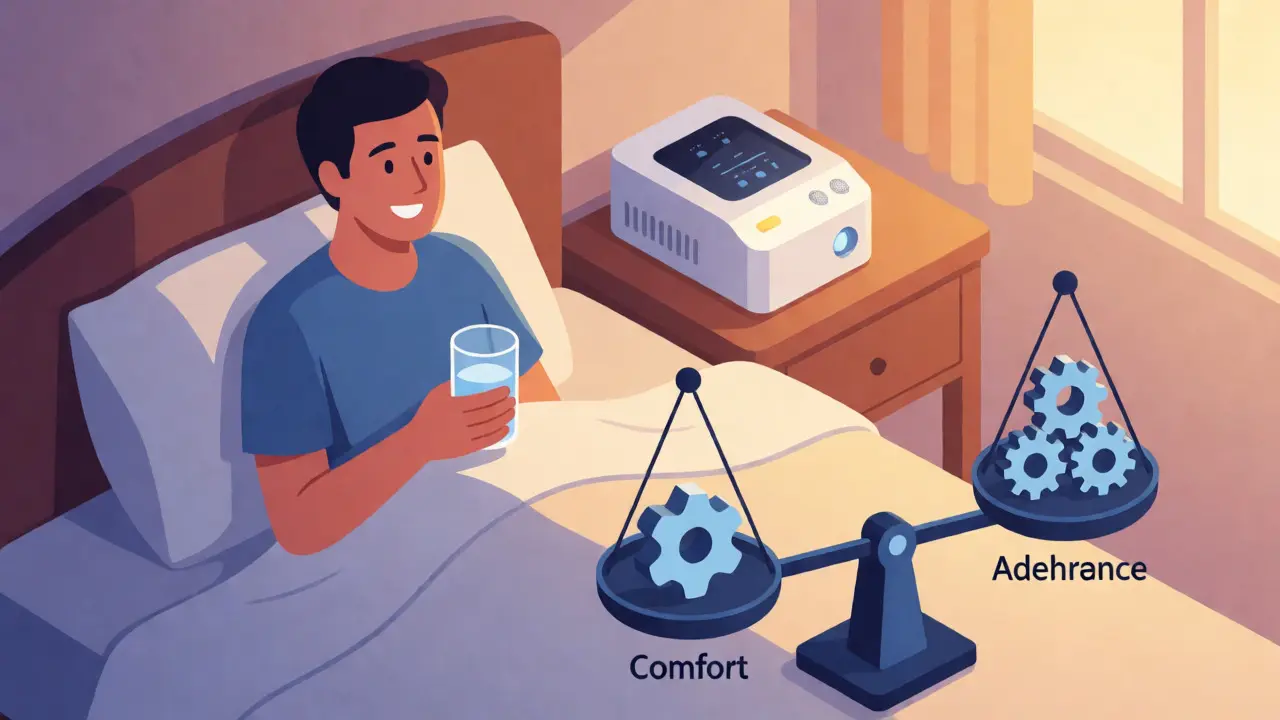
Adherence is another factor. Surprisingly, studies show no significant difference in how many hours per night people use CPAP versus BiPAP for standard OSA. Both hover around 5 hours a night on average. However, among patients with specific indications like COPD, BiPAP adherence tends to be higher because the therapy is actually tolerable for them. If you force a BiPAP patient onto CPAP, they’ll likely quit. If you give a simple OSA patient BiPAP without need, they might struggle with setup errors and quit anyway.
Setup and Maintenance: What to Expect
Getting started takes time. CPAP acclimatization usually takes 2-4 weeks. Your brain needs to learn to sleep with noise and airflow. BiPAP can take longer-up to 6 weeks-because the settings are more nuanced. You’ll likely need follow-up visits to fine-tune the IPAP/EPAP differential and ensure the backup rate matches your natural breathing pattern.
Mask fit matters more than you think. About 70% of initial discomfort comes from improper mask fitting, regardless of the machine type. Don’t suffer through leaks. If air blows into your eyes, ask for a different size or style. Modern devices like the Philips DreamStation 2 offer heated humidification and ramp features to ease you into therapy. For BiPAP, working with a specialized respiratory therapist is highly recommended. They can adjust sensitivity settings so the machine triggers precisely when you start to inhale, avoiding that "fighting the machine" feeling.
Making the Right Choice
Don’t let marketing hype or peer pressure dictate your therapy. Just because your friend loves their BiPAP doesn’t mean you need one. If you have straightforward obstructive sleep apnea, start with CPAP. It’s effective, affordable, and widely supported. If you try CPAP and consistently feel like you’re fighting to exhale, or if you have lung conditions like COPD, advocate for a re-evaluation. Ask your sleep specialist about a split-night study or a home test that compares both therapies. The goal isn’t to have the fanciest machine; it’s to get restful, uninterrupted sleep that improves your health.
Can I switch from CPAP to BiPAP if I hate my current machine?
Yes, but it usually requires medical justification. Insurers often require proof that you attempted CPAP therapy and found it intolerable due to high pressure requirements or inability to exhale against constant pressure. Consult your sleep physician to document these issues formally.
Is BiPAP better for snoring?
Not necessarily. Snoring is caused by airway vibration. Both CPAP and BiPAP stop snoring by keeping the airway open. CPAP is usually sufficient for snoring unless it’s part of a complex sleep-disordered breathing condition. BiPAP’s advantage is comfort during exhalation, not superior anti-snoring capability.
Do I need a sleep study to get a BiPAP machine?
Yes. Proper BiPAP therapy requires precise titration of two pressure settings (IPAP and EPAP) and potentially a backup rate. This is best done during an overnight polysomnography (sleep study) in a lab or via a supervised home sleep test. Incorrect settings can lead to ineffective therapy or discomfort.
Which machine is quieter?
Modern CPAP and BiPAP machines from top manufacturers like ResMed and Philips are both very quiet, typically under 30 decibels. Noise levels depend more on the mask fit and airflow turbulence than the machine type itself. A leaking mask will always be louder than a well-sealed one.
Can I use a CPAP mask on a BiPAP machine?
Generally, yes. Most masks are universal and compatible with both CPAP and BiPAP devices. The connection port is standardized across major brands. However, always check the manufacturer’s compatibility list to ensure the tubing fits securely.



Comments (10)
Neil Sahli
3 Sep 2026
Finally, someone who actually explains this without making me feel like I need a medical degree to understand it. CPAP saved my life, but I spent three months thinking BiPAP was some kind of luxury upgrade because the sales guy at the DME shop kept pushing it on me. Spoiler alert: for regular OSA, you don't need the extra bells and whistles if your pressure is under 15. Just stick with what works and save your money for better masks. Keep fighting the good fight against bad sleep hygiene!
Aurelio Haney
4 Sep 2026
It is frustrating that so many patients still fall for the marketing trap of "newer is better." 🙄 The data clearly shows that for uncomplicated OSA, CPAP remains the gold standard for a reason. Adding complexity does not equal efficacy. If you are using BiPAP for simple snoring or mild apnea, you are likely wasting resources and potentially introducing machine-cycling issues that degrade your sleep architecture. Stop trying to outsmart physiology with gadgets. 😤
Rob Alderman
6 Sep 2026
While the post provides a rudimentary overview, it glosses over the nuanced hemodynamic implications of positive airway pressure in patients with concurrent cardiovascular comorbidities. One must consider the afterload reduction benefits versus the potential for gastric distension when selecting between modalities. It is rather simplistic to suggest a binary choice without accounting for the individual's ventilatory drive and upper airway collapsibility profile. True therapeutic optimization requires a holistic assessment, not just a pressure differential analysis.
Evelyn Reed
6 Sep 2026
good breakdown honestly
i work in respiratory therapy and see this confusion daily
the key is really about adherence though
if cpap causes anxiety due to exhaling against resistance biap is worth the hassle
but yeah insurance usually makes you jump through hoops first
keep it simple unless you have hypercapnia or high pressures
Somnath Thombre
6 Sep 2026
bro i had same issue
my doc pushed bipap cause he said it feels more natural
turns out i only needed cpap at 8cm h2o
wasted so much money on filters and parts for bipap that were harder to clean
now im back on simple resmed airsense and sleeping like baby
dont let them upsell u if ur pressure is low
Kimberley Odish
8 Sep 2026
The assertion that adherence rates are comparable between the two devices is dangerously misleading when applied to complex patient populations. In clinical practice, forcing a COPD overlap patient onto CPAP often results in complete therapy abandonment within weeks. The physiological burden of expiring against constant positive pressure cannot be understated for those with compromised lung mechanics. We must stop treating these as interchangeable commodities and start respecting the distinct pathophysiological indications.
Adam Viruet
9 Sep 2026
I mean... sure... but isn't it also possible that the titration study itself is flawed??
Because sometimes... you know... the technicians are rushed... and they miss subtle events...
So maybe the pressure setting is wrong from day one... regardless of which machine you use...
And then you spend months suffering... blaming the machine type... when it was actually just bad calibration...
Just saying... food for thought...
Don't blindly trust the numbers...
They might be lying to you...
Jenn Bell
10 Sep 2026
This is such a helpful guide for anyone new to therapy! I remember being terrified of the mask fit issues mentioned here. You are absolutely right that comfort leads to consistency. Don't give up if the first week is rough; finding the right seal takes time but it changes everything. Wishing everyone sweet dreams tonight!
Jeremy Westcott
11 Sep 2026
You think it's random that insurance companies hate BiPAP? Nah man. It's all about the profit margins on the disposable supplies. CPAP has simpler filters, easier maintenance contracts. BiPAP has more moving parts, more sensors, more things that break. They want you on the cheap, durable tech. Also, have you noticed how the 'titration' process always seems to favor the cheaper option initially? It's like they're gatekeeping the good stuff until you prove you're desperate enough to pay for it or fail their arbitrary metrics. Wake up and smell the aerosolized plastic fumes.
Amanda SF
12 Sep 2026
I find it utterly disgraceful that we are still having this conversation in 2026. Patients are bombarded with conflicting information while healthcare providers hide behind bureaucratic red tape. The fact that Medicare requires a month of documented failure before approving a superior device for specific conditions is an affront to patient dignity. We deserve personalized care, not cookie-cutter protocols designed by accountants. This entire system is broken, and articles like this merely scratch the surface of the incompetence inherent in modern sleep medicine administration.