Severe Hypertensive Crisis from Drug Interactions: Causes, Risks, and Prevention

Hypertensive Crisis Risk Assessor
Check your status against clinical guidelines. A systolic pressure >180 mmHg or diastolic >120 mmHg may indicate a crisis.
Awaiting Input...
Enter your readings above and click assess.
Imagine waking up with a splitting headache, blurred vision, and a blood pressure reading of 220/130 mmHg. For many, this is not a random event but the result of a specific combination of medications or foods they consumed. A severe hypertensive crisis is a medical emergency where blood pressure spikes to dangerous levels, often exceeding 180/120 mmHg, due to acute physiological disruptions. While high blood pressure is common, the sudden, extreme nature of a crisis caused by drug interactions makes it particularly dangerous and preventable.
Most people associate heart attacks with cholesterol or stress, but fewer realize that the wrong mix of pills can trigger a vascular storm within hours. This article breaks down how specific medications collide to create life-threatening pressure spikes, who is at highest risk, and exactly what you can do to keep your readings safe.
Key Takeaways
- Hypertensive crisis is defined as systolic BP >180 mmHg or diastolic BP >120 mmHg, with or without organ damage.
- Drug-induced cases account for 15-20% of secondary hypertension, yet remain underdiagnosed in up to 65% of emergency visits.
- The most dangerous interaction involves MAOIs (like selegiline) and tyramine-rich foods, causing pressure spikes within 30 minutes.
- Cyclosporine affects up to 50% of transplant patients, often misdiagnosed as rejection episodes.
- Prevention relies on strict dietary restrictions, regular monitoring, and using digital decision-support tools.
Understanding the Mechanism: How Drugs Spike Pressure
To understand why certain combinations are lethal, you need to look at how blood vessels regulate themselves. Normally, your body balances blood flow through autoregulation. When this system fails, vasoconstriction becomes uncontrolled, leading to endothelial damage and increased vascular permeability. In drug-induced crises, this failure is triggered by specific pharmacological pathways.
The two main culprits are sympathomimetic overstimulation and mineralocorticoid receptor activation. Sympathomimetics, found in decongestants and stimulants, force blood vessels to constrict rapidly. Meanwhile, drugs that activate mineralocorticoid receptors cause the body to retain sodium and water, expanding blood volume. A study published in the European Journal of Pharmacology (2021) notes that while these mechanisms seem distinct, they often overlap in polypharmacy scenarios, creating a 'perfect storm' for a crisis.
| Trigger Class | Onset Time | Typical BP Spike | Duration After Cessation |
|---|---|---|---|
| MAOI + Tyramine | 30-120 mins | +50-100 mmHg | Hours to days |
| Cocaine + Propranolol | 30-60 mins | >220 mmHg systolic | Minutes to hours |
| Corticosteroids | Weeks-Months | +10-15 mmHg systolic | Days to weeks |
| Cyclosporine | Variable | Varies widely | Weeks |
The MAOI-Tyramine Connection: A Silent Killer
If there is one interaction every patient must know, it is the reaction between Monoamine Oxidase Inhibitors (MAOIs) and tyramine. MAOIs are older antidepressants like phenelzine and tranylcypromine. They work by blocking the enzyme that breaks down neurotransmitters. The problem? Tyramine, an amino acid found in aged foods, also triggers the release of norepinephrine. If your body can't break down the excess norepinephrine because of the MAOI, it floods your system.
This isn't just a theoretical risk. Dr. George L. Bakris, Director of the American Heart Association's Comprehensive Hypertension Center, noted in a 2022 review that untreated MAOI-tyramine reactions have mortality rates approaching 30%. The onset is rapid. Patients often report waking up with severe headaches after eating aged cheese, cured meats, or fermented soy products. One user on the r/Hypertension community described waking up with a reading of 220/130 after consuming aged cheddar while taking selegiline, resulting in a three-day ICU stay.
The mechanism is known as the 'cheese effect.' Tyramine displaces norepinephrine from storage vesicles in nerve terminals. Without MAO activity to degrade the released norepinephrine, systemic vasoconstriction occurs immediately. This is why the American Heart Association recommends a strict 2-week washout period when switching from MAOIs to other serotonergic agents, though irreversible MAOIs may require 4-5 weeks.
Beyond Antidepressants: Transplant Medications and Steroids
While MAOIs get the most attention, other drug classes pose significant threats. Cyclosporine, an immunosuppressant used heavily in kidney transplants, induces hypertension in up to 50% of patients. The mechanism involves decreased sodium excretion and altered prostaglandin synthesis. What makes this tricky is that clinicians often mistake cyclosporine-induced hypertension for a sign of organ rejection, leading them to increase the immunosuppressant dose, which worsens the blood pressure issue. A 2019 European Society of Hypertension report found that 55% of such cases were initially misdiagnosed.
Corticosteroids present a slower but equally persistent threat. Unlike the rapid spike of MAOIs, steroid-induced hypertension develops gradually over weeks. Mean systolic increases of 10-15 mmHg are common. Because the rise is slow, patients often attribute their symptoms to age or stress rather than their medication. However, long-term exposure leads to sustained vascular damage if not monitored.
Another emerging concern involves newer antidepressants. Venlafaxine, an SNRI, shows dose-dependent effects. At doses above 300 mg/day, statistically significant diastolic elevation occurs. More alarmingly, combining venlafaxine with amphetamines has shown a 40% higher crisis rate compared to historical controls, according to Dr. Suzanne Oparil’s commentary in Circulation (2021).
Diagnosis and Clinical Challenges
Diagnosing drug-induced hypertensive crisis is harder than it should be. In a multicenter study cited by Grossman et al., only 35% of emergency department physicians routinely screened for medication interactions in severe hypertension cases. This gap leaves many patients with 'unexplained' high blood pressure until a specialist intervenes.
Patients often experience warning signs before the full crisis hits. A 2021 survey in the Journal of Patient Safety found that 68% of patients had previously reported unexplained headaches or vision changes to their doctors. Yet, only 22% had their medication lists reviewed for potential conflicts. This disconnect highlights a systemic failure in primary care to connect daily symptoms with prescription histories.
When a crisis does occur, the clinical presentation varies. Hypertensive urgency involves severe numbers without immediate organ damage, while hypertensive emergency includes evidence of acute injury to the brain, heart, or kidneys. Distinguishing between the two is critical for treatment. For instance, labetalol demonstrates 85% efficacy in MAOI-related crises, whereas calcium channel blockers show 78% efficacy in cyclosporine-induced cases. Using the wrong rescue medication can delay stabilization.
Prevention Strategies and Monitoring Protocols
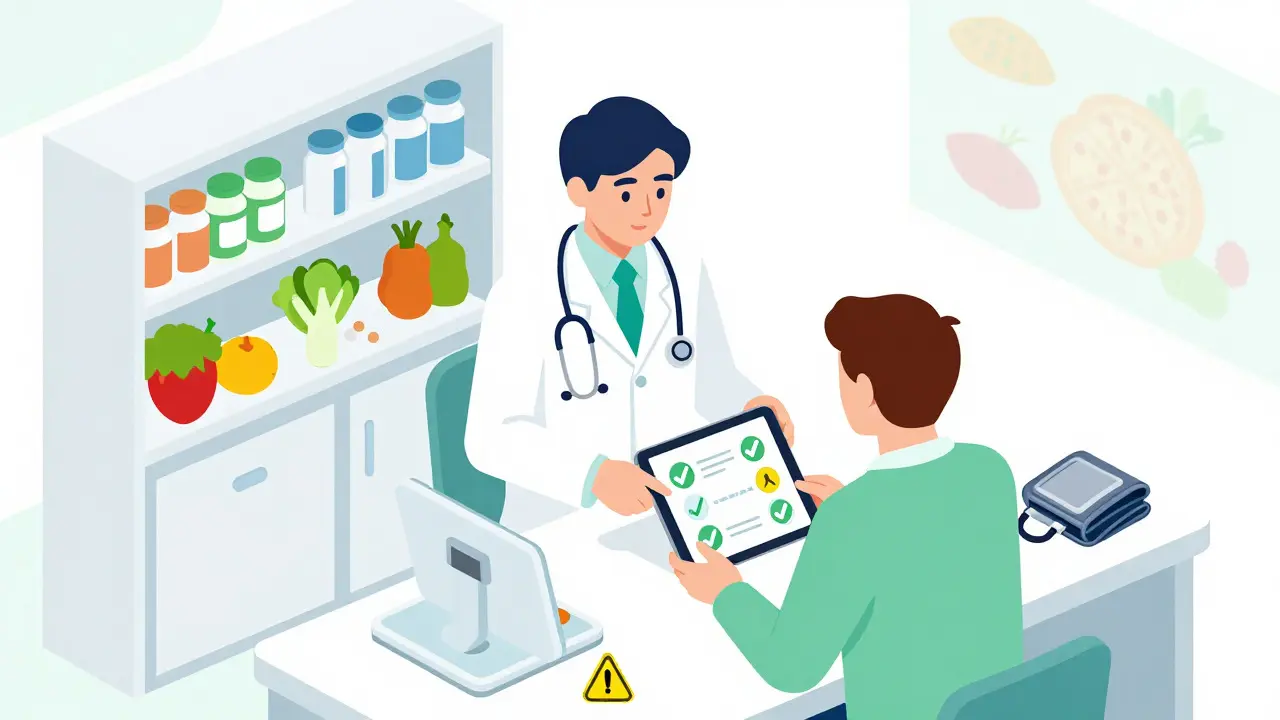
Prevention is far more effective than treatment. The first line of defense is education. Patients on MAOIs must adhere to a tyramine-restricted diet. This means avoiding aged cheeses, cured meats, tap beer, and fermented soy products. Adherence is difficult; studies show 45% of patients fail to maintain proper diets. Smartphone apps like 'MAOI Diet Helper' have shown a 78% improvement in adherence by providing real-time food scanning and alerts.
Monitoring frequency depends on risk level. Patients on high-risk combinations, such as cyclosporine plus calcium channel blockers, require biweekly blood pressure checks for the first three months. Those on moderate-risk medications like venlafaxine need monthly checks. The American College of Cardiology’s 2024 guidelines now classify venlafaxine doses above 225 mg/day as 'high risk,' mandating quarterly monitoring regardless of current readings.
Technology is stepping in to fill the gaps. The FDA approved the first decision-support tool specifically designed to prevent drug-induced hypertensive crisis in 2023. In a multicenter trial, this tool reduced MAOI-related emergencies by 40%. Additionally, genetic testing for CYP2D6 polymorphisms can identify patients at 3.2 times higher risk for severe reactions to certain antidepressants, allowing for personalized dosing strategies.
Managing Acute Crises: What Happens in the ER?
If a crisis occurs, time is tissue. The goal is to lower blood pressure gradually, not instantly, to avoid ischemia in organs accustomed to high pressure. For MAOI-tyramine reactions, intravenous phentolamine is the gold standard. A 2020 New England Journal of Medicine study documented 92% efficacy within 20 minutes when administered at doses of 5-15 mg.
For sympathomimetic-induced crises (from decongestants or stimulants), discontinuation of the offending agent often resolves the issue within 6-12 hours. However, mineralocorticoid-mediated crises may persist for weeks after stopping the drug due to prolonged receptor activation. This difference in duration dictates the length of hospitalization and follow-up care.
Patients should never attempt to self-treat a suspected crisis with extra doses of their usual medication. This can lead to rebound effects or further complications. Instead, seek emergency care if you experience chest pain, shortness of breath, confusion, or visual disturbances alongside a high reading.
The Future of Interaction Awareness
The landscape of drug safety is evolving. Prescription drug monitoring programs have already reduced MAOI-related crises by 28% in states with comprehensive systems. The pharmaceutical industry has improved labeling, with FDA-mandated 'black box' warnings now appearing on 100% of relevant MAOI medications, up from 65% in 2015.
However, gaps remain in over-the-counter products. Only 12% of decongestant products contain adequate hypertension risk information, according to Consumer Reports testing in 2023. As the population ages and polypharmacy becomes more common, the challenge grows. The NIH-funded 'Hypertension Interaction Alert System,' currently in phase 3 trials, uses AI to analyze over 15,000 documented interactions with 92% predictive accuracy. If successful, this could transform how we manage complex medication regimens.
Frequently Asked Questions
What blood pressure reading qualifies as a hypertensive crisis?
A systolic pressure greater than 180 mmHg or a diastolic pressure greater than 120 mmHg. If accompanied by symptoms like chest pain or vision changes, it is considered an emergency requiring immediate medical attention.
Can over-the-counter cold medicine cause a hypertensive crisis?
Yes. Decongestants containing pseudoephedrine or phenylephrine are sympathomimetics. In individuals with pre-existing hypertension or those taking interacting medications, they can trigger significant pressure spikes. Always check labels for hypertension warnings.
How long does it take for MAOI-related hypertension to resolve?
Acute symptoms typically subside within hours after stopping the tyramine source and administering rescue medication like phentolamine. However, full normalization may take several days depending on the severity of the initial spike and individual metabolic factors.
Is licorice candy really dangerous for blood pressure?
Yes, especially in large quantities. Licorice root contains glycyrrhizin, which inhibits the enzyme that breaks down cortisol. This leads to mineralocorticoid effects, causing sodium retention and potassium loss. Case reports show blood pressure normalizing within 14 days of cessation.
Should I stop my blood pressure medication if I feel fine?
Never stop medication abruptly without consulting your doctor. Sudden cessation can lead to rebound hypertension, which is itself a risk factor for crisis. Any changes to your regimen should be guided by a healthcare professional.