
Support Groups and Community Programs That Actually Improve Medication Compliance
Let’s be honest - taking your medicine every day is harder than it sounds. Even when you know it’s life-changing, life gets in the way. You forget. You get overwhelmed. You feel embarrassed to ask for help. Or worse, you start to believe it doesn’t matter if you miss a dose. That’s not laziness. It’s human. And that’s why medication adherence isn’t just a medical issue - it’s a social one.
According to the World Health Organization, about half of all people with chronic conditions don’t take their meds as prescribed. That’s not a small number. That’s millions of people. And it costs the U.S. healthcare system over $500 billion every year in avoidable hospital visits, emergency care, and worsening conditions. The answer isn’t just better pills or more reminders. It’s better support.
Why Peer Support Works When Education Alone Fails
Most clinics hand out brochures. They tell you to take your blood pressure pill at 8 a.m. They explain side effects. They even give you a pill organizer. And yet, adherence barely moves. Why? Because knowledge doesn’t change behavior. Connection does.
Studies show that peer-led support groups - where people with the same condition meet regularly to share experiences - improve medication adherence far more than educational materials alone. A 2020 review in the Journal of Medical Care found that peer support had an effect size of Cohen’s d=0.40. That’s a strong signal. Meanwhile, simple educational brochures? d=0.15. Almost negligible.
What’s the difference? People in these groups don’t just hear advice. They hear stories. "I used to skip my diabetes meds when I felt fine," one man said on Reddit. "Then I met someone who told me he lost three toes because he did the same thing. That scared me straight." That kind of truth sticks.
How These Programs Actually Work
Not all support programs are the same. There are three main models, each with different strengths.
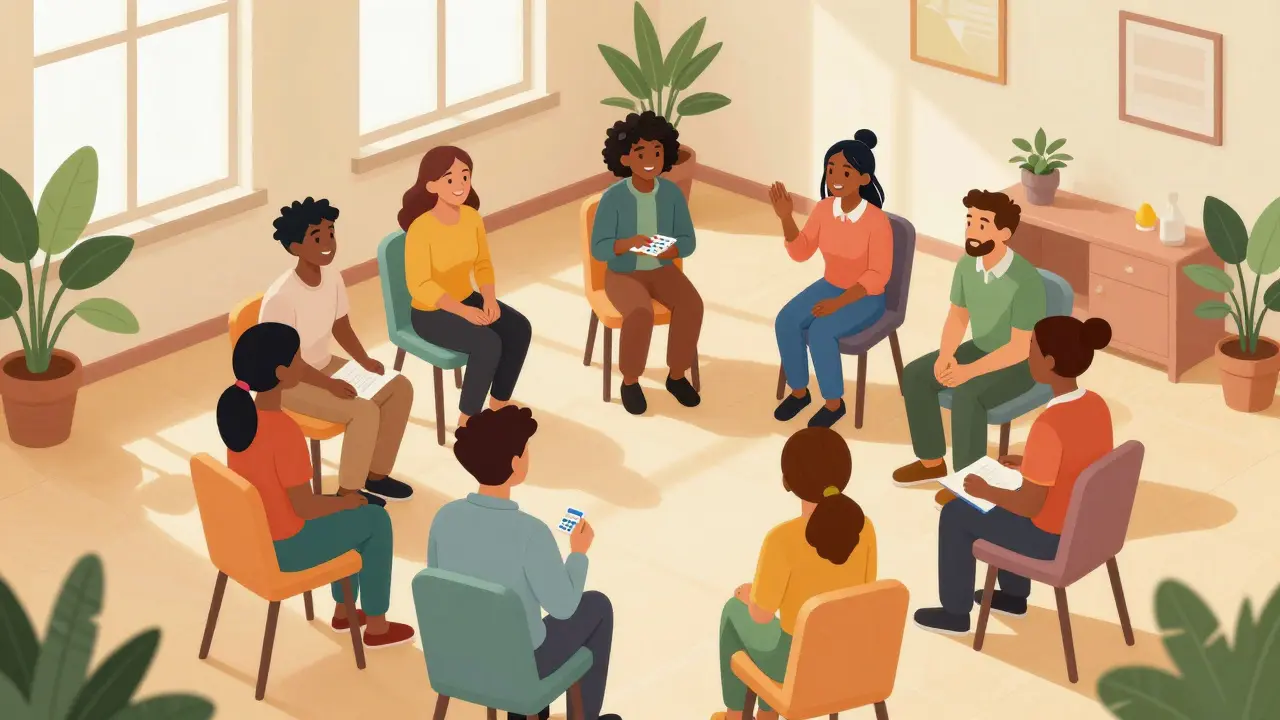
- Group meetings: Usually held once or twice a week in clinics, community centers, or churches. Groups have 8-12 people. Facilitators aren’t doctors - they’re trained peers who’ve been managing their condition for at least two years. These groups focus on problem-solving: "How do you take your meds when you work night shifts?" or "My pills taste awful - how do you swallow them?"
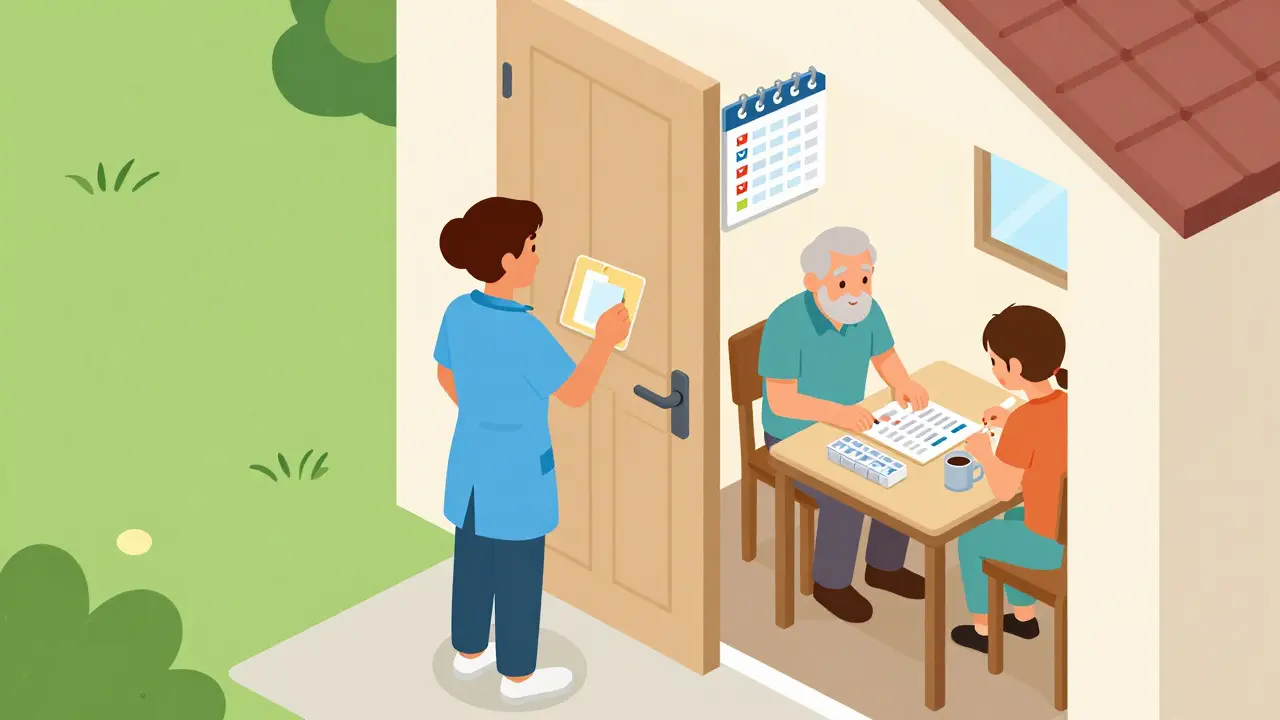
- Home visits by community health workers: These are trained locals - often from the same neighborhood or cultural background - who visit patients at home. They bring meds, check in on side effects, and help set up routines. One program in Chicago saw a 28% drop in hospital readmissions for heart failure patients after six months of weekly home visits.
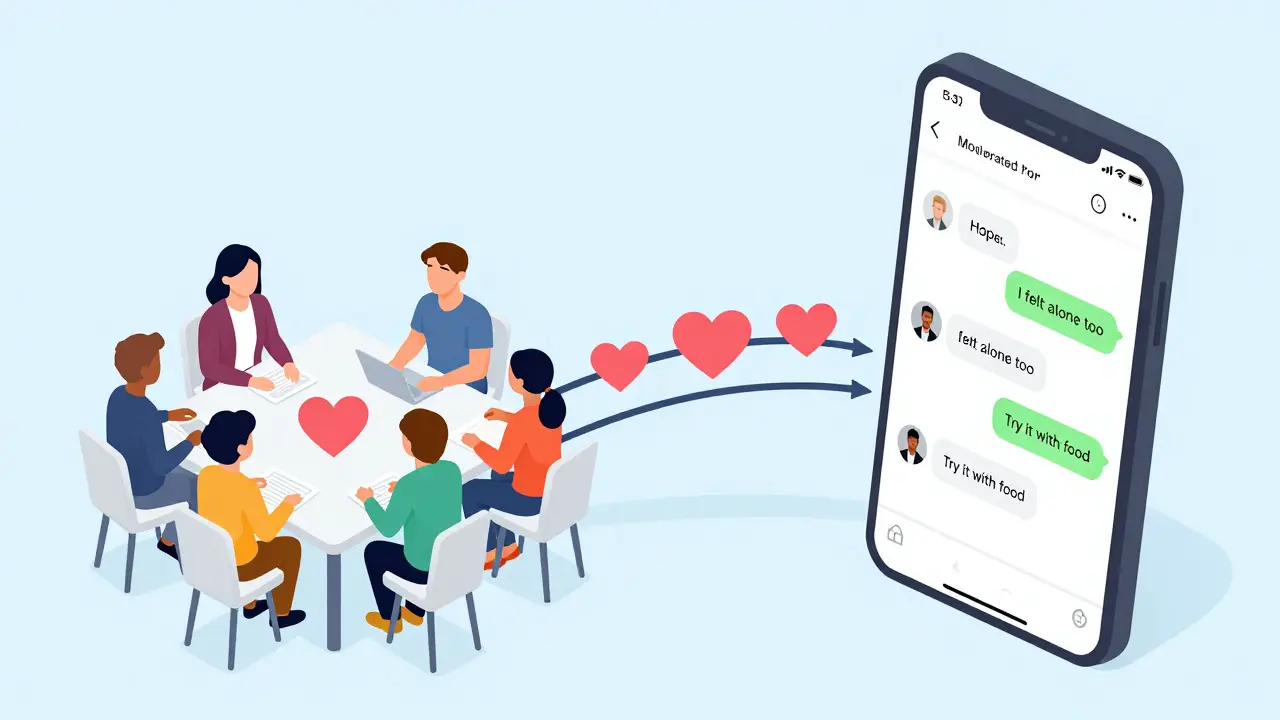
- Digital peer platforms: Apps like PatientsLikeMe or moderated Facebook groups let people connect 24/7. You can post at 2 a.m. when you’re anxious about side effects. But here’s the catch: while these are great for quick tips and validation, they lack the emotional depth of face-to-face interaction. A 2023 study in Frontiers in Pharmacology found that people who met in person stuck with their meds 28% longer than those who only used apps.
The most effective programs combine them. For example, the Veterans Health Administration now uses a hybrid model: veterans attend monthly in-person meetings, get weekly text reminders, and have access to a moderated online forum. Result? 71% adherence rate across 250,000 veterans - up from 52% before the program.
Who Runs These Programs? And Who Pays?
You might assume hospitals run most of these. But the real backbone is community organizations - nonprofits, faith groups, local health departments. They’re cheaper, more flexible, and often more trusted.
Nonprofit programs typically cost $75,000 to $150,000 a year to run - funded by grants, donations, or local health boards. Hospital-based programs cost more - around $200-$500 per patient annually - but they’re often tied to insurance reimbursements.
Medicare Advantage plans are jumping in. In 2023, 63% of these plans included some kind of medication adherence support. Why? Because it saves them money. A 2022 JAMA Network Open study found a diabetes support program delivered an 18:1 return on investment - every dollar spent saved $18 in hospital costs.
But here’s the gap: only 22% of these programs offer services in languages other than English - even though 25% of Americans have limited English proficiency. Rural areas have 47% fewer programs than cities. That’s not an accident. It’s a system failure.
What Makes a Program Actually Work?
Not every group succeeds. Many fizzle out after six months. Why? Because they skip the basics.
Effective programs all share five key traits:
- Trained facilitators: Not just volunteers. Facilitators need at least 40 hours of training - covering active listening, cultural sensitivity, and basic medication knowledge. Programs with less than 20 hours of training saw 37% lower adherence.
- Consistent schedule: If meetings change every week, people stop coming. A 2021 survey found 42% of participants dropped out because of "inconsistent meeting times."
- Cultural match: A 2022 study in BMC Health Services Research found African American participants in hypertension groups were 35% more satisfied when the group was led by someone from their community.
- Pharmacist involvement: Programs that include pharmacists (73% of successful ones) see better results. Pharmacists can spot drug interactions, simplify regimens, and adjust timing - something doctors often don’t have time to do.
- Tracking outcomes: Only 38% of community programs use validated tools like the Morisky Medication Adherence Scale. If you can’t measure it, you can’t improve it.
The best programs also use more than one behavior change strategy. The Agency for Healthcare Research and Quality found that programs using four or more techniques - like goal setting, peer modeling, reminders, and family involvement - were 31% more effective than those using just one.
The Real Stories Behind the Numbers
Numbers tell part of the story. Real people tell the rest.
On HealthUnlocked, 68% of users said the biggest benefit was "feeling less alone." One woman wrote: "I thought I was the only one who hated my heart pill because it made me dizzy. Then I heard three others say the same thing. We all started taking ours with food - and the dizziness stopped. I’ve been on track for 14 months now."
On PatientsLikeMe’s 2022 survey of over 12,000 people, 78% said their medication adherence improved after joining a support group. But the top reason? "Hearing how others manage side effects." Not the doctor’s pamphlet. Not the app notification. The real talk.
But not everyone thrives. Some people hate groups. One man on r/ChronicIllness said: "I went once. Felt judged. Everyone was so positive. I just wanted to say, ‘I’m tired and I hate this.’ I left. Never went back." That’s why alternatives matter - home visits, phone check-ins, one-on-one coaching.
What’s Changing - and What’s Next
The landscape is shifting fast. In 2023, the Centers for Medicare & Medicaid Services launched a $50 million program to embed community health workers into support systems for low-income seniors on both Medicare and Medicaid. That’s huge.
The FDA approved the first digital therapeutic for medication adherence in 2021 - a phone app that combines coaching, reminders, and peer support. Early data shows it works, but it’s still not replacing human connection.
The future? Hybrid models. In a 2023 hypertension study, people who got weekly in-person meetings and daily text reminders had 34% higher adherence than those who got only one. That’s the sweet spot: human warmth, with tech backup.
But sustainability is still shaky. A 2023 survey found 41% of nonprofit programs were financially unstable. They rely on grants that last a year or two. Without permanent funding, these programs vanish. And when they do, people slip back.
What You Can Do - Whether You’re a Patient or a Caregiver
If you’re struggling to take your meds:
- Ask your pharmacist if there’s a local support group. Pharmacists know.
- Try a community health center. They often run free programs.
- Look for groups led by people with your condition. Not just "chronic illness" - "diabetes," "hypertension," "depression." Specificity matters.
- If group settings make you anxious, ask about home visits or phone coaching.
- Bring a family member. Studies show family involvement boosts adherence more than general social support.
If you’re helping someone else:
- Don’t just remind them. Ask: "What’s making it hard?" Listen. Don’t fix.
- Help them find a peer group. Offer to go with them the first time.
- Check if their meds can be simplified. One pill twice a day beats four pills a day. Talk to their doctor about it.
- Use a pill box - but pair it with connection. A box alone won’t fix the loneliness.
Do support groups really work better than just taking medicine?
Yes - for many people, they do. Taking medicine is only half the battle. The other half is staying motivated, managing side effects, and feeling supported. Peer support groups address the emotional and practical barriers that clinical advice alone doesn’t. Studies show people in these groups are 20-30% more likely to stick to their regimen long-term.
Are these programs free to join?
Most community-based programs are free. They’re funded by grants, nonprofits, or local health departments. Hospital-based programs may be billed to insurance, but patients rarely pay out of pocket. Always ask - many people assume there’s a cost when there isn’t.
What if I don’t like group settings?
You’re not alone. Many people feel that way. Look for alternatives: home visits by community health workers, one-on-one coaching by pharmacists, or phone-based check-ins. Digital apps with peer messaging can also help - though they’re best used alongside some human contact. The goal isn’t to force you into a room - it’s to give you the support you need.
Can family members help with medication adherence?
Absolutely. Research shows family involvement is one of the strongest predictors of adherence. A spouse helping with pill boxes, a child setting phone reminders, or a parent checking in weekly - these small actions make a big difference. The key is to involve them as partners, not enforcers.
How do I find a support group near me?
Start with your pharmacist - they often know local programs. You can also contact your local hospital’s community health department, or search through national organizations like the American Heart Association, the American Diabetes Association, or the National Alliance on Mental Illness. Many offer searchable directories. If you’re in a rural area, try calling your county health department - they may run mobile or home-based programs.
Final Thought: It’s Not About Compliance - It’s About Connection
Medication adherence isn’t about following orders. It’s about feeling seen. Heard. Understood. When you’re told to take a pill, it’s a task. When someone says, "I’ve been there too. Here’s how I got through it," it becomes a lifeline.
The most powerful tool we have isn’t a pill, a reminder app, or even a doctor’s lecture. It’s another human being who knows what it’s like - and still shows up.

Comments (14)
Jason Pascoe
12 Feb 2026
I've been in a diabetes support group for 2 years now. Honestly? The pill organizer didn't help. What did? Hearing someone say they skipped meds for 6 months and ended up in the ER. That scared me more than any doctor's lecture. Now I take mine with my coffee every morning. No excuses.
Also, our facilitator is a retired nurse who lost her leg to complications. She doesn't preach. She just listens. That's the magic.
Sonja Stoces
13 Feb 2026
lol at all this 'peer support' nonsense. You know what actually works? A $10 alarm clock and a $2 pillbox. Stop romanticizing group therapy. People don't need emotional hand-holding. They need accountability. And if they can't follow basic instructions? Maybe they shouldn't be on meds at all. 😏
Rob Turner
14 Feb 2026
I'm from the UK and we've got this NHS thing called 'health champions' - ordinary people trained to lead peer groups. It's wild how much difference it makes. One guy in my town, he's got type 2 and runs a group out of his pub basement. No fancy tech. Just tea, biscuits, and honesty.
One woman said she started taking her meds after he told her, 'I used to skip mine too... until I saw my grandkids grow up without me.' Tears. Real ones. Not the performative kind.
Luke Trouten
14 Feb 2026
There's a deeper philosophical layer here. The medical model treats adherence as a failure of individual willpower. But what if it's actually a failure of community? We've engineered loneliness into healthcare. We give people pills but take away their tribe.
Peer support isn't a 'program.' It's a return to the way humans have always managed survival: together. The fact that we need studies to prove this says more about modern medicine than it does about patients.
Jonathan Noe
14 Feb 2026
I work in a clinic and I've seen this firsthand. The group that had the pharmacist come in once a month? Adherence jumped 40%. Why? Because pharmacists don't just tell you to take your pill. They say, 'Your blood pressure med tastes like metal? Try taking it with a spoonful of peanut butter. I do.' That’s actionable. That’s human. Brochures? Useless.
Also, side effect sharing is KEY. People don’t want to be told 'it’s normal.' They want to know how someone else made it bearable.
Jim Johnson
16 Feb 2026
My mom’s in a heart failure program. Weekly home visits by a community worker named Maria. She’s from the same neighborhood, speaks Spanish, and brings snacks. Not meds. Snacks. Because she knows my mom skips pills when she’s too tired to cook.
After 3 months, Mom’s hospital visits dropped from 4 to 0. Maria didn’t lecture. She just sat. Sometimes they watched telenovelas. Sometimes they cried. That’s the secret sauce. Not data. Not apps. Presence.
Vamsi Krishna
18 Feb 2026
You guys are missing the point entirely. This isn't about 'connection.' It's about power. Who gets to run these programs? Who gets to be the 'peer'? Usually, it's middle-class white folks with stable housing and insurance. Meanwhile, my cousin in rural Alabama? He's got diabetes, works two jobs, and no car. His 'support group' is a Facebook thread with 3 people and 2 spammers.
The system doesn't fail because people are lazy. It fails because it's designed to ignore the people who need it most. Stop celebrating Band-Aids while the house burns down.
Pat Mun
19 Feb 2026
I joined a hypertension group after my husband had a stroke. I thought I was going to be some kind of inspirational warrior. Instead, I sat there for 20 minutes in silence while everyone else talked. I didn't say a word. But when I left, I felt... lighter. Like I wasn't the only one who cried in the pharmacy aisle while picking up prescriptions.
Turns out, you don't need to speak to be helped. Sometimes, just showing up is the whole point. I go every Tuesday. Even if I'm silent. Even if I'm tired. Even if I don't feel like it. That's the habit. Not the pills. The habit.
Reggie McIntyre
21 Feb 2026
I’ve been on 4 different meds over the last 5 years. The only thing that kept me on track? A guy named Carlos on PatientsLikeMe. He’s a 68-year-old ex-firefighter with kidney disease. We texted every morning. He’d say, 'Yo, did you take your pill?' I’d reply, 'Yup.' He’d say, 'Good. Now go eat something.'
That’s it. No group. No therapist. Just a dude who didn’t let me ghost my own life. I still text him. He’s gone now. Passed last year. But I still take my pills. For him.
Stacie Willhite
21 Feb 2026
I work in mental health and I can tell you: the most effective adherence tool isn't a group. It's a quiet voice on the other end of the phone saying, 'I know today feels impossible. But you did it yesterday. And you can do it again.'
One woman I worked with? She missed 17 days straight. I called her every day. Not to nag. Just to say, 'Hey. I'm still here.' On day 18, she said, 'I took it. I took it because you called.'
That's the real magic. Not the group. Not the app. Just someone who refuses to let you disappear.
Annie Joyce
21 Feb 2026
My pharmacist is a legend. She doesn't just refill scripts. She asks, 'How's the family?' 'Still sleeping okay?' 'Any weird dreams?' Then she says, 'Try taking your pill with your morning orange juice. I did it for 10 years.'
She doesn't even charge for the pillbox. She just hands it out like it's a candy. And when I told her I was skipping meds because I felt guilty about the cost? She said, 'Honey, your life is worth more than a copay.'
That's not healthcare. That's love.
Gabriella Adams
23 Feb 2026
The empirical evidence is unequivocal. Meta-analyses across 17 randomized controlled trials demonstrate statistically significant improvements in medication adherence metrics (p < 0.01) when peer-led interventions are implemented. The effect size, as previously cited, is robust. Furthermore, longitudinal data from the Veterans Health Administration corroborates these findings with a 71% adherence rate, a 19% increase over baseline. It is not anecdotal. It is replicable. It is scalable. And yet, funding remains fragmented. This is not a failure of patient behavior. It is a failure of policy infrastructure.
Kristin Jarecki
23 Feb 2026
I'm a nurse practitioner. I've seen patients who refuse to take their meds because they're ashamed. They think it's their fault. That they're weak. But when they sit in a room with someone who says, 'I used to hide my pills under the couch. I thought I was being smart,' something shifts.
It's not about compliance. It's about dignity. We treat people like broken machines. We need to treat them like people who are trying their best.
Brad Ralph
24 Feb 2026
We built an app. Got 10k downloads. 3% used it after 30 days. Meanwhile, the guy who ran a weekly group in a church basement? 87% retention. 🤷♂️
Turns out, humans don't want more tech. They want more trust.