Dry Eye Relief: Best Lubricants, Prescription Drops & Humidifier Tips

Dry Eye Treatment & Cost Estimator
Select Your Symptoms & Preferences
It starts as a gritty feeling, like you’ve got sand in your eyes. Then comes the burning, the redness, and that frustrating blur right when you need to focus on a screen or read a book. If you are dealing with Dry Eye Disease, also known as DED, you know this struggle well. It is not just an annoyance; it can significantly impact your daily life, affecting everything from driving at night to working comfortably at your desk.
The good news is that you do not have to live with constant discomfort. Modern management strategies go far beyond simply blinking more. By combining the right lubricants, targeted prescription medications, and simple environmental changes like using a humidifier, you can restore comfort and protect your vision. This guide breaks down exactly how these treatments work, which ones fit your specific type of dry eye, and how to use them effectively without breaking the bank.
Understanding Your Dry Eye Type
Before picking up a bottle of drops, it helps to understand what is actually happening in your eyes. Most people assume dry eye means their glands stop producing tears. While that is true for some (aqueous-deficient dry eye), it is not the whole story. According to data from the Tear Film & Ocular Surface Society, about 86% of cases are actually evaporative. This means your eyes produce enough fluid, but the lipid layer-the oily top coating-fails to keep it from evaporating too quickly.
This distinction matters because it dictates your treatment path. If you have evaporative dry eye, adding more water-based drops might help temporarily, but they will vanish quickly unless you address the oil layer. If you have aqueous deficiency, your body literally lacks the volume needed to keep the surface moist. Identifying which one you have often requires a visit to an eye care professional who can measure tear break-up time and osmolarity.
Over-the-Counter Artificial Tears: The First Line of Defense
For mild symptoms, over-the-counter (OTC) artificial tears are the standard starting point. These lubricants come in various viscosities, which determines how long they last and how much they blur your vision.
- Low-viscosity drops: Brands like Refresh Tears contain ingredients such as carboxymethylcellulose (0.5%) or polyethylene glycol. They provide immediate relief but typically last only 1-2 hours. These are great for frequent application during the day.
- High-viscosity gels: Formulations like Refresh Celluvisc are thicker. They can provide relief for 4-6 hours, making them ideal for nighttime use. However, they may cause temporary blurring, so avoid using them right before driving or reading fine print.
A common mistake is relying solely on preservative-free single-use vials for severe cases without escalating treatment. While preservative-free options reduce irritation from chemicals, they do not address underlying inflammation. If you find yourself using drops more than four times a day, it is time to consider stronger interventions.

Prescription Medications: Targeting Inflammation and Evaporation
When OTC drops fail, prescription medications step in. These drugs target the root causes of dry eye: inflammation and inadequate tear production. Here is how the major players compare.
| Medication | Active Ingredient | Mechanism | Onset of Action | Approx. Cost (30 days) |
|---|---|---|---|---|
| Restasis (Generic available) | Cyclosporine 0.05% | Reduces lacrimal gland inflammation | 3-6 months | $150-$250 (Generic) |
| Xiidra | Lifitegrast 5% | Blocks T-cell mediated inflammation | 2 weeks | $450-$550 |
| Miebo | Perfluorohexyloctane 3.5% | Forms protective lipid barrier | Immediate | ~$650 |
| Tyrvaya | Varenicline 0.03 mg/mL | Nasal spray stimulating tear production | Few days | ~$200 |
Restasis has been around since 1998 and remains a cornerstone of treatment. It works by suppressing the immune response in the eye, allowing natural tear production to recover. However, its slow onset (3-6 months) and the notorious "burning" sensation upon application lead many patients to quit early. Generic cyclosporine is now widely available, significantly reducing costs.
Xiidra offers a faster alternative. By targeting LFA-1 proteins, it reduces inflammation more quickly, with many users noticing improvement within two weeks. The trade-off is that it can cause stinging in about 25% of users, though this often subsides with continued use.
Miebo, approved in 2023, represents a new approach. Instead of fighting inflammation, it acts as a physical shield. The semifluorinated alkane creates a stable lipid layer that prevents evaporation. Clinical trials showed it provided immediate relief and had an excellent safety profile, with less than 0.2% of patients discontinuing due to side effects. For those with evaporative dry eye, this can be a game-changer, though insurance coverage varies.
Tyrvaya is unique because it is a nasal spray, not an eye drop. It stimulates nerve endings in the nose to signal the brain to produce more tears. This bypasses the ocular surface entirely, avoiding any local irritation. It is particularly useful for patients who cannot tolerate eye drops.
The Role of Humidifiers in Dry Eye Management
Medications treat the biological problem, but your environment can make or break your progress. Dry air is a major culprit in tear evaporation. This is where humidifiers become a critical part of your toolkit.
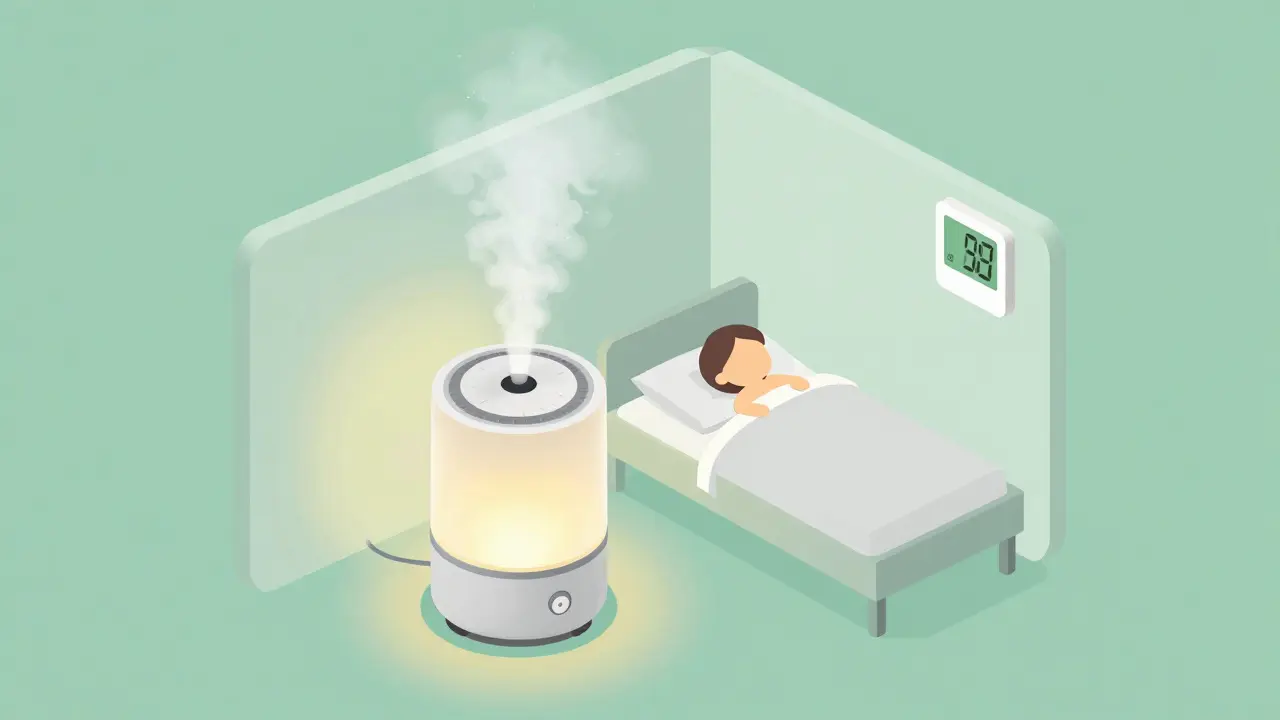
Indoor heating and air conditioning strip moisture from the air, accelerating tear loss. Using a humidifier to maintain relative humidity between 40% and 60% can significantly reduce nighttime symptoms. A survey of dry eye sufferers found that 72% reported significant improvement in morning dryness when using a humidifier in their bedroom.
When choosing a humidifier, opt for a cool-mist model rather than a warm-mist one. Cool mist is safer, especially if you have young children or pets, and does not risk burns. Place the unit near your bed or workstation, but avoid pointing the mist directly at your face, which can create condensation issues or encourage mold growth if not cleaned properly. Regular cleaning is essential; a dirty humidifier can spread bacteria and worsen respiratory issues.
Practical Tips for Success and Adherence
Knowing which medication to use is half the battle; sticking to the regimen is the other half. Poor adherence is the number one reason treatments fail. Here are practical strategies to stay on track.
- Cool the drops: Store your prescription eye drops in the refrigerator. Cold drops constrict blood vessels slightly, which can reduce the burning or stinging sensation upon instillation. Many users report this makes the experience much more tolerable.
- Timing matters: If you use multiple types of drops, wait at least 10-15 minutes between applications. This ensures each medication stays on the eye long enough to work. Remove contact lenses before applying most drops, waiting 30 minutes for Miebo and 10-15 minutes for others before reinserting them.
- Set reminders: Use phone alarms or pill boxes designed for liquids to ensure you do not miss doses. Consistency is key, especially for medications like Restasis that require twice-daily use over months to show full benefit.
- Track your symptoms: Keep a simple journal noting your comfort levels, visual clarity, and any side effects. This data helps your eye doctor adjust your treatment plan based on real-world results rather than guesswork.
If cost is a barrier, ask your doctor about patient assistance programs. Many manufacturers offer coupons or copay cards that can drastically reduce out-of-pocket expenses. Additionally, generic alternatives like cyclosporine emulsion are becoming more accessible, offering similar efficacy at a fraction of the price.
Looking Ahead: New Treatments and Personalized Care
The field of dry eye management is evolving rapidly. New agents like Reproxalap, an anti-inflammatory ketoprofen prodrug, are showing promise in clinical trials for reducing redness and improving tear scores. Future trends point toward personalized medicine, where treatments are selected based on detailed tear film analysis using devices like the TearLab Osmolarity System.
Combination therapies are likely to become the standard of care. For example, pairing a long-term anti-inflammatory like cyclosporine with a rapid-acting lipid supplement like Miebo addresses both the chronic inflammation and the immediate symptom relief. As research continues, expect more targeted therapies that minimize side effects and maximize convenience.
Remember, dry eye is a chronic condition, but it is manageable. By understanding your specific type of dry eye, utilizing the right combination of lubricants and medications, and optimizing your environment with tools like humidifiers, you can reclaim your comfort and quality of life.
How long does it take for Restasis to work?
Restasis (cyclosporine) typically takes 3 to 6 months of consistent twice-daily use to show significant improvement. Because it works by reducing inflammation over time, patience is required. Many patients experience initial burning, which may subside as the eye heals.
Is Miebo better than Xiidra?
Miebo and Xiidra work differently. Miebo provides immediate relief by forming a protective lipid layer, making it ideal for evaporative dry eye. Xiidra targets inflammation and may take up to two weeks to show benefits. Miebo generally has fewer side effects like burning, but Xiidra addresses underlying inflammatory causes. Your choice depends on whether you need instant comfort or long-term inflammation control.
Can I wear contact lenses while using dry eye drops?
It depends on the medication. For most prescription drops, you should remove your contacts before application and wait 10-15 minutes before reinserting them. For Miebo, you must wait 30 minutes after instillation before putting lenses back in. Always check the specific instructions for your medication, as some preservatives can damage soft lenses.
Do humidifiers really help with dry eyes?
Yes, humidifiers are highly effective, especially for nighttime symptoms. By maintaining indoor humidity between 40% and 60%, you reduce the rate of tear evaporation. This is particularly helpful in winter when heating systems dry out the air. Use a cool-mist humidifier and clean it regularly to prevent mold growth.
What is the best artificial tear for severe dry eye?
For severe dry eye, high-viscosity lubricants like Refresh Celluvisc or prescription-strength options are recommended. Low-viscosity drops provide short-term relief (1-2 hours), while high-viscosity gels can last 4-6 hours. If OTC drops are insufficient, prescription medications like Xiidra or Miebo may be necessary to address underlying inflammation or evaporation issues.
Why do my eye drops burn?
Burning is a common side effect of medications like Restasis and Xiidra due to their active ingredients and preservatives. To reduce this, try refrigerating the drops before use. The cold temperature numbs the surface slightly, making instillation more comfortable. If burning persists, consult your doctor; they may switch you to a preservative-free formulation or a different medication.
How much do prescription dry eye drops cost?
Costs vary widely. Generic cyclosporine ranges from $150-$250 per month. Brand-name Xiidra costs approximately $450-$550, while Miebo is around $650. Tyrvaya is about $200. Insurance coverage differs by plan, and many manufacturers offer patient assistance programs to lower out-of-pocket costs. Always check with your insurer and ask about coupons.