
How to Prepare for a Medication Review Appointment: A Step-by-Step Guide

Why a medication review isn’t just another doctor’s appointment
You’ve been taking the same pills for years. Maybe you’ve added a few more after a hospital stay. Your GP says it’s time for a medication review. You think, It’s just a chat, right? Wrong. A medication review isn’t a quick check-in. It’s a safety check on everything you’re putting into your body - prescription, over-the-counter, herbal, even the vitamins you grab off the shelf.
In the UK, if you’re on five or more medications, you’re at higher risk of harmful interactions, side effects, or taking something that no longer helps. That’s why practices like Godiva Group Practice NHS now treat medication reviews as mandatory. If you don’t show up, they’ll limit your prescriptions. After three months of no response? They stop issuing repeats altogether. This isn’t bureaucracy. It’s protection.
And it’s not just about pills. It’s about inhalers, creams, patches, liquid medicines, supplements, and even herbal teas that affect your heart or blood pressure. Missing one item on your list could mean your doctor misses a dangerous interaction.
What to bring: Your medicine suitcase
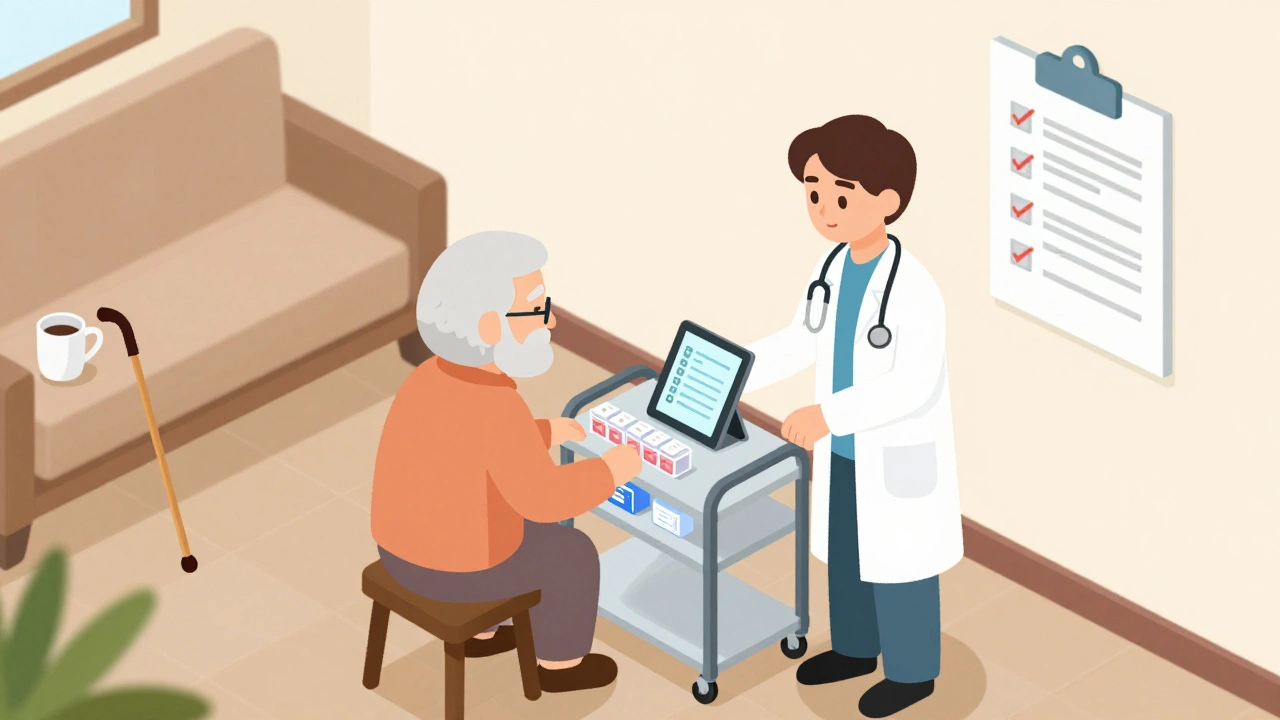
Don’t just list your meds. Bring them. All of them.
That means every single thing you take - even if you haven’t used it in weeks. Your GP or pharmacist doesn’t care if you think it’s "not important." They need to see it. This includes:
- Prescription tablets and liquids
- Over-the-counter painkillers (paracetamol, ibuprofen, aspirin)
- Vitamins and supplements (fish oil, vitamin D, magnesium)
- Herbal remedies (St John’s wort, ginkgo biloba, turmeric)
- Inhalers, patches, eye drops, creams, and ointments
- Any medicine you got from a supermarket or chemist without a prescription
Bring the actual bottles. Not just a list. Why? Because labels tell you the exact dose, expiry date, and instructions. A handwritten note might say "as needed," but the bottle says "take one tablet every 6 hours, max 4 per day." That difference matters.
For Parkinson’s patients, timing is everything. Medications like levodopa need to be taken within strict windows. A missed 15-minute window can mean hours of stiffness or tremors. If your review is over the phone or video call, having the bottles in front of you helps you describe the schedule accurately.
Write down what you can’t remember
Your brain is full. Work, family, appointments - it’s hard to recall every side effect you’ve had in the last six months. That’s why you need a simple, clear list before you walk in.
Create a table or bullet list with these four columns:
- Medicine name - Use the exact name on the bottle. Not "the blue pill for my heart." Write "bisoprolol 5mg."
- Dosage and frequency - "Take one tablet every morning, with food."
- Why you take it - "For high blood pressure," "For arthritis pain," "For sleep."
- Side effects you’ve noticed - "Dizzy after lunch," "Dry mouth," "Constipated," "Felt sick after starting this."
Be honest. If you skipped doses because the side effects were bad, say so. If you stopped one because it was expensive, tell them. Your pharmacist can help you find cheaper alternatives. Your doctor can adjust the dose or switch you to something else.
Don’t forget to note if you’ve had any falls, confusion, memory lapses, or unusual fatigue lately. These aren’t "just getting older" - they could be signs of medication buildup.

Prepare your questions - don’t wait to think of them
Most people leave appointments with half their questions unanswered. That’s because they didn’t write them down.
Here are real questions patients ask during medication reviews:
- "Is this still necessary? I’ve been on it for 10 years."
- "Can I stop this one? It makes me feel foggy."
- "Are any of these causing my constipation?"
- "Is there a cheaper version?"
- "What happens if I don’t take this anymore?"
- "Are there other ways to treat this besides pills?"
- "Do any of these interact with my supplements?"
Write these down before you go. Bring the list. Use it. If you’re nervous, practice saying them out loud. You’re not being difficult. You’re being smart.
Know who’s doing the review - and what they can do
Not every medication review is with your GP. More and more, it’s a clinical pharmacist. That’s not a downgrade. It’s an upgrade.
Pharmacists are medicine experts. They know how drugs interact, what doses are safe together, and which ones are outdated. They can often change your prescription on the spot - no need to wait for a doctor’s signature. They can also help you switch to a cheaper brand or suggest a different form (like a liquid instead of a pill if swallowing is hard).
Ask at booking: "Will this be with my GP or a pharmacist?" If it’s a pharmacist, you can ask more detailed questions about how the drugs work. If it’s your GP, they’ll focus more on your overall health and whether the meds still match your goals.
Telehealth? Here’s what you need to do differently
If your review is over Zoom, phone, or another video call, preparation is even more critical. You can’t hand over your pills. So you need to be ready to describe them perfectly.
Before the call:
- Gather every medicine and lay them out on a table.
- Take photos of each bottle label - front and back.
- Have your written list open on your screen or printed out.
- Test your tech: make sure your camera works, your mic isn’t muted, and you’re in a quiet space.
- Have a glass of water nearby - you might need to take a pill during the call.
During the call, hold up each bottle one at a time. Say the name, dose, and why you take it. If you’re unsure, say: "This is the one for my blood pressure - I think it’s called lisinopril?" That’s fine. They’ll help you confirm.
What happens after the review?
Don’t assume it’s over when you walk out.
Your clinician might:
- Stop one medicine entirely
- Reduce the dose of another
- Switch you to a different brand
- Add a new medicine to fix a side effect
- Suggest a non-drug treatment - like exercise for arthritis instead of more painkillers
Ask for a printed summary or email with the changes. Write down any new instructions. Don’t rely on memory.
And if you’re told to stop a medicine - don’t just quit cold turkey. Ask: "How do I do this safely?" Some drugs need to be tapered off slowly to avoid withdrawal or rebound symptoms.
What if you can’t get to the clinic?
If you’re housebound, have mobility issues, or live far from your practice, you’re not out of luck.
The Northern Health and Social Services Board confirms that home visits for medication reviews are available - but you have to ask. Don’t wait for them to offer. Call your practice and say: "I need a home visit for my medication review because I can’t travel."
Some practices also offer phone reviews with a pharmacist. Ask if that’s an option.
Don’t wait until you’re in trouble
People often wait until they feel awful to book a review. But the best time to have one is when you’re feeling fine. That’s when you can spot subtle changes - like needing more sleep, feeling more tired, or having trouble remembering to take your pills.
Medication reviews aren’t about blame. They’re about keeping you safe, healthy, and in control. Every pill you take has a purpose. But if that purpose changes - or if the risks grow - it’s time to adjust.
Take 30 minutes before your appointment. Gather your medicines. Write down your concerns. Bring your questions. You’re not just showing up - you’re taking charge of your health.





Comments (9)
Linda Migdal
2 Dec 2025
This is why the NHS gets it right. Five meds? You’re already in the danger zone. No more 'I think I'm fine' nonsense. If you're on polypharmacy, you're not a patient-you're a walking pharmacokinetic experiment. And if your GP isn't forcing this review, they're negligent. I've seen people end up in ERs because some clown thought 'vitamin D is harmless.' It's not. It interacts with every cardiac med. Bring the bottles. Period. No excuses.
Dennis Jesuyon Balogun
3 Dec 2025
Medication reviews are not bureaucratic-they’re existential. We live in an age where the body is treated like a machine with too many parts, and no one checks if the gears still mesh. You take a pill because it was prescribed in 2012. But your kidneys aren’t 30 anymore. Your liver isn’t a factory-it’s a tired janitor. The real question isn’t 'What am I taking?' but 'Who am I becoming because of what I’m taking?' The bottle doesn’t lie. But your memory does. And that’s the real tragedy.
Lucinda Bresnehan
5 Dec 2025
OMG YES I did this last month and it changed everything. I brought my whole medicine cabinet-yes, even that expired fish oil from 2021. The pharmacist caught that I was double-dosing on magnesium because I didn’t realize my multivitamin had it too. I was having leg cramps and thought it was 'aging'-turns out it was overdose. She also switched me to a cheaper blood pressure med that my insurance actually covers. I cried. Not because I was sad-because I finally felt seen. 🙏
Eric Vlach
5 Dec 2025
Bring the actual bottles no cap. I used to just write stuff down but then I forgot half of it. Last time I brought my meds in a shoebox and the pharmacist laughed and said 'this is why people end up in the hospital.' She saw my gout med was expired and my blood pressure pill was taken wrong. I was taking it at night instead of morning. Duh. Now I keep them in a labeled drawer. Life changed. Also if you’re on video call-just hold them up. Don’t overthink it.
Souvik Datta
6 Dec 2025
Let me tell you something-this isn’t just about pills. It’s about dignity. Every time you forget to take a med or skip a dose because you’re tired or confused or broke, you’re not failing yourself-you’re failing a system that doesn’t care enough to meet you where you are. A medication review isn’t a chore. It’s a ritual of self-respect. Write down your side effects. Speak your fears. Ask for help. You don’t need to be perfect. You just need to show up. And if you can’t go to the clinic? Ask for the home visit. They’ll come. You just have to say it out loud.
Priyam Tomar
8 Dec 2025
Everyone’s acting like this is groundbreaking. Newsflash: this is basic. If you’re on five meds, you’re either a geriatric patient or you’ve been poorly managed for a decade. And yes, St. John’s Wort with SSRIs? That’s not 'natural healing'-that’s a chemical grenade. And if you’re taking turmeric for 'inflammation' while on warfarin? Congrats, you’re one INR spike away from a stroke. Stop romanticizing supplements. They’re not yoga. They’re drugs with zero regulation. Bring the bottles. Or don’t. But don’t complain when you end up in ICU.
Jack Arscott
9 Dec 2025
Just did this last week. Brought my whole medicine shelf. The pharmacist was like 'whoa, you’re basically a pharmacy.' 😅 She cut out two things I hadn’t taken in 2 years and switched my pain med to a patch. No more swallowing pills. Best. Decision. Ever. 🙌 Also-YES to photos of labels for telehealth. I took pics with my phone and had them open on my laptop. She said it was the clearest review she’d ever had. You’re not weird for being prepared. You’re the MVP.
Irving Steinberg
10 Dec 2025
Why are we making this so complicated? Just take your pills and shut up. I’ve been on the same meds for 15 years. I’m fine. They’re just trying to control us. Next they’ll make us fill out a form before breathing. 😴 Also I don’t need to bring bottles. I know what I take. If they can’t remember, that’s their problem. And no I’m not doing a telehealth thing. I don’t trust cameras. 🤷♂️
Lydia Zhang
10 Dec 2025
My mom had one last year. They took her off three meds. She says she feels like a new person. No more dizziness. No more confusion. Turns out the 'old age' stuff was just drug buildup. We didn’t know. She didn’t know. Now she brings her pills to every appointment. Simple. Smart. Done.