
Sleep Hygiene: Simple Behavioral Changes to Improve Sleep Quality
Why Your Sleep Isn’t Improving (Even Though You’re Trying)
You’ve turned off the lights. You’ve laid still. You’ve even tried chamomile tea. But you’re still lying awake at 2 a.m., counting sheep that won’t stay still. If this sounds familiar, you’re not broken. You’re just missing the right behavioral shifts. Sleep hygiene isn’t about fancy gadgets or expensive mattresses. It’s about the small, daily choices that either help your body settle into sleep-or fight it every step of the way.
Research shows that consistent, evidence-based sleep habits can cut insomnia severity by 30-40%. That’s not magic. It’s biology. Your body thrives on rhythm. When you mess with your sleep schedule, light exposure, or evening routine, your brain doesn’t know when to shut down. The good news? You don’t need a doctor to fix this. You just need to change a few habits.
The Four Pillars of Real Sleep Hygiene
Not all advice you find online works. Some tips are outdated. Others sound helpful but have zero proof. The science-backed core of sleep hygiene breaks down into four areas: routine, environment, mental wind-down, and body prep.
1. Stick to a Consistent Wake Time
This is the single most powerful habit you can build. Not bedtime. Wake time.
Studies show that waking up at the same time every day-even on weekends-has a stronger impact on sleep quality than going to bed early. Why? Your body’s internal clock (circadian rhythm) is driven more by when you wake than when you sleep. If you wake at 7 a.m. Monday through Friday but roll out of bed at 11 a.m. Saturday, you’re confusing your brain. That’s why people who sleep in on weekends often feel groggy all week.
Try this: Set your alarm for the same time every day. No exceptions. Even if you went to bed at midnight, get up at 6:30 a.m. on Sunday. It feels brutal at first. But after 7-10 days, your body adjusts. You’ll start feeling sleepy at a predictable time without trying.
2. Make Your Bedroom a Sleep-Only Zone
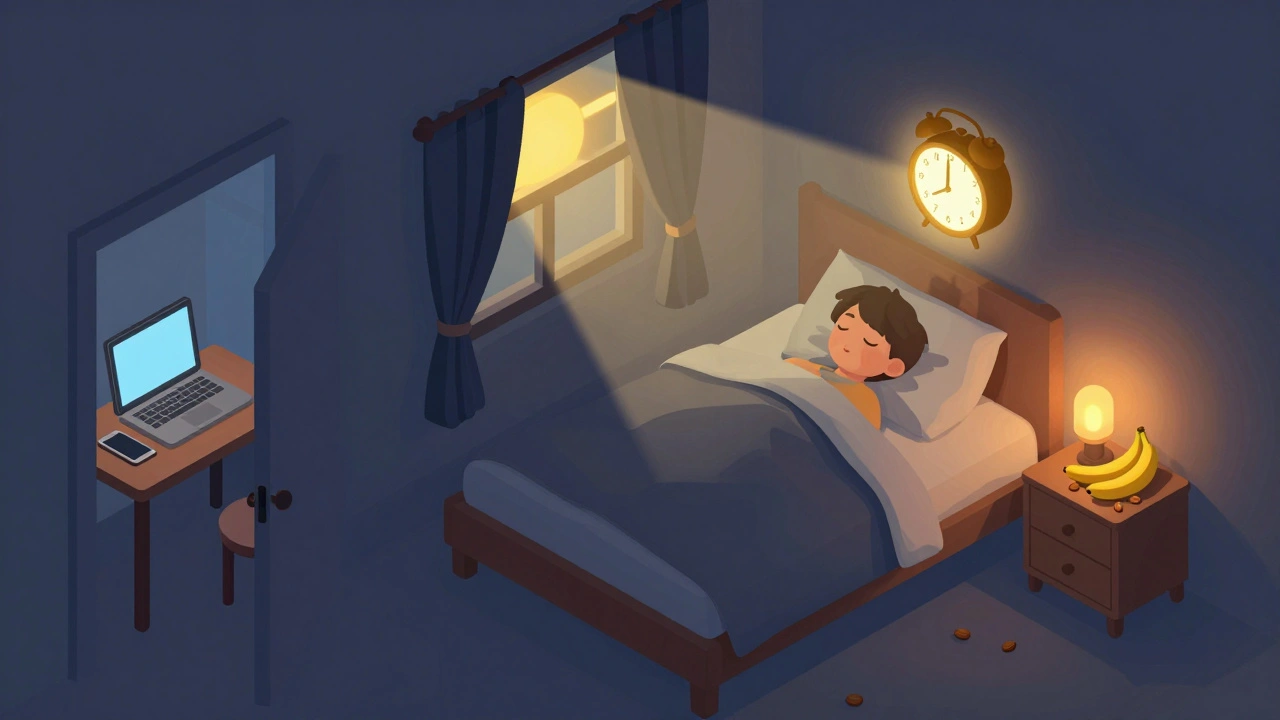
Your bedroom should be a sanctuary for sleep, not a workspace, TV lounge, or social media hub.
The ideal bedroom temperature is between 60-67°F (15.6-19.4°C). Too warm, and your body can’t drop its core temperature-something it needs to do to fall asleep. Too cold, and you’ll toss and turn trying to get warm.
Light matters too. Even a small LED from a charger or a streetlamp outside can disrupt melatonin. Keep it under 5 lux (about the glow of a nightlight). Use blackout curtains. Cover or remove glowing electronics. If you need a nightlight, use red or amber-those colors don’t interfere with sleep hormones.
And here’s a big one: Don’t work, scroll, or watch TV in bed. Your brain starts associating your bed with alertness. If you want to sleep better, make your bed a place only for sleep and intimacy.
3. Quiet Your Mind Before Bed
It’s not just about what you do-it’s what you think. Racing thoughts, replaying conversations, worrying about tomorrow-these are the real sleep killers.
For 60 minutes before bed, give your brain a signal: “It’s time to stop solving problems.” Try one of these:
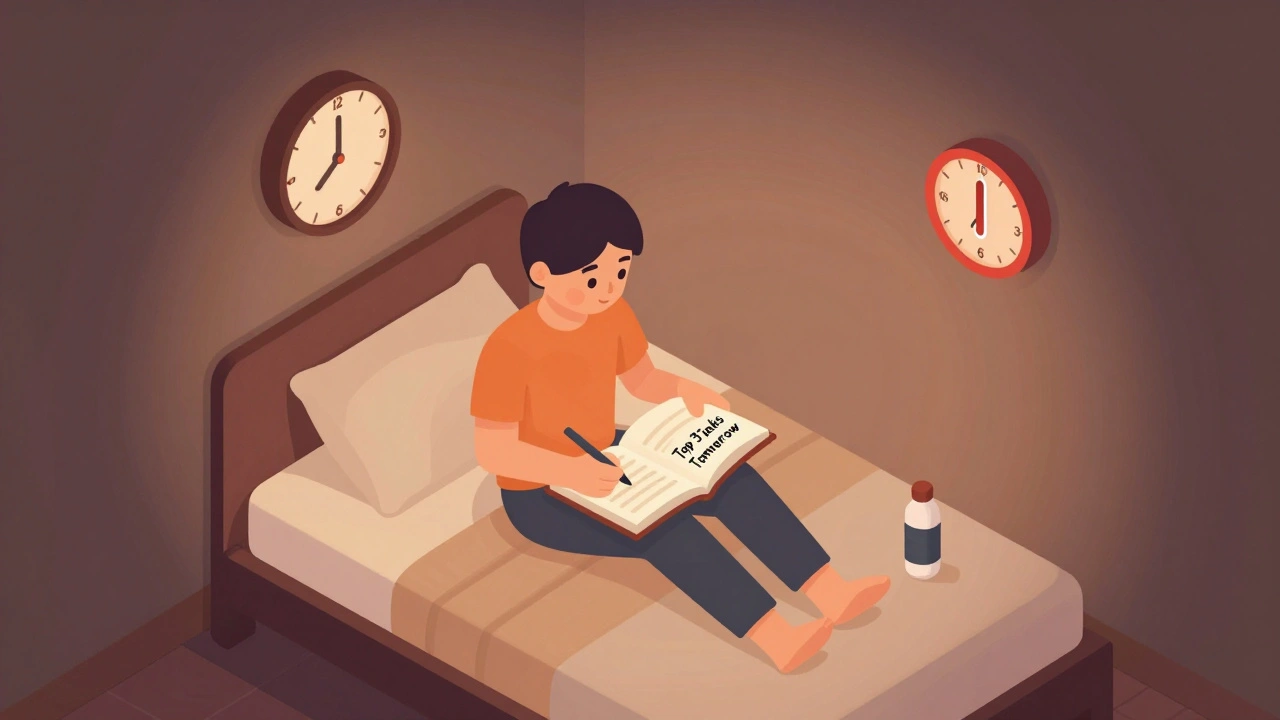
- Write down tomorrow’s top 3 tasks on paper. Get them out of your head.
- Do 5 minutes of slow breathing: inhale for 4 counts, hold for 4, exhale for 6.
- Listen to a calm, non-stimulating podcast or audiobook-not something exciting.
A 2023 study found that reducing pre-sleep cognitive arousal had the strongest link to better sleep (β = -0.41). That means calming your mind is more effective than changing your pillow.
4. Watch What You Eat, Drink, and Do in the Evening
Caffeine lasts longer than you think. If you drink coffee at 3 p.m., it’s still in your system at 11 p.m. Cut it off at least 8 hours before bed. That means no espresso after 3 p.m. if you’re aiming for a 11 p.m. bedtime.
Alcohol? It might make you fall asleep faster, but it wrecks your deep sleep later in the night. You’ll wake up more often and feel less rested.
Heavy meals within 3 hours of bed can cause discomfort and acid reflux, which disrupts sleep. A light snack is fine-like a banana or a handful of almonds-but avoid pizza, burgers, or fried food.
Fluid intake? Reduce it 2 hours before bed to cut down on nighttime bathroom trips. You don’t need to go thirsty, but don’t chug water right before sleep.
And here’s a surprise: Exercise close to bedtime? It’s not the enemy. A 2023 study from the University of Tsukuba found that 68% of people slept better after evening workouts. If you feel energized after a walk or yoga, go for it. The old rule about avoiding exercise after 7 p.m. is outdated.
What Doesn’t Work (And Why You’re Wasting Time)
Not everything you hear about sleep hygiene is backed by science. Some popular tips are myths.
- Blue light filters: Glasses or screen settings that block blue light? They help a little-maybe 4-7 minutes faster sleep onset. But they’re not a game-changer. Consistent wake times matter far more.
- Sleep tracking apps: They can be useful for spotting patterns, but obsessing over your sleep score can make you anxious. Anxiety = worse sleep.
- Going to bed hungry: Some people say it helps. Others feel shaky and can’t sleep. It’s individual. Don’t force it.
- Counting sheep: It doesn’t work. A 2006 Oxford study found people who imagined relaxing scenes (like a beach) fell asleep faster than those counting.
Focus on the big four: wake time, environment, mental calm, and evening habits. Ignore the noise.
How Long Until You See Results?
Don’t expect miracles after one night. Sleep hygiene is a slow build.
Most people notice small improvements after 7-10 days. Meaningful changes-like falling asleep faster, waking up less, feeling more alert-usually show up after 14-21 days of consistent effort.
One study of 1,247 university students found that those who followed five or more sleep hygiene practices dropped their Pittsburgh Sleep Quality Index (PSQI) score from 5.8 (clinically poor) to 3.9 (normal). That’s not a small shift. It’s moving from struggling to sleep to sleeping well.
Track your progress. Use a simple notebook or a free app like Sleep Cycle or ShutEye. Note your wake time, how long it took to fall asleep, and how you felt in the morning. Patterns will emerge. You’ll start to see what works for you.
When Sleep Hygiene Isn’t Enough
Let’s be real: If you’ve been trying for 4-6 weeks and still can’t sleep, you might have more than just poor habits. Clinical insomnia-where you struggle to sleep at least 3 nights a week for 3 months or more-needs more than just sleep hygiene.
The American Academy of Sleep Medicine says sleep hygiene alone is only a “weak recommendation” for chronic insomnia. It’s a foundation, not a cure.
If you’re still awake for over an hour most nights, feel exhausted during the day, or rely on sleep aids, it’s time to see a specialist. Cognitive Behavioral Therapy for Insomnia (CBT-I) is the gold standard. It combines sleep hygiene with techniques to retrain your thoughts about sleep. It’s more effective than pills, and it lasts.
But don’t wait. Start with sleep hygiene now. Even if you need therapy later, these habits will make it work better.
Real People, Real Results
Reddit user u/NightOwlPhD posted: “I kept waking up at 3 a.m. every night. I started waking up at 6:30 a.m. no matter what. Within three weeks, I was falling asleep by 10:45 p.m. without trying.”
Another user, a nurse working night shifts, said: “I used to take melatonin every night. I started sticking to my wake time-even on days off-and now I don’t need it. My energy is back.”
These aren’t outliers. They’re people who did the basics right.
Final Tip: Stack Your Habits
Trying to change everything at once? You’ll burn out.
Use “habit stacking”: Attach your new sleep habit to something you already do.
- After I brush my teeth, I turn off all screens.
- After I turn off the light, I do 3 slow breaths.
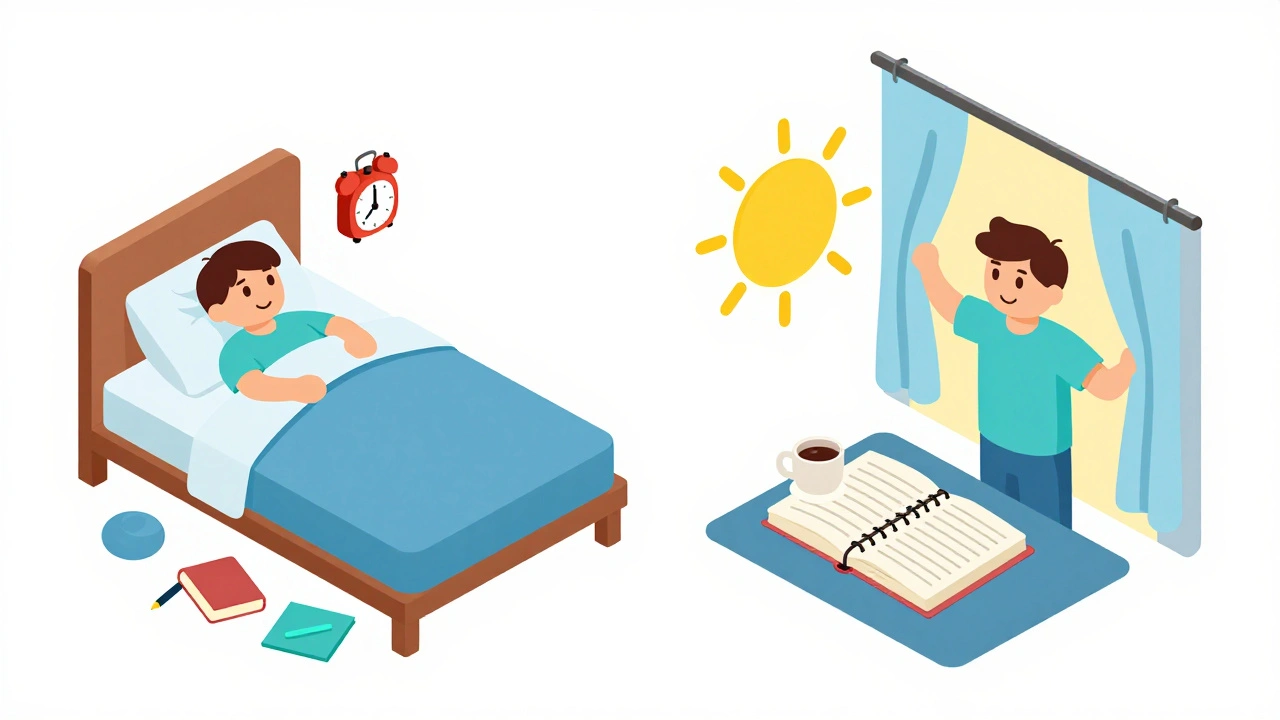
- After I get out of bed, I open the curtains for 5 minutes.
These tiny links make habits stick. You’re not adding work-you’re just connecting new actions to old ones.
Start Today. Not Tomorrow.
You don’t need to overhaul your life. Pick one thing. Just one.
Tomorrow, wake up at the same time. No snoozing. No weekend oversleeping.
That’s it. Do that for a week. Then add one more: no screens 30 minutes before bed.
Slow, steady changes beat dramatic overhauls. Your body doesn’t need perfection. It just needs consistency.
Sleep isn’t a luxury. It’s the foundation of everything you do-your focus, your mood, your health. Fix the habits, and the sleep will follow.
Comments (10)
John Webber
2 Dec 2025
i just set my alarm for 6:30 am no matter what and holy crap it worked. no more lying there at 2am thinking about work. my brain finally gets it. i didnt even try anything else. just wake up same time. its wild.
Sandi Allen
3 Dec 2025
This is all just government propaganda to make us more docile... Wake at the same time? That's how they control the population. You think your circadian rhythm is natural? It's been engineered. The blue light filters are a distraction. They don't want you to know that melatonin is a controlled substance in 14 countries... And don't get me started on the sleep trackers-those are spyware disguised as apps. I stopped using mine after I saw the data being sent to a server in... well, I can't say. But it wasn't Apple.
Shubham Pandey
4 Dec 2025
wake up same time works. no need for fancy stuff.
Elizabeth Farrell
5 Dec 2025
I just want to say how much this resonated with me. I used to be the person who slept in on weekends thinking I was ‘catching up’-until I realized I was just resetting my whole system. It took me three weeks of brutal 6:30 a.m. alarms, but now I fall asleep naturally around 10:30 without even trying. I started stacking habits too-brush teeth, turn off phone, breathe slow for three counts. It’s not magic, but it’s mine. And I’m so proud of myself for sticking with it. You don’t need to do everything at once. Just pick one thing. Do it. Then do it again tomorrow. That’s all it takes.
John Biesecker
7 Dec 2025
i tried the 6:30 am thing and honestly?? it changed my life 😊 i used to think sleep was just luck but turns out it’s just… rhythm?? like my body was waiting for me to give it a schedule. also the red nightlight tip?? game changer. i got one from amazon for like $8 and now my room feels like a cozy cave. no more staring at blue glow like a zombie. thanks for this!!
Genesis Rubi
7 Dec 2025
America used to have real sleep standards. Now we're letting people think bedtime routines are enough? Wake up at 6:30? That's what Europeans do. We're becoming a nation of weaklings who need apps to tell them when to sleep. Back in my day, we just passed out when tired. No alarms. No breathing exercises. Just exhaustion. And we were stronger for it. This whole post is woke sleep culture nonsense.
Doug Hawk
7 Dec 2025
the research cited here is solid but incomplete. the 30-40% insomnia reduction is from meta-analyses with high heterogeneity. also, the 2023 tsukuba study on evening exercise? sample size was 112. underpowered. and they didn't control for chronotype. i'm not saying it's wrong-just that the framing oversimplifies neurobiology. your cortisol rhythm matters more than wake time if you're a night owl. also, melatonin isn't banned-it's regulated. and yes, sleep trackers can be anxiety triggers but they're not spyware. stop conflating correlation with causation.
John Morrow
8 Dec 2025
Let’s be honest-this is the same recycled advice that’s been floating around since 2012. Wake at the same time? Everyone knows that. The real issue is systemic. You think your brain doesn’t know when to shut down? It’s because your life is a constant stream of micro-stressors: remote work, algorithmic feeds, wage stagnation, the quiet terror of never being enough. No amount of amber lighting fixes that. Sleep hygiene is the capitalist’s way of blaming the individual for a broken system. You don’t need a new routine-you need a revolution. Or at least a raise.
Saurabh Tiwari
10 Dec 2025
i tried the wake time thing and it kinda worked but i still wake up at 3am sometimes 😅 maybe its my coffee? or maybe i just need to chill more. no big deal. i like the red light idea tho. gonna try that.
Michael Campbell
12 Dec 2025
they say wake up at the same time but no one talks about how the government monitors your sleep patterns through smart devices. you think that’s a coincidence? wake up at 6:30? they want you predictable. compliant. docile. and the red nightlight? it’s not for sleep. it’s to mask the infrared signals. don’t fall for it.